
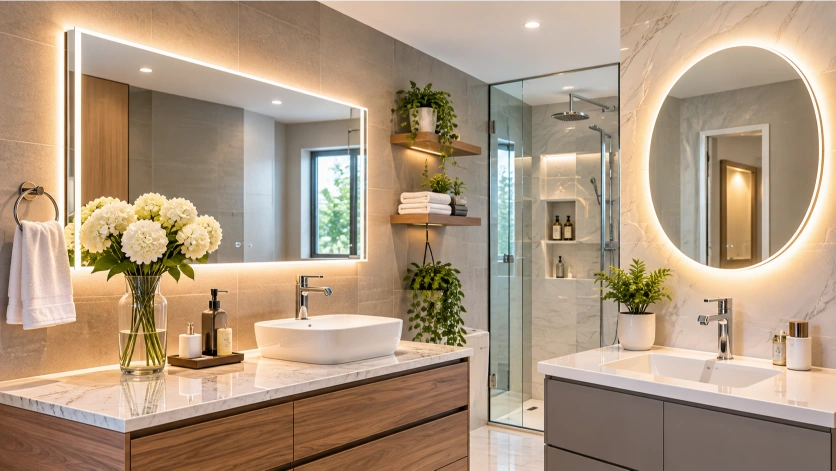
Bathroom Mirrors with Lighting: 15 Stylish Ideas for Modern Bathrooms
A bathroom mirror does more than reflect your image. The right lighting makes everyday grooming easier and gives the room a more finished look. Bathroom mirrors with lighting can create a soft spa atmosphere, improve visibility, and make a small vanity feel brighter. The best choice depends on your bathroom size, lighting needs, design style, and electrical setup.
This guide focuses on styles, layouts, and planning. Below, you’ll find 15 ideas, plus practical advice on lighting basics, placement, installation, and cost. If you’re ready to compare specific products, see our best LED bathroom mirrors buying guide.
Key Takeaways
- Choose front-facing light for makeup and shaving.
- Use backlighting for a softer decorative glow.
- Look for a high color rendering index (CRI).
- Choose a color temperature that suits your bathroom.
- Measure the vanity before selecting your mirror.
- Check electrical requirements before purchasing.
- Consider separate sconces when you need better face lighting.
Quick Answer: What Is the Best Bathroom Mirror Lighting?
The best all-round setup combines even front-facing illumination, good color rendering, and adjustable brightness. A CRI of 90 or higher is a useful target for accurate color appearance. A color temperature around 3000K offers a warm, balanced look. Some bathrooms benefit from a more neutral 3500K–4000K option.
Choose based on your needs:
| Your priority | Lighting option to consider |
|---|---|
| Makeup application | Front-lit mirror or side sconces |
| Shaving | Even front-facing illumination |
| Small bathroom | Round or slim vertical LED mirror |
| Spa atmosphere | Backlit mirror with warm lighting |
| Double vanity | Two matching mirrors or one wide mirror |
| Extra storage | Recessed lighted medicine cabinet |
Remember, brightness and placement matter more than appearance alone. A beautiful mirror may still create shadows if its light does not reach your face.
What Are Bathroom Mirrors with Lighting?
Bathroom mirrors with lighting combine reflective glass with built-in illumination. Some models have LEDs around the front. Others produce light behind the mirror. You can also create a similar effect with a standard mirror and separate wall fixtures.
There are three common lighting arrangements.
Front-lit mirrors
Front-lit mirrors direct light toward the person standing at the vanity. LEDs usually sit around the mirror’s edges or behind a translucent border.
This arrangement helps illuminate your face. It can support shaving, skincare, and makeup application.
Look for diffused lighting. Exposed or poorly positioned LEDs can create glare.
Backlit mirrors
Backlit mirrors direct light toward the wall behind the glass. This creates a soft halo around the mirror.
The effect works well in contemporary and spa-inspired bathrooms. However, backlighting alone may not provide enough task lighting.
Pair it with suitable vanity lighting when grooming matters.
Dual-lit mirrors
Dual-lit mirrors combine front and rear illumination. They provide light toward the user and a decorative wall glow.
This design suits bathrooms that need both function and atmosphere. Check whether both lighting modes operate independently.
That flexibility can make the mirror more useful throughout the day.
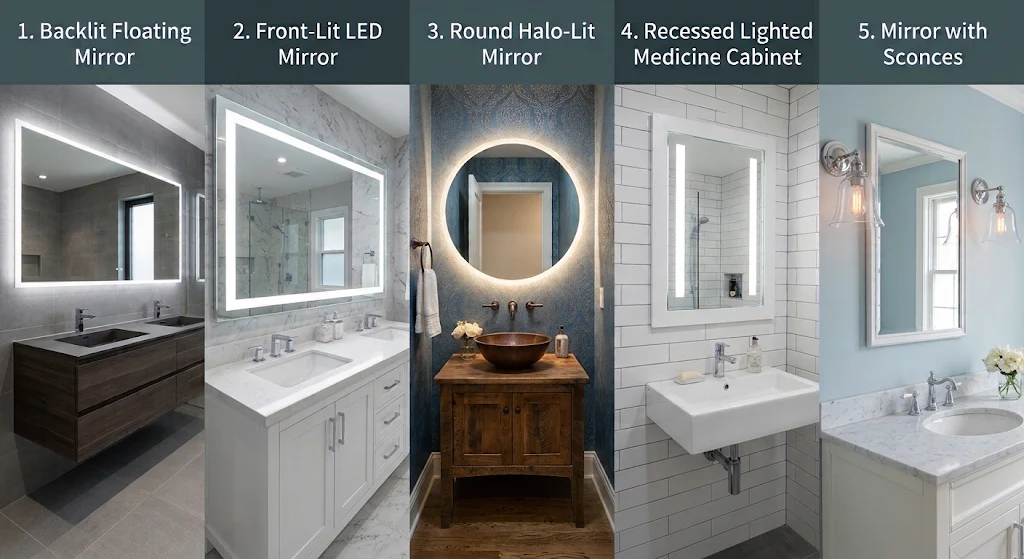
15 Stylish Bathroom Mirror Lighting Ideas
The following ideas cover different shapes, finishes, lighting methods, and bathroom layouts. Consider your wall space and daily routine before choosing a design.
1. Backlit Floating Mirror
A backlit floating mirror creates a gentle glow around the glass. The light appears to lift the mirror away from the wall.
It suits contemporary, minimalist, and spa-style bathrooms. Choose a simple rectangular or round shape for a clean finish.
Best for: Modern bathrooms and relaxing evening lighting.
Design tip: Use a wall finish that complements the glow. Textured stone-look tiles can add depth without competing with the mirror.
2. Front-Lit Grooming Mirror
A front-lit mirror is a practical choice for daily routines. Its light faces the user instead of only illuminating the wall.
This helps make the face more visible. It is particularly useful for shaving and applying makeup.
Best for: Primary bathrooms and everyday grooming.
Design tip: Look for diffused LEDs and a high CRI. Check the brightness specification before buying.
3. Dual-Lit LED Mirror
A dual-lit mirror combines direct and indirect lighting. The front light supports grooming. The rear glow adds atmosphere.
It can reduce the need for separate decorative lighting. However, the rest of the bathroom still needs suitable general illumination.
Best for: Bathrooms that need both task and ambient light.
Design tip: Choose independent controls if available. This lets you use task lighting in the morning and softer light later.
4. Round Mirror with a Halo LED
A round mirror softens bathrooms with many straight lines. Its circular shape works well above compact vanities.
A rear LED strip creates a halo effect. This adds visual interest without requiring a bulky frame.
Best for: Powder rooms and small bathrooms.
Design tip: Match the mirror diameter to the vanity. Leave enough space around the mirror for a balanced appearance.
5. Arched Mirror with Warm Lighting
An arched mirror introduces a softer architectural shape. Its curved top works with traditional, transitional, and modern farmhouse interiors.
Warm lighting can make the design feel welcoming. A thin frame also adds definition.
Best for: Traditional and transitional bathrooms.
Design tip: Coordinate the frame with your faucets or cabinet hardware, and avoid mixing too many metal finishes. Our guide to matching bathroom fixture finishes explains how.
6. Oversized Rectangular LED Mirror
An oversized rectangular mirror can make a vanity wall feel more open. It also provides a broad reflective surface.
This option works particularly well above double vanities. Make sure the mirror does not overwhelm the countertop or nearby fixtures.
Best for: Large bathrooms and double-sink layouts.
Design tip: Check the mirror’s weight and mounting requirements. Large glass panels may need additional support.
7. Vertical or Pill-Shaped Lighted Mirror
A vertical mirror works well when wall space is narrow. Its elongated shape creates a strong visual line.
Pill-shaped designs combine straight sides with rounded ends. They can soften a compact bathroom without using much horizontal space.
Best for: Narrow vanities and small wall sections.
Design tip: Check your standing position before installation. The mirror should show your face comfortably.
8. Frameless Minimalist Mirror
A frameless mirror keeps attention on the glass and lighting. It works with simple cabinetry and uncluttered surfaces.
A thin illuminated edge adds a modern finish. This style can suit Scandinavian and minimalist interiors.
Best for: Minimalist bathrooms.
Design tip: Keep surrounding finishes simple. Explore our minimalist bathroom ideas for more design inspiration.
9. Black-Framed Lighted Mirror
A black frame creates contrast against pale walls and tiles. It also connects visually with black faucets and shower hardware.
Choose a slim frame for a modern look. A thicker frame can feel more industrial.
Best for: Industrial and contemporary bathrooms.
Design tip: Repeat black accents elsewhere. A matching bathroom faucet or cabinet handle can make the design feel intentional.
10. Brass or Gold-Framed Lighted Mirror
Brass and gold finishes add warmth to a bathroom. They work especially well with cream, white, beige, and darker green surfaces.
A lighted mirror combines decorative framing with practical illumination. Keep the rest of the hardware coordinated.
Best for: Traditional, elegant, and glam bathrooms.
Design tip: Choose a finish that complements existing fixtures. Browse our luxury bathroom ideas before selecting your hardware.
11. Wood-Framed Lighted Mirror
A wood frame introduces natural texture. It can soften bathrooms with stone, tile, and white cabinetry.
Light oak creates a bright, relaxed appearance. Darker wood adds contrast and depth.
Best for: Japandi, organic modern, and spa-inspired bathrooms.
Design tip: Select materials and finishes suitable for bathroom conditions. Check the manufacturer’s care instructions before placing wood near moisture.
12. Recessed Lighted Medicine Cabinet
A recessed medicine cabinet combines mirror lighting with hidden storage. It can sit within the wall rather than projecting far into the room.
This helps keep toiletries and everyday products organized. It is particularly useful when countertop space is limited.
Best for: Small bathrooms and practical family spaces.
Design tip: Plan the wall cavity before ordering. Plumbing, wiring, and structural framing may affect installation.
13. Anti-Fog Mirror with Integrated Lighting
An anti-fog mirror uses a heating element to reduce condensation on the glass. Some models combine this feature with built-in LEDs.
It can be useful in bathrooms where steam regularly covers the mirror. However, performance depends on the product and bathroom conditions.
Best for: Frequently used bathrooms and shower-adjacent vanities.
Design tip: Check how the demister operates. Some models activate with the main light, while others have separate controls. Good ventilation also matters. Use our bathroom fan size calculator and exhaust fan guide when planning moisture control.
14. Smart Bathroom Mirror
A smart mirror may include touch controls, adjustable color temperature, dimming, clocks, or Bluetooth features.
These functions can make the mirror more convenient. However, not every feature adds value to every bathroom.
Best for: Technology-focused and modern bathrooms.
Design tip: Prioritize lighting quality and reliable controls. Treat entertainment features as optional extras.
15. Standard Mirror with Wall Sconces
A standard mirror with separate sconces offers another effective arrangement. The fixtures sit beside the mirror and direct light toward the face.
This is not an integrated lighted mirror. However, it can provide excellent vanity illumination and allows easier bulb replacement.
Best for: Traditional bathrooms and remodels with flexible lighting plans.
Design tip: Position the fixtures near face level. Use suitable diffusers to reduce glare.
Comparing Bathroom Mirror Lighting Options
Different mirror styles serve different purposes. Use this table to narrow your choices.
| Mirror or lighting type | Best for | Light quality |
|---|---|---|
| Backlit mirror | Ambient glow | Indirect |
| Front-lit mirror | Grooming | Direct |
| Dual-lit mirror | Mixed lighting needs | Direct and indirect |
| Round LED mirror | Compact vanities | Depends on LED position |
| Arched LED mirror | Decorative bathrooms | Depends on design |
| Oversized mirror | Double vanities | Depends on design |
| Pill-shaped mirror | Narrow spaces | Depends on design |
| Frameless mirror | Minimalist rooms | Depends on design |
| Black-framed mirror | Modern interiors | Depends on design |
| Brass or gold mirror | Traditional interiors | Depends on design |
| Wood-framed mirror | Natural interiors | Depends on design |
| Recessed medicine cabinet | Storage | Depends on design |
| Anti-fog mirror | Steamy bathrooms | Depends on design |
| Smart mirror | Connected features | Depends on design |
| Mirror with sconces | Flexible task lighting | Direct, adjustable by fixture |
For side-by-side product comparisons, brightness specifications, and current picks, see our LED bathroom mirror buying guide.
How to Choose the Right Bathroom Mirror Lighting
Choose a mirror by considering light quality first. Then compare its size, shape, features, and finish.
Choose the right color temperature
Color temperature describes whether light appears warm or cool. It is measured in Kelvin (K).
| Color temperature | Appearance | Common use |
|---|---|---|
| 2700K–3000K | Warm white | Relaxing and traditional bathrooms |
| 3000K–3500K | Warm-neutral | Everyday vanity lighting |
| 3500K–4000K | Neutral white | Clean, modern bathrooms |
| 5000K and above | Cooler daylight appearance | Specific detail tasks, if preferred |
There is no single perfect temperature for every bathroom. Consider the tiles, wall colors, and other lights.
A 3000K option often provides a comfortable starting point. Adjustable color temperature gives you more flexibility.
Check the CRI rating
CRI means Color Rendering Index. It describes how accurately a light source reveals colors.
For grooming, accurate color appearance is useful. The U.S. Department of Energy notes that a minimum CRI of 80 is recommended for interior lighting, and that a CRI of 90 or higher indicates excellent color fidelity. Read its LED basics guide for more detail.
Understand brightness and dimming
Lumens measure the amount of light a source produces. They are more useful than wattage alone when comparing brightness, so check the actual lumen output and how the manufacturer measures it.
Dimming lets you adjust brightness throughout the day: brighter for morning routines, softer for the evening. Confirm that the mirror works with your dimmer or controls before purchasing.
Match the lighting with your finishes
Lighting should work with the rest of the bathroom. Consider your tile, vanity, faucet, and cabinet hardware.
- Brass finishes pair well with warm lighting.
- Chrome works with many neutral schemes.
- Black fixtures create contrast in modern spaces.
- Wood finishes complement warm, natural interiors.
Keep the lighting consistent across the room. Mixing very different color temperatures can make the space feel uneven.
Where Should You Position Bathroom Mirror Lighting?
Positioning affects how well the light reaches your face. A poorly placed fixture can create shadows, even when it looks attractive.
Front-facing light versus backlighting. Front-facing illumination helps with grooming. Backlighting creates a decorative glow. If you rely only on rear illumination, your face may remain relatively dark, so consider adding side sconces or another suitable task light.
Side lighting. Sconces beside the mirror can illuminate both sides of your face and reduce shadows around the eyes and chin. Lighting designers commonly suggest centering side sconces about 60–66 inches from the finished floor, roughly at eye level, as in Golden Lighting’s placement guide. Treat this as a starting point, not a universal rule, because the right height depends on the users and the fixture design.
Above-mirror fixtures. Some bathrooms lack room for side sconces. A wide horizontal fixture with diffused light above the mirror may be more practical. Avoid a narrow, harsh source that creates strong downward shadows.
Glare. A bright LED strip can become uncomfortable when viewed directly. Diffusers help soften the light. Check the mirror from your normal standing position to make sure it does not reflect directly into your eyes.
Layering. A mirror should not carry the entire lighting plan. Combine general ceiling lighting, mirror or vanity task lighting, accent lighting where useful, and night lighting if needed. Our bathroom lighting guide covers layering in more depth.
Lighted Mirrors for Small Bathrooms and Double Vanities
The right mirror can make a bathroom feel more organized. Its size and placement matter as much as its design.
Small bathrooms
Choose a mirror that fits the available wall space. Round and vertical mirrors can work well in compact layouts.
A backlit mirror may add visual depth. However, do not sacrifice useful face lighting for appearance.
Consider a recessed medicine cabinet if storage is limited. Explore our small bathroom ideas for more space-saving designs.
Powder rooms
Powder rooms offer room for bolder designs. A round, arched, or decorative framed mirror can become a focal point.
A warm halo can create a welcoming atmosphere. Add suitable general lighting so the room does not feel dim.
Double vanities
You can use one wide mirror or two separate mirrors. Both arrangements can work.
One large mirror creates a continuous appearance. Two mirrors give each sink its own visual space.
Choose separate mirrors when you want individual lighting controls. A shared mirror may be simpler when wall space is limited.
How wide should the mirror be?
Measure the vanity before ordering. The mirror should look balanced above the countertop.
A common design approach is to keep the mirror within the vanity’s width. Leave enough room for nearby sconces and other fixtures.
Do not rely on a standard measurement for every bathroom. Check the actual wall, faucet positions, and light placement.
Installation and Electrical Safety in US Bathrooms
Lighted mirrors need more planning than standard mirrors. Some plug into an outlet, while others connect directly to household wiring.
Bathroom conditions also require suitable electrical protection. Always follow the product instructions and applicable local requirements.
Plug-in versus hardwired mirrors
Plug-in mirrors connect through a power cord. They may be easier to install when a suitable outlet is available.
However, the cord and outlet need careful placement. Avoid exposed or unsuitable connections near water.
Hardwired mirrors connect to the building’s electrical wiring. They can create a cleaner appearance.
They may require new wiring or changes to an existing circuit. Have a qualified electrician assess the work.
Check UL or ETL safety markings
Look for a recognized product safety certification. UL and ETL marks indicate that products have been evaluated against applicable safety standards.
Check the exact model and its documentation. Do not assume every product from a brand has the same certification.
Understand damp and wet location ratings
Bathrooms contain moisture. A product must be suitable for its installation location.
A damp-location product is designed for areas exposed to moisture or condensation. A wet-location product is intended for areas where water may drip, splash, or flow against it. A wet-rated product can generally be used in a damp location, but a damp-rated one should not be used in a wet location.
These ratings are not interchangeable. Check the product label and instructions before installation. For the code definitions of dry, damp, and wet locations, see this NEC location reference from H.E. Williams.
Understand GFCI protection
GFCI protection helps reduce electric shock risk. It detects certain electrical faults and interrupts power.
US electrical requirements include GFCI protection for bathroom receptacles. The exact requirements for an installation depend on the adopted code and local rules.
The Electrical Safety Foundation International explains how GFCIs protect against electric shock.
Do not assume that a GFCI outlet makes every nearby fixture suitable for every location. Product ratings and installation requirements still matter.
When should you hire an electrician?
Hire a qualified electrician when the mirror needs hardwiring. Also get professional help when moving outlets or changing circuits. Our guide to DIY vs. professional bathroom remodeling can help you decide which tasks to hand off.
Ask the electrician to confirm:
- The correct power supply.
- The required protection.
- The mirror’s location rating.
- The wiring route.
- The switch and dimmer compatibility.
- Compliance with local electrical rules.
Plan these details before finishing the wall. This can help avoid opening finished tile later, and it fits naturally into a bathroom remodeling checklist.
Common Bathroom Mirror Lighting Mistakes
A few planning mistakes can reduce comfort and increase installation costs.
- Choosing a mirror that is too large. An oversized mirror can crowd the vanity wall and leave insufficient space for sconces. Measure the vanity and surrounding fixtures first.
- Ignoring color temperature. A mirror may look different from your ceiling lights. Compare the color temperatures before purchasing.
- Relying only on backlighting. Backlighting creates a soft glow but may not illuminate your face well enough. Add suitable task lighting when needed.
- Ignoring CRI. A bright light does not always show colors accurately. Check the CRI specification for grooming areas.
- Forgetting electrical planning. Hardwired mirrors need a suitable connection, and last-minute wiring changes can complicate a remodel. Discuss the mirror with your electrician early.
- Overlooking moisture ratings. Not every mirror or fixture suits every bathroom location. Check the manufacturer’s installation instructions.
- Buying without checking replacement options. Some mirrors have replaceable LED components. Others require servicing or replacement of a larger assembly. Ask about parts availability and warranty coverage before buying.
How Much Do Bathroom Mirrors with Lighting Cost?
Bathroom mirror prices vary widely. Size, frame material, lighting type, smart features, and brand all affect the price. Installation can add to the total, and electrical work may also be needed.
Published US cost references show broad ranges. HomeGuide lists lighted vanity mirrors at roughly $85–$3,000 before installation, and notes that wiring can add around $160 when there is no existing electrical hookup. Angi puts lighted mirrors at about $100–$2,500, excluding labor. These are reference ranges, not quotes, and current pricing may differ.
What affects the total cost?
| Cost factor | Why it matters |
|---|---|
| Mirror size | Larger mirrors need more material and support |
| Lighting type | Dual-lit and advanced designs may cost more |
| Frame material | Specialty finishes can increase the price |
| Smart features | Added controls and electronics affect cost |
| Anti-fog function | Heating elements add components |
| Installation | Mounting difficulty affects labor |
| Electrical work | New wiring or switches may add costs |
| Wall preparation | Repairs or reinforcement may be needed |
Where should you spend more?
Spend more on features that affect everyday use. These may include good light distribution, reliable controls, and suitable safety certification.
You may save by choosing a simpler frame. You may also skip smart features that you will rarely use.
For a wider project estimate, use our remodeling budget calculator. You can also review the bathroom remodel cost calculator or follow our bathroom budget planner when planning the full room.
Frequently Asked Questions
1. Are bathroom mirrors with built-in lights worth it?
They can be worth it when they provide useful task lighting. They also create a clean, modern appearance. Compare brightness, CRI, controls, warranty, and installation costs before buying.
2. Are backlit mirrors bright enough for makeup?
Not always. Backlit mirrors mainly illuminate the wall behind the glass. Choose front-facing illumination or add side lighting for makeup and detailed grooming.
3. What is the best color temperature for bathroom mirror lighting?
A range around 3000K–3500K suits many bathrooms. Warmer light creates a softer appearance. More neutral light may suit some grooming preferences. Choose a setting that works with the rest of your bathroom.
4. Can you install a lighted mirror in a small bathroom?
Yes. Choose a size that fits the vanity and wall. Round and vertical mirrors can work well in compact spaces. Check clearance and electrical access before ordering.
5. Do lighted bathroom mirrors need to be hardwired?
No. Some models are plug-in, while others are hardwired. The correct option depends on the product and bathroom layout. Follow the manufacturer’s instructions and local electrical requirements.
6. Can a lighted mirror be installed near a shower?
It depends on the mirror’s location rating and installation instructions. Check whether the product is approved for the intended moisture exposure. Ask a qualified electrician to confirm suitability.
7. Are LED bathroom mirrors energy efficient?
LEDs generally use less energy than traditional incandescent lighting. The actual consumption depends on the mirror’s output and operating time. The US Department of Energy explains LED efficiency and lifespan in its LED basics guide.
8. Can you replace the LEDs in a lighted mirror?
That depends on the model. Some products have replaceable LED components. Others use integrated systems that require specialist servicing. Check the warranty and repair policy before purchasing.
9. Do you still need a separate vanity light?
You may still need one. A mirror’s built-in lighting may not provide enough general or task lighting. Check the light output and distribution before removing existing fixtures.
10. Do anti-fog mirrors use much electricity?
Consumption varies by model and heating element. Check the manufacturer’s wattage and operating instructions. A timer or separate control may help avoid unnecessary use.
Final Thoughts
Bathroom mirrors with lighting can improve both appearance and everyday comfort. The best design depends on your bathroom layout and routine.
Start with lighting quality. Then consider the mirror’s shape, size, frame, and features. Plan the electrical work before installation.
A backlit mirror may create the perfect atmosphere. A front-lit design may suit grooming better. Separate sconces can also provide useful flexibility.
Take time to compare the options before committing. If you’re planning a wider update, explore our bathroom remodeling guide and the other renovation resources at Home Renova Hub.
Disclaimer: Product specifications, prices, electrical requirements, and building codes can change over time. Requirements may also differ between US states and local jurisdictions. Always confirm current product documentation and local regulations. Consult a qualified electrician for electrical work.

