Bathroom Lighting Ideas That Make a Big Difference
Bathroom Lighting Trends 2026
The best Bathroom Lighting Ideas That Make a Big Difference use layered lighting, not one bright ceiling fixture. Combine ambient ceiling light, face-level vanity lighting, shower-safe lighting, dimmers, and low-glare night lighting. Choose LED fixtures with the right lumens, color temperature, CRI, and damp or wet rating for each bathroom zone.
Bad bathroom lighting is sneaky. It does not always look wrong at first. The tile may be new, the vanity may be expensive, and the mirror may be oversized. Then you stand there at 7:15 in the morning and wonder why your face looks tired, the shower feels dull, and the whole room feels smaller than it is.
Here’s what nobody tells homeowners early enough. Bathroom lighting is not decoration first. It is comfort, safety, grooming accuracy, mood, energy use, and resale appeal all working together.
Most bathrooms fail because they depend on one ceiling light. That light may brighten the floor, but it throws shadows under your eyes, nose, and chin. It also leaves corners flat. The fix is not always a full remodel. Sometimes the right wall sconces, LED mirror, dimmer, or shower-rated downlight can change the room more than new paint.
The U.S. Department of Energy says residential LEDs, especially ENERGY STAR rated products, use at least 75% less energy and last up to 25 times longer than incandescent lighting. Lighting also accounts for around 15% of average home electricity use, and switching to LEDs can save the average household about $225 per year. (The Department of Energy’s Energy.gov)
Who will benefit from this guide?
Use this checklist before you continue.
| This guide is useful for you if | Why it matters |
| You are planning a bathroom remodel | Lighting must be planned before tile and mirror placement |
| You want your bathroom to look bigger | Shadows make small bathrooms feel tighter |
| You struggle with makeup or shaving light | Vanity lighting needs face-level balance |
| You have a windowless bathroom | Color temperature and mirror reflection matter more |
| You are hiring a contractor | You need clear lighting instructions before wiring |
| You are selling or renting a home | Better lighting improves first impressions |
| You want lower energy bills | LEDs and dimmers reduce waste |
| You want a spa-style bathroom | Ambient and accent lighting create the mood |
What do competitors usually miss about Bathroom Lighting Ideas That Make a Big Difference?
Most competitors show pretty fixtures, but they do not teach homeowners how to choose lighting by task, zone, safety rating, face visibility, and future maintenance. That gap matters because a beautiful fixture can still create glare, shadows, code issues, or a bathroom that feels cold at night.
The strongest competitors cover vanity sconces, pendants, chandeliers, recessed lighting, LED mirrors, and small bathroom tricks. The weaker ones simply list products. The real ranking opportunity is to combine inspiration with contractor-ready advice.
Here are the big gaps this post fills.
| Competitor gap | Better content angle |
| Few explain CRI clearly | Explain why CRI 90+ helps skin tone and makeup accuracy |
| Many skip lumens | Show how to plan brightness by bathroom zone |
| Safety is often shallow | Explain damp-rated and wet-rated thinking |
| Little aging-in-place advice | Add glare control and night lighting |
| Few discuss contractors | Add installation notes and hiring questions |
| Smart lighting is vague | Tie smart lighting to 2026 Matter, tunable white, and routines |
| Small bathroom advice repeats | Add mirror placement, glossy finishes, and vertical light logic |
What bathroom lighting ideas make the biggest difference first?
Start with the vanity, then fix the ceiling, then add shower and night lighting. The vanity affects daily grooming. The ceiling affects overall brightness. The shower affects comfort and safety. Night lighting prevents harsh midnight glare. That order gives the biggest visible improvement for most homeowners.
My strongest opinion is simple. Do not start with a chandelier. Start with your face.
A bathroom is one of the only rooms where you judge the lighting while looking directly at yourself. That means overhead-only lighting is usually the wrong hero. Place light near face level when possible.
Best first upgrades:
- Add side sconces beside the mirror
- Replace yellow bulbs with better LED bulbs
- Install a dimmer where allowed by code
- Add a wet-rated shower light
- Use a low-level night light near the vanity or toe kick
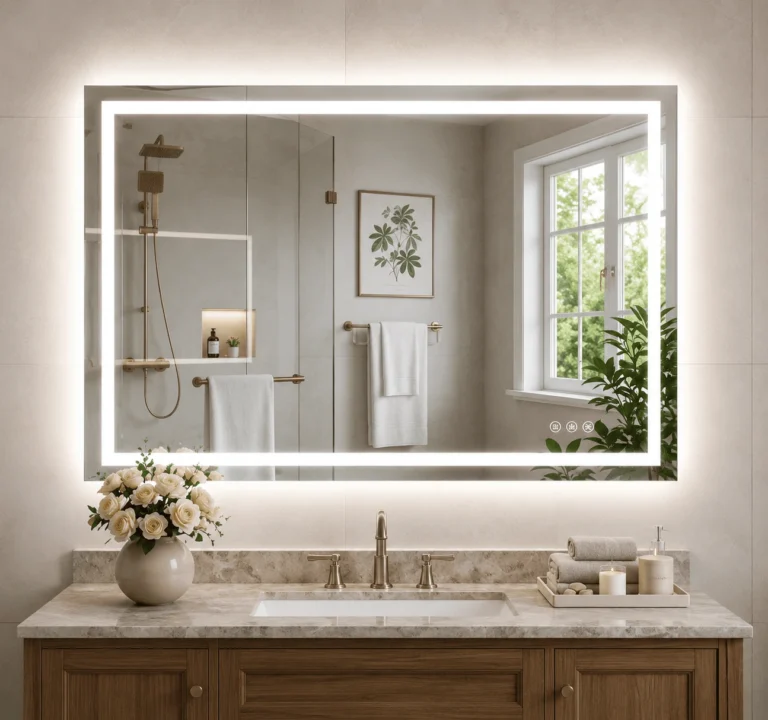
- Upgrade to a backlit or front-lit LED mirror
Why is vanity lighting more important than ceiling lighting?
Vanity lighting matters most because it controls how your face looks in the mirror. Ceiling lights shine downward and create shadows. Side-mounted sconces or vertical light bars reduce shadows and make shaving, skincare, and makeup easier. For most bathrooms, vanity lighting is the first upgrade worth paying for.
The classic mistake is a three-bulb bar above the mirror with frosted shades pointing down. It feels normal because everyone has seen it. That does not make it good.
Better options include:
| Vanity setup | Best for | Watch out for |
| Side sconces | Most balanced face lighting | Needs enough wall width |
| Vertical LED bars | Modern bathrooms | Can glare if too bright |
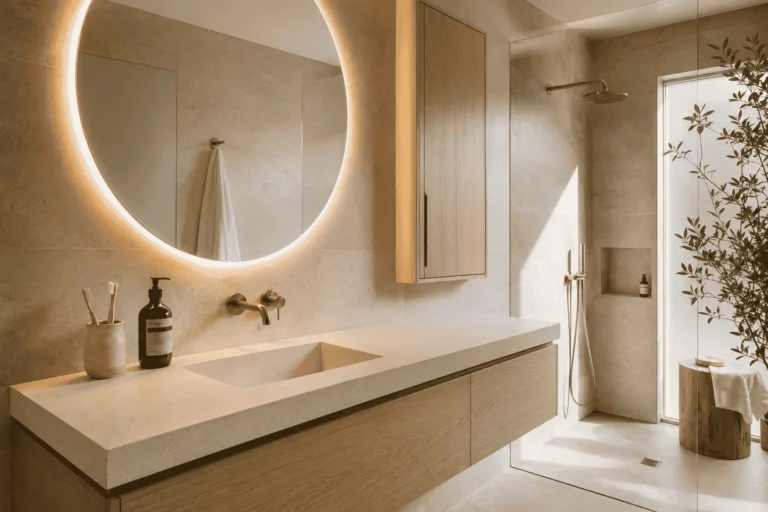
| Backlit mirror | Soft mood and depth | Not always enough for makeup |
| Front-lit LED mirror | Grooming and small bathrooms | Choose good CRI |
| Over-mirror bar | Tight spaces | Avoid harsh downward shadows |
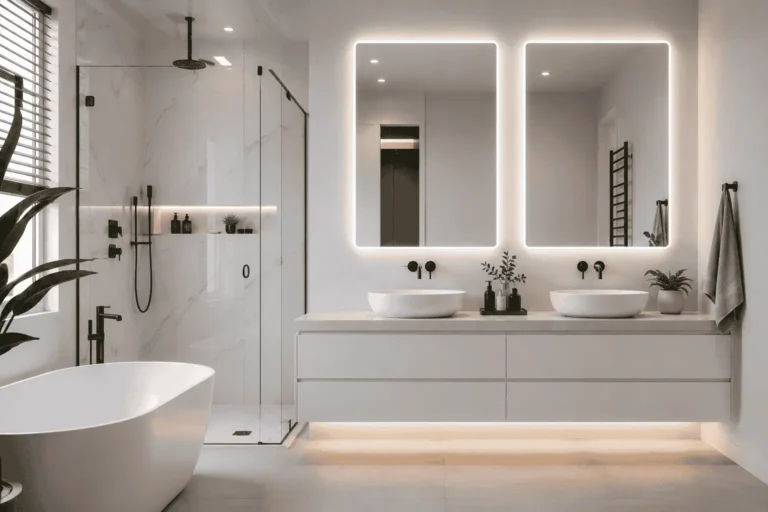
For double vanities, use one sconce on each outer side and one between mirrors when space allows. For one wide mirror, vertical bars on both sides usually beat one long bar above.
Should bathroom lights be warm, cool, or adjustable?
Use warm to neutral light for most bathrooms. Around 2700K to 3000K feels relaxing and flattering. Around 3500K to 4000K helps windowless rooms feel brighter. Tunable white lighting is best when one bathroom serves both morning grooming and evening relaxation.
Color temperature changes the emotional tone of the bathroom. Warm light feels calm. Cool light feels clean and alert. Too warm can make white tile look dull. Too cool can make skin look flat.
Here is a practical setup.
| Bathroom area | Suggested color temperature | Why it works |
| Vanity mirror | 3000K to 3500K | Flattering without feeling yellow |
| Shower | 2700K to 3000K | Softer and spa-like |
| Ceiling ambient light | 3000K to 4000K | Balanced general visibility |
| Windowless bathroom | 3500K to 4000K | Helps reduce the cave effect |
| Night lighting | 2200K to 2700K | Gentle for late use |
The FTC Lighting Facts label helps shoppers compare brightness, energy cost, life, light appearance, and wattage. That matters because homeowners still say “watts” when they really need lumens and color temperature. (Federal Trade Commission)
How many lumens does a bathroom need?
A small bathroom may need about 1,500 to 3,000 total lumens, while a larger primary bathroom may need 4,000 to 8,000 lumens across multiple layers. Do not put all lumens in one fixture. Spread brightness between ceiling, vanity, shower, and accent lighting.
Lumens measure how much light you get. More lumens means brighter light. The Department of Energy advises shoppers to think in lumens, not watts, when buying bulbs. (The Department of Energy’s Energy.gov)
Use this as a homeowner planning guide.
| Bathroom size | Total lighting goal | Best distribution |
| Powder room | 1,500 to 2,500 lumens | Vanity plus ceiling |
| Small full bath | 2,000 to 3,500 lumens | Ceiling, vanity, shower |
| Medium bathroom | 3,500 to 5,500 lumens | Layered zones |
| Large primary bath | 5,000 to 8,000 lumens | Multiple circuits and dimmers |
The mistake is not “too many lumens.” The mistake is too many lumens from one bad angle.
Are LED mirrors worth it in 2026?
LED mirrors are worth it when they solve a real problem: poor vanity lighting, limited wall space, fog, or a windowless bathroom. They are not always enough as the only light source. The best LED mirror works with ceiling and side lighting, not against it.
LED mirrors became popular because they look clean and modern. In small bathrooms, they also remove the need for bulky wall fixtures. That is helpful when the mirror nearly touches both side walls.
Look for:
- Front lighting for grooming
- Backlighting for mood
- Anti-fog feature for showers nearby
- Dimming
- 3000K to 4000K adjustment
- High CRI
- Damp-location suitability
In 2026, smart mirrors are moving beyond basic glow. Lifx announced a Matter-enabled smart mirror with front and backlighting, Makeup Check, Anti-Fog modes, and support for major smart home platforms. (The Verge)
What are the best small bathroom lighting ideas?
Small bathrooms need vertical light, reflected light, and low-profile fixtures. Use a backlit mirror, slim sconces, recessed or flush ceiling lights, glossy surfaces, and under-vanity lighting. Avoid bulky pendants unless ceiling height and safety clearances make sense.
Small bathrooms are not hard to light because they are small. They are hard to light because shadows have nowhere to hide.
Try these upgrades:
- Use a large mirror to reflect light
- Add vertical sconces to stretch the wall visually
- Choose flush ceiling lights for low ceilings
- Use glossy tile or satin paint to bounce light
- Add under-vanity LED strips for floating depth
- Keep the shower bright, not gloomy
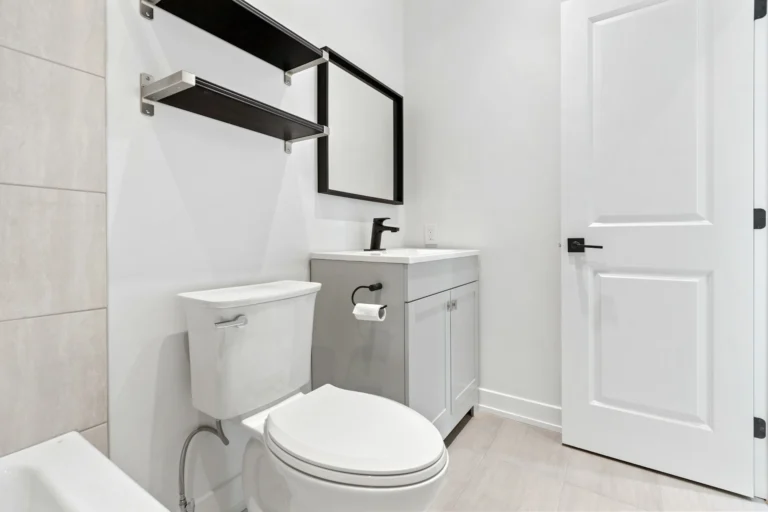
A common small bathroom failure is a single ceiling light behind the user. When you stand at the sink, your own head blocks the light. That creates the “why do I look exhausted?” mirror problem.
How do you light a windowless bathroom?
A windowless bathroom needs layered artificial daylight. Use neutral ceiling lighting, flattering vanity lighting, reflective surfaces, and a dimmable evening mode. Do not use only warm yellow bulbs. They can make a dark bathroom feel smaller and older.
Windowless bathrooms need a different strategy.
Use:
| Layer | Recommendation |
| Ceiling | 3500K to 4000K LED flush or recessed lights |
| Vanity | 3000K to 3500K side lighting or LED mirror |
| Shower | Wet-rated recessed light |
| Accent | Niche, toe-kick, or under-vanity strip |
| Surface support | Mirror, glossy tile, pale wall colors |
Here is a simple contractor note you can use.
“Please separate the vanity light from the ceiling light and put both on dimmers where code allows.”
That one sentence can save you years of annoying lighting.
Can shower lighting really change the bathroom?
Yes. Shower lighting makes a bathroom feel larger, safer, and more finished. A dark shower creates a visual dead zone. A properly rated recessed light, lit niche, or soft waterproof LED detail can make the whole room feel more expensive.
Shower lighting is where homeowners get tempted to DIY. Be careful. Bathrooms combine water, electricity, steam, and slippery surfaces.
Use a licensed electrician. Choose fixtures rated for the location. In many markets, lights near showers and tubs must be damp or wet rated depending on exposure. InterNACHI notes that light fixtures within 3 feet of the tub or shower should be rated for damp or wet locations. (NACHI)
Good shower lighting ideas:
- Recessed wet-rated downlight
- LED-lit shower niche
- Linear light in a ceiling recess
- Soft cove light outside the wet zone
- Separate shower switch for control
Are smart bathroom lights useful or just trendy?
Smart bathroom lighting is useful when it solves timing, mood, safety, or accessibility problems. It is just trendy when it adds color effects nobody uses. The best 2026 smart setup includes dimming, tunable white, motion night lighting, and reliable wall controls.
Smart lighting has matured. The real value is not turning the bathroom purple. It is walking in half-asleep and getting 10% warm light instead of a full blast ceiling light.
Good smart features:
| Feature | Real value |
| Motion night mode | Safer late-night use |
| Tunable white | Morning energy and evening calm |
| Scene controls | Faster routines |
| Matter support | Better platform compatibility |
| Voice control | Helpful for accessibility |
| Timer controls | Reduces energy waste |
At CES 2026, Govee highlighted DaySync, a system designed to adjust brightness and color temperature by time of day, sunrise, sunset, and local conditions. That shows where bathroom lighting is heading: less manual control and more natural daily rhythm. (Android Central)
What bathroom lighting ideas help older adults and families?
Older adults and families need even light, low glare, easy switches, and night visibility. Avoid shiny glare bombs. Use brighter task lighting, motion night lights, rocker switches, and clear shower illumination. The goal is confidence, not drama.
This is one area competitors miss badly.
A bathroom used by kids, guests, or older adults needs forgiving light. That means fewer dark corners and fewer blinding fixtures.
Use:
- Motion toe-kick lighting
- Non-glare vanity fixtures
- Shower lighting with clear coverage
- Easy-to-find switches
- Separate night mode
- Matte diffusers instead of exposed bulbs
- Higher contrast around steps, niches, and thresholds
One practical example: A powder room can look dramatic with one moody pendant. A family bathroom cannot. The family bathroom has to work at 6 a.m., midnight, and during a rushed school morning.
Which bathroom lighting mistakes make a room look cheap?
The biggest mistakes are relying on one ceiling light, choosing exposed bulbs near the mirror, ignoring CRI, using dry-rated fixtures in damp areas, placing pendants too low, and forgetting dimmers. These mistakes make even expensive tile and vanities feel unfinished.
Avoid these seven errors.
| Mistake | Why it fails | Better fix |
| One ceiling light | Creates face shadows | Add vanity lighting |
| Exposed clear bulbs | Causes glare | Use diffused shades |
| Wrong color temperature | Makes skin or tile look off | Use 3000K to 4000K |
| No shower light | Makes room feel smaller | Add wet-rated light |
| No dimmer | One mood only | Use dimmable LEDs |
| Bad mirror spacing | Uneven face light | Use side sconces |
| Wrong rating | Safety and durability risk | Choose damp or wet rated |
ENERGY STAR’s product finder shows modern certified fixtures with features such as continuous dimming, wet-location ratings, white tunable options, and high lumens-per-watt performance. That is the kind of product detail homeowners should check before buying. (ENERGY STAR)
What bathroom lighting brands and tools are worth considering?
The best bathroom lighting brand depends on the job. Use lighting brands for fixture quality, smart brands for controls, and certified product databases for performance checks. Do not choose only by style. Moisture rating, dimming quality, CRI, and warranty matter.
| Brand or tool | Best use | Honest note |
| ENERGY STAR Product Finder | Checking efficient certified fixtures | Great for performance, not design inspiration |
| Philips Hue | Smart bulbs and scenes | Strong ecosystem, can cost more |
| LIFX | Smart mirror and color lighting | Exciting 2026 smart mirror direction |
| Govee | Smart ambient lighting | Strong effects, choose bathroom-safe placement |
| Lutron Caseta | Reliable dimming controls | Excellent, but needs planning |
| Leviton | Switches and dimmers | Practical contractor-friendly choice |
| WAC Lighting | Modern LED fixtures | Good for clean architectural looks |
| Kichler | Decorative bathroom fixtures | Style range is strong |
| Hinkley | Vanity and sconce designs | Often good for transitional homes |
| Robern | Premium medicine cabinets and mirrors | Higher budget category |
| Kohler | Bathroom mirrors and fixtures | Strong bathroom ecosystem |
| ConTech or SATCO Nuvo | Downlight options | Check exact wet rating and dimmer compatibility |
The Illuminating Engineering Society maintains lighting practice standards that cover design principles, light sources, luminaires, controls, upgrades, economics, and maintenance. For serious remodels, that type of industry-standard thinking is more reliable than choosing by Pinterest alone. (Illuminating Engineering Society)
How much should homeowners budget for bathroom lighting?
A basic fixture swap may be affordable, but new wiring, recessed lights, smart controls, and shower-rated fixtures raise costs. In 2026, homeowners should budget separately for fixtures, electrician labor, dimmers, permits, wall repair, and mirror upgrades.
Cost varies by country and city. Global readers should treat these as planning ranges, not fixed quotes.
| Upgrade | Typical planning range |
| Bulb upgrade only | Low cost |
| Vanity fixture swap | Low to medium |
| New wall sconces with wiring | Medium |
| LED mirror | Medium to premium |
| Shower-rated recessed light | Medium |
| Full layered lighting plan | Medium to high |
| Smart lighting and controls | Medium to premium |
HomeAdvisor’s 2026 electrical cost guide lists lighting fixture installation around $465 on average, while Angi’s 2026 data shows standard light fixture installation ranging from $158 to $1,021 depending on fixture type and complexity. (Home Advisor)
What should you ask a contractor before installing bathroom lights?
Ask your contractor about fixture rating, switch locations, dimmer compatibility, wiring access, mirror placement, shower zones, local electrical code, and repair work after installation. Good bathroom lighting starts before the electrician cuts the wall.
Ask these questions:
- Are these fixtures suitable for damp or wet bathroom areas?
- Can the vanity, ceiling, and shower lights be controlled separately?
- Will these LEDs work with the dimmer you recommend?
- Is the shower fixture rated for its exact location?
- Will the mirror block the junction box?
- Do we need permits or inspection?
- Who repairs drywall or tile after wiring?
- Can we add a night light circuit now?
- What color temperature do you recommend for each zone?
- What happens if the LED driver fails later?
The last question is boring. It is also important. Integrated LED fixtures can look beautiful, but if the driver fails, repair may not be as simple as changing a bulb.
FAQs about Bathroom Lighting Ideas That Make a Big Difference
What is the best lighting for a bathroom?
The best bathroom lighting combines ambient ceiling lighting, vanity task lighting, shower lighting, and soft night lighting. For most homes, the biggest improvement comes from face-level vanity lights and dimmable LED ceiling lights.
Should vanity lights point up or down?
Vanity lights can point up for softer ambient glow or down for stronger task light. For the most flattering face lighting, side sconces or vertical bars usually work better than a single downward fixture above the mirror.
Is 3000K or 4000K better for a bathroom?
3000K is warmer and more flattering. 4000K feels cleaner and brighter. Use 3000K near the vanity if comfort matters. Use 3500K to 4000K in windowless bathrooms that need extra brightness.
What CRI is best for bathroom lighting?
CRI 90+ is a strong target for vanity lighting because it helps colors look more accurate. This matters for makeup, shaving, skincare, hair color, and tile selection.
Can I put LED strip lights in a bathroom?
Yes, but only if the LED strip, driver, and placement suit the bathroom zone. Keep strips away from direct water unless they are properly rated. Use an electrician for wet areas.
Are recessed lights good for bathrooms?
Recessed lights are useful for ambient and shower lighting. They are not enough for the vanity when placed behind or above your head. Pair them with mirror lighting or sconces.
How do I make a small bathroom look brighter?
Use a large mirror, vertical vanity lights, flush ceiling fixtures, pale reflective surfaces, and a separate shower light. Avoid bulky fixtures and dark corners.
Do bathroom lights need to be wet rated?
Some bathroom lights need wet ratings, especially where direct water exposure is possible. Damp-rated fixtures may work in humid areas without direct spray. Always follow local code and product labels.
Are smart bathroom lights worth it?
They are worth it if you use dimming, motion night modes, tunable white, or scene controls. They are less useful if you only want novelty colors.
What is the most common bathroom lighting mistake?
The most common mistake is relying on one ceiling fixture. It lights the room but usually makes the mirror worse.
Should bathroom lighting match faucets and hardware?
It should coordinate, but it does not need to match perfectly. Brass, matte black, chrome, nickel, and bronze can mix well when repeated intentionally.
What lighting is best for a luxury bathroom?
Luxury bathrooms need layers: sconces, dimmable ceiling lights, accent niches, lit mirrors, shower lights, and low-level night lighting. The luxury feeling comes from control, not just expensive fixtures.
Conclusion
Bathroom Lighting Ideas That Make a Big Difference are not about buying the fanciest fixture. They are about solving shadows, glare, dullness, safety, and mood in the right order.
Start with the vanity. Add balanced face-level lighting. Improve ceiling brightness. Light the shower. Add dimmers and night lighting. Then choose beautiful fixtures that support the plan.
My practical prediction for 2026 and beyond: bathroom lighting will become less about single statement fixtures and more about quiet systems. Mirrors, sensors, dimmers, and tunable LEDs will work together. The best bathrooms will not scream “smart home.” They will simply feel right at 6 a.m., 6 p.m., and midnight.
2026 Material Watch
Watch these bathroom lighting materials and technologies in 2026:
| 2026 lighting watch item | Why it matters |
| Matter-enabled smart mirrors | Better smart home compatibility |
| Tunable white LED engines | One room can support morning and evening routines |
| Low-glare micro-optic diffusers | Brighter light without harsh reflection |
| Recycled aluminum fixture bodies | More sustainable premium lighting |
| Opal glass globes | Softer glow and timeless style |
| Silicone-sealed LED strips | Better moisture resistance in suitable zones |
| Plaster-in linear light channels | Clean architectural lighting for luxury remodels |
| Anti-fog mirror heating films | Clearer mirrors after hot showers |
| Motion toe-kick lighting | Safer night movement without harsh overhead light |
| High-CRI vanity LEDs | Better skin tone and makeup accuracy |