Home Renovation Guide 2026: How to Plan, Budget, and Hire the Right Contractor Near You
A home renovation is the process of repairing, updating, restoring, or improving a house so it looks better, works better, and fits your current needs. A smart home renovation starts with a clear goal, realistic budget, local permit check, contractor comparison, material plan, and contingency fund. In 2026, homeowners should also consider energy efficiency, aging-in-place upgrades, lead-safe work, and material price changes before starting.
A good renovation does not begin with tile samples.
It begins with an honest question.
“What problem am I actually trying to solve?”
Maybe your kitchen feels cramped every morning. May the bathroom floor is soft near the shower. Maybe your parents need safer access. Maybe you want to sell next year and stop buyers from saying, “It needs too much work.”
That moment matters. If you start with Pinterest, you may buy a dream. If you start with the problem, you build a plan.
In 2026, planning matters even more. Harvard’s remodeling indicator expects owner-occupied improvement and maintenance spending to gradually slow through 2026, but still remain very large by historic standards. NAHB also says remodeling demand is supported by older homes, mortgage rate lock-in, and aging-in-place needs. (Harvard Joint Center for Housing Studies)
Here is the practical truth: the best renovation is not always the biggest one. It is the one that fixes the right problem without wrecking your budget.
Who is this home renovation guide beneficial for?
This guide is helpful if you are:
- A homeowner planning a kitchen, bathroom, basement, or full-house renovation
- A first-time buyer who purchased an older home
- A seller preparing a house for listing
- A landlord updating a rental property
- A homeowner searching for a “home renovation contractor near me”
- A family planning aging-in-place improvements
- A homeowner worried about permits, inspections, or contractor mistakes
- A real estate investor comparing repair costs
- A local renovation company building better service content
- A DIY homeowner who wants to know when to hire a licensed pro
What is a home renovation in simple words?
A home renovation means improving an existing house without always rebuilding it from scratch. It can include painting, flooring, roofing, kitchen updates, bathroom upgrades, insulation, windows, repairs, layout changes, energy improvements, and safety upgrades. The scope can be small, like one room, or large, like a whole-house renovation.
Some renovations are cosmetic.
Few are structural.
Some are boring but important.
Here is what nobody tells you: the boring work often protects the beautiful work.
New flooring looks great. But if the subfloor is weak, the finish will fail. A new bathroom vanity feels fresh. But if the shutoff valves leak, you have a water problem. A new kitchen backsplash looks clean. But if the electrical panel is overloaded, you still have a safety issue.
A smart renovation has three layers:
- Repair: Fix what is broken.
- Performance: Improve safety, comfort, and efficiency.
- Design: Make the home look and feel better.
Most bad renovations skip layer one and layer two.
That is how people spend thousands and still feel disappointed.
Why is home renovation so important in 2026?
Home renovation matters in 2026 because many homeowners are staying in their current homes instead of moving. Older housing stock, high replacement costs, aging-in-place needs, and changing energy rules are making renovation a practical choice for comfort, safety, and long-term value.
NAHB reported that the typical age of a home increased from 31 years in 2006 to 41 years in 2023. It also noted that home improvement spending grew from 33 percent of residential construction spending in 2007 to 44 percent in early 2025. (National Association of Home Builders)
That means many homes now need serious updates.
Not luxury updates.
Real updates.
Think wiring, insulation, HVAC, roofs, windows, bathrooms, ventilation, water damage, accessibility, and storage.
The U.S. Census Bureau also reported that the 2021 American Housing Survey showed the median age of all owned homes was 41 years, and older pre-1950 homes made up about 17 percent of homes. (Census.gov)
That age matters.
Older homes often have charm. They also hide surprises.
You may find:
- Outdated wiring
- Old plumbing
- Lead paint
- Poor insulation
- Uneven floors
- Moisture damage
- Undersized electrical panels
- Weak bathroom ventilation
- Poor kitchen layouts
A 2026 home renovation should not only chase style. It should improve how the home performs.
That is the part many competitors miss.
How do you start a home renovation the right way?
Start a home renovation by defining the problem, listing must-haves, checking local permits, setting a realistic budget, choosing a project order, and deciding whether you need a designer, contractor, architect, or engineer. Do not start by buying materials before the scope is clear.
The wrong first step is shopping.
The right first step is diagnosis.
Ask these five questions before you call anyone:
- What problem needs to change first?
- What must stay within budget?
- What can wait six to twelve months?
- Will this project affect plumbing, electrical, HVAC, or structure?
- Will my city or county require a permit?
A Reddit homeowner asking where to start with permits received a simple answer that matches real permit logic: list the work first, because structural changes, plumbing, electrical, and HVAC often require permits. (Reddit)
That is the best starting point.
Write the scope first.
Then ask for help.
Beginner home renovation approach
Start small if you have never renovated before.
Good beginner projects include:
- Painting
- Lighting updates
- Cabinet hardware
- Flooring replacement
- Basic landscaping
- Closet improvements
- Faucet replacement
- Interior door updates
These projects teach planning without opening the walls.
Intermediate home renovation approach
Move into projects with more coordination.
Examples include:
- Bathroom refresh
- Kitchen surface upgrade
- Window replacement
- Insulation upgrade
- Deck repair
- Laundry room update
These may involve permits, trades, or inspections.
Advanced home renovation approach
Hire professionals for complex work.
Examples include:
- Whole-house renovation
- Wall removal
- Basement finishing
- Addition
- Major kitchen remodel
- Primary suite renovation
- Structural repair
- Electrical panel upgrade
This is not where you learn from YouTube at midnight.
How much does home renovation cost in 2026?
Home renovation costs in 2026 depend on location, project size, labor rates, material quality, permits, hidden damage, and whether plumbing, electrical, HVAC, or structural work is involved. Cosmetic renovations cost less. Whole-home renovations and system upgrades cost much more. Always add a contingency fund.
There is no single national price that fits every home.
A bathroom in rural Ohio will not cost the same as a bathroom in San Francisco. A 1970s ranch will not behave like a 1910 brick rowhouse. A cosmetic update will not cost the same as a wall-removal project.
Current price pressure still matters. BLS reported that the Producer Price Index for final demand rose 0.5 percent in March 2026, while final demand goods rose 1.6 percent and final demand prices rose 4.0 percent over the prior 12 months. (Bureau of Labor Statistics)
That does not mean every renovation material rose by the same amount.
It means homeowners should avoid stale budgets.
A quote from 2023 may not protect you in 2026.
Practical 2026 renovation cost buckets
| Project type | Typical scope | Budget risk |
| Cosmetic refresh | Paint, lighting, hardware, minor flooring | Low |
| Room renovation | Bathroom, kitchen surfaces, laundry room | Medium |
| System upgrade | HVAC, electrical panel, plumbing, insulation | Medium to high |
| Structural renovation | Wall removal, beam, foundation, addition | High |
| Whole-home renovation | Multiple rooms, systems, finishes | Very high |
| Historic or older home renovation | Lead paint, old wiring, plaster, repairs | Very high |
What contingency should you add?
Use this rule:
- 10 percent for cosmetic work
- 15 percent for room renovations
- 20 percent for older homes
- 25 percent or more for structural or whole-home work
I know that sounds conservative.
It is not.
It is cheaper than panic borrowing after demolition.
Do you need permits for home renovation near you?
You may need a permit for home renovation if the project changes structure, walls, wiring, plumbing, HVAC, windows, additions, decks, basements, or occupancy. Cosmetic work like painting, carpet removal, or small fixture swaps may not require a permit, but rules vary by city and county.
Local rules control permits.
That is why “near me” matters.
The City of Grand Rapids says home renovations often need permits when you add or modify walls, wiring, piping, ductwork, or HVAC equipment. It also warns that unpermitted work can create problems during home sales because permit and inspection records are public. (City of Grand Rapids, Michigan)
That advice applies far beyond one city.
Permit offices care about safety, recordkeeping, and code compliance.
Permit red flags for homeowners
Check with your local building department if you plan to:
- Remove or add walls
- Finish a basement
- Add a bathroom
- Move plumbing
- Add electrical circuits
- Replace or upgrade an electrical panel
- Move HVAC ducts
- Add a deck
- Replace windows with size changes
- Build an addition
- Convert a garage
- Add a rental unit
When permits are often not needed
Many cities do not require permits for:
- Painting
- Carpet removal
- Cabinet hardware
- Simple backsplash
- Minor cosmetic updates
- Some fixture swaps
- Non-structural trim work
But do not guess.
Search this phrase:
“[your city] residential renovation permit”
That search can save you thousands.
What should homeowners know about lead paint before renovating?
If your home was built before 1978, lead-safe renovation matters. EPA rules require paid contractors who disturb painted surfaces in pre-1978 homes, childcare facilities, or preschools to be certified and trained in lead-safe work practices. Homeowners should hire lead-safe certified contractors for these projects.
This is one of the most important missed topics in competitor posts.
The EPA says anyone paid to disturb painted surfaces in homes, childcare facilities, and preschools built before 1978 must be certified and trained in lead-safe work practices. The EPA also recommends that homeowners planning work in pre-1978 homes hire a lead-safe certified contractor. (US EPA)
This matters during:
- Sanding
- Demolition
- Window replacement
- Door replacement
- Wall repair
- Trim removal
- Exterior scraping
- Kitchen renovation
- Bathroom renovation
Lead dust is not a design issue.
It is a health issue.
Ask contractors:
“Are you EPA RRP certified for pre-1978 homes?”
Also ask:
“How will you contain dust, clean the work area, and protect occupants?”
If the contractor laughs at that question, keep looking.
Should you renovate before selling your home?
Renovating before selling can help if the updates improve visible appeal, repair obvious defects, and match buyer expectations in your local market. Cosmetic updates often make more sense than expensive custom remodels when you plan to sell soon.
This is where homeowners overspend.
They install the kitchen they always wanted, then sell six months later.
That is not renovation planning. That is emotional back pay.
Zonda’s 2025 Cost vs. Value Report found that exterior improvements continued to deliver strong resale value, while Zonda commentary noted that exterior projects often make more sense for sellers and interior projects often make more sense for owners staying longer. (Zonda)
That is a useful rule.
Best pre-sale renovation focus
Before selling, prioritize:
- Paint
- Curb appeal
- Lighting
- Clean flooring
- Minor kitchen updates
- Minor bathroom updates
- Entry door appeal
- Garage door condition
- Safety repairs
- Odor and moisture issues
What to avoid before selling
Be careful with:
- Luxury custom kitchens
- Expensive niche tile
- Overbuilt bathrooms
- Hobby rooms
- Trend-heavy finishes
- Major layout changes without local demand
Your buyer may not share your taste.
A pre-sale home renovation should reduce objections.
It should not become your dream project.
Should you renovate if you plan to stay long term?
If you plan to stay for five years or more, your home renovation should focus on comfort, safety, energy performance, storage, accessibility, and daily function. Resale still matters, but lifestyle value becomes more important.
Here is the contrarian point: ROI is not always the right question.
If your bathroom is unsafe for an aging parent, the “return” is not only resale value. It is fewer falls. Less stress. More independence.
NAHB says aging-in-place is now a major remodeling driver. Its survey found that 56 percent of remodelers are involved in home modification work related to aging-in-place, and 73 percent said requests for aging-in-place features increased over the past five years. (National Association of Home Builders)
That is not a trend.
That is a demographic shift.
Long-term renovation priorities
Consider:
- Walk-in showers
- Grab-bar blocking
- Wider doorways
- Better lighting
- Non-slip flooring
- Main-floor laundry
- Lever door handles
- Improved ventilation
- Heat pump systems
- Better insulation
- Smart thermostats
- Safer stairs
A beautiful home that is hard to live in is not finished.
It is just decorated.
How should you choose a home renovation contractor near you?
Choose a home renovation contractor by checking license requirements, insurance, references, past work, written scope, permit knowledge, payment schedule, communication style, and change-order process. Do not choose based only on the lowest price.
A contractor is not just a labor source.
A good contractor is a risk manager.
They protect your budget, schedule, safety, and sanity.
Ask these questions before hiring:
- Are you licensed for this type of work in my city or state?
- Do you carry liability insurance and workers’ compensation?
- Who pulls permits?
- Who manages inspections?
- What is excluded from this estimate?
- How do you handle hidden damage?
- What is your change-order process?
- What brands and models are included?
- What is the payment schedule?
- Who will be on site each day?
A 2026 Kiplinger contractor guide also emphasizes that asking the right questions before hiring can help homeowners compare candidates, set expectations, and protect their budget. (Kiplinger)
Red flags
Avoid contractors who:
- Refuse written estimates
- Ask for full payment upfront
- Avoid permits
- Cannot show insurance
- Pressure you to decide today
- Give vague material allowances
- Do not explain change orders
- Have no clear schedule
- Say “trust me” too often
Trust is good.
Documentation is better.
What should be included in a home renovation contract?
A home renovation contract should include scope of work, materials, brands, allowances, start date, estimated timeline, payment schedule, permit responsibility, change-order rules, cleanup, warranty, insurance, and dispute terms. A vague contract is one of the fastest ways to lose control of a renovation.
The contract should make the invisible visible.
Do not accept:
“Renovate bathroom.”
That is not a scope.
Ask for details like:
- Remove existing vanity
- Replace shutoff valves if needed
- Install specified vanity model
- Install specified faucet
- Install moisture-rated drywall where needed
- Prime and paint walls
- Haul away debris
- Protect floors from entry to work area
- Pull required plumbing permit
That level of detail feels boring.
It is also how you avoid arguments.
Watch material allowances
An allowance is a placeholder amount.
Example:
“Tile allowance: $3,000.”
That does not tell you enough.
Ask:
- Does it include delivery?
- Does it include setting materials?
- Does it include waste factor?
- Does it include labor?
- What happens if tile costs more?
A renovation budget can collapse through tiny vague lines.
One vague allowance at a time.
How can you renovate while living in your home?
You can live through a home renovation if the project is phased, dust is controlled, utilities are planned, pets and children are protected, and you create temporary zones for cooking, bathing, sleeping, and storage. Whole-home renovations may require temporary housing.
Living through renovation sounds manageable until day four.
Then the dust gets into the hallway.
The dog is barking.
Someone needs a shower.
The microwave is sitting on a folding table.
This is not dramatic. It is normal.
Plan for it.
Create temporary zones
For kitchen renovations:
- Set up a microwave station
- Use a mini fridge
- Store paper plates
- Plan simple meals
- Keep coffee accessible
- Protect one clean eating area
Bathroom renovations:
- Confirm another working bathroom
- Schedule showers around work hours
- Store toiletries elsewhere
- Keep towels sealed from dust
For whole-home work:
- Renovate by zone
- Keep one clean room
- Use zip walls or plastic barriers
- Plan pet care
- Protect HVAC returns
- Consider short-term rental time
The hidden cost of renovation is disruption.
Budget for your actual life.
What home renovation projects offer the best value?
The best value home renovation projects usually fix visible defects, improve function, reduce safety concerns, and match local buyer expectations. Exterior updates often help resale, while interior updates often improve daily living.
Value depends on your goal.
If you are selling, value means buyer confidence.
You are staying, value means daily comfort.
If you are renting, value means durability and fewer maintenance calls.
High-value cosmetic projects
- Paint
- Lighting
- Entry update
- Cabinet hardware
- Flooring repair
- Deep cleaning
- Landscaping
- Caulking and grout repair
Functional projects with high value
- Bathroom ventilation
- Insulation
- HVAC updates
- Safer stairs
- Better storage
- Water damage repair
- Electrical safety upgrades
High-value lifestyle projects
- Kitchen layout improvement
- Walk-in shower
- Mudroom
- Laundry upgrade
- Home office
- Outdoor living area
Do not copy national trends blindly.
Ask what your home actually needs.
What 2026 energy changes should homeowners know before renovation?
Homeowners should check current federal, state, utility, and local rebate rules before planning energy upgrades in 2026. Federal energy credits changed after 2025, so do not assume a 2026 project qualifies under old rules.
This is a major competitor gap.
The IRS says the Energy Efficient Home Improvement Credit applied to qualified improvements made after January 1, 2023, and through December 31, 2025. The IRS also states under later guidance that the credit is not allowed for property placed in service after December 31, 2025. (IRS)
ENERGY STAR also says federal income tax credits for homeowners were available through December 31, 2025, with up to $3,200 available for eligible upgrades under that program period. (ENERGY STAR)
So in 2026, verify first.
Do not let old blog posts guide your tax expectations.
Smart energy renovation upgrades
Even without the same federal credit, these upgrades may still matter:
- Heat pump systems
- Heat pump water heaters
- Air sealing
- Attic insulation
- Duct sealing
- Efficient windows
- Smart thermostats
- Energy recovery ventilation
- Electrical panel planning
Energy work is not only about saving money.
It is about comfort, humidity, air quality, and future resale expectations.
Which tools and brands help with home renovation planning?
Useful home renovation tools help you plan layout, compare costs, track budgets, manage contractors, document decisions, and research energy or resale value. No tool replaces a qualified contractor, but the right tools reduce confusion before work starts.
| Tool or brand | Best use | Honest note |
| Google Sheets | Budget tracking | Simple and flexible |
| Matterport | 3D capture and planning | Useful for visual documentation |
| Houzz | Inspiration and contractor discovery | Can inflate taste and budget fast |
| Mood boards | Great for ideas, weak for cost control | |
| Homewyse | Cost ballparks | Not a contractor quote |
| Zonda Cost vs. Value | Resale value research | Strong market context |
| ENERGY STAR Product Finder | Efficient product research | Good for appliances and HVAC planning |
| IRS energy credit pages | Tax rule verification | Essential before claiming credits |
| ICC Digital Codes | Code research | Local amendments still matter |
| Buildertrend | Contractor project management | Works best if contractor uses it well |
| CoConstruct | Selections and communication | Strong for design-build teams |
| Bluebeam | Plan markup | More pro-focused than homeowner-focused |
The tool does not matter if your scope is vague.
Start with the scope.
Then choose the tool.
What is the best order for a home renovation?
The best home renovation order is planning, inspection, design, budget, permits, demolition, structural work, rough plumbing, rough electrical, HVAC, insulation, drywall, flooring, cabinets, fixtures, paint, final inspections, and punch list. The exact order changes by project.
Use this general sequence:
- Define goals
- Inspect problem areas
- Create scope
- Set budget
- Check permits
- Hire pros
- Order long-lead materials
- Protect the home
- Demolish carefully
- Complete structural work
- Rough-in plumbing, electrical, HVAC
- Insulate and close walls
- Install drywall and finishes
- Install cabinets and fixtures
- Paint and touch up
- Complete inspections
- Finish punch list
Do not install finishes before dirty work ends.
It sounds obvious.
Yet people do it.
Then the new floor gets scratched, the fresh paint gets patched, and the homeowner pays twice.
FAQs about home renovation
Start by defining the problem and writing a clear scope. Do not begin with materials. Decide what needs repair, what needs updating, what must stay, and what your budget can handle.
Your budget depends on scope, city, labor, materials, and hidden damage. Add at least 10 percent contingency for cosmetic work and 15 to 25 percent for larger or older-home renovations.
Not always. You can DIY painting, hardware, basic shelves, and simple cosmetic updates. Hire a licensed pro for electrical, plumbing, HVAC, structural work, roofing, and complex waterproofing.
Search locally, check licensing rules, read reviews, ask for references, compare detailed written estimates, and verify insurance. Also ask who pulls permits and manages inspections.
It can be worth it if the project removes buyer objections. Paint, lighting, curb appeal, minor kitchen updates, and bathroom refreshes often help more than expensive custom changes.
The most expensive mistakes are vague scope, skipped permits, cheap bids with missing items, poor waterproofing, bad electrical work, and ordering materials too late.
Renovate one room if your budget is limited or you need less disruption. Consider a whole-house plan if systems, layout, flooring, and finishes all need coordinated updates.
Yes, but plan zones carefully. Keep one clean area, protect HVAC returns, create temporary kitchen or bathroom access, and schedule noisy or dusty work around your routine.
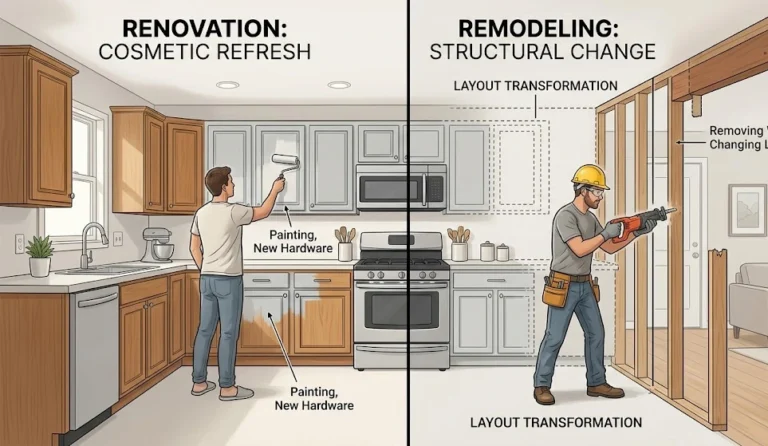
Renovation updates or restores an existing space. Remodeling changes the layout, structure, or function. Painting cabinets is renovation. Moving the sink and changing the kitchen layout is remodeling.
Ask about scope, exclusions, permits, inspections, payment schedule, warranties, materials, change orders, insurance, timeline, cleanup, and who will be on site daily.
Final thoughts: How to make your home renovation actually worth it
A successful home renovation is not about doing everything.
It is about doing the right things in the right order.
Start with the problem. Check the structure. Respect permits. Protect your health. Choose materials early. Hire carefully. Keep money aside for surprises.
And remember this: your home does not need to impress strangers online.
It needs to support the life you actually live.
The best renovation is the one that makes your house safer, calmer, more useful, and easier to love.
2026 Material Watch
Home renovation in 2026 is moving beyond paint colors and cabinet styles. Watch these materials and systems:
- Smart Glass: Useful for privacy, glare control, and solar heat management in high-end renovations.
- Heat Pump Integration: Important for comfort, energy planning, and future-ready HVAC upgrades.
- Recycled Steel Framing: Worth watching for durability, lower waste, and structural consistency.
- Low-Carbon Concrete: More common in larger renovation and addition projects.
- Smart Ventilation: Important as homes become tighter and better insulated.
- Moisture-Resistant Building Panels: Helpful in bathrooms, basements, and humid climates.