Open Concept Kitchen Remodeling: Pros, Cons & Hidden Costs Homeowners Should Know Before Removing a Wall
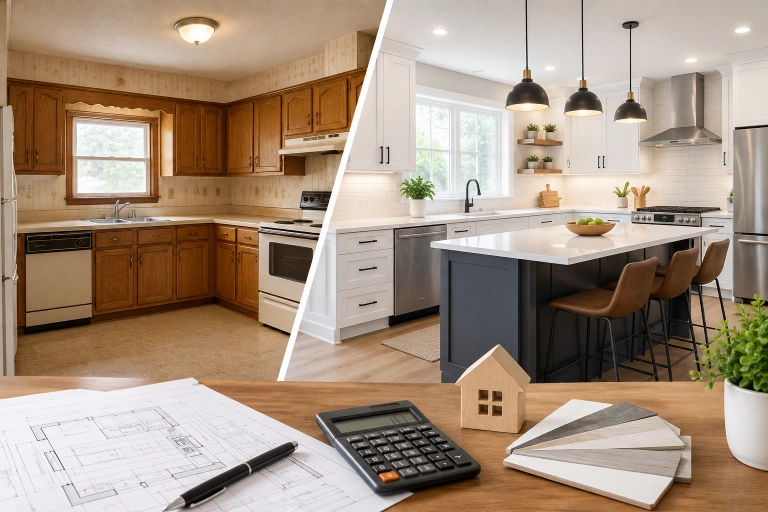
Open concept kitchen remodeling can make a home feel brighter, larger, and more social, but it can also expose hidden costs. The biggest risks are load-bearing wall removal, structural engineering, permits, electrical rerouting, plumbing, HVAC changes, floor patching, ventilation upgrades, storage loss, and noise control. In 2026, homeowners should budget beyond cabinets and countertops and treat wall removal as a structural project, not just a design upgrade.
You start with a simple idea.
“Let’s remove this wall and open the kitchen.”
Then the contractor looks up. The wall may carry floor joists. The electrician finds old wiring. The HVAC return sits where the new island should go. The flooring under the wall does not match. Suddenly, a bright open kitchen is not just a kitchen remodel. It is structure, air quality, permits, lighting, storage, and resale strategy in one messy package.
That is the truth about Open Concept Kitchen Remodeling: Pros, Cons & Hidden Costs. It can be one of the best upgrades in a home. It can also become the project that eats the contingency budget before cabinets even arrive.
Current 2026 kitchen trends support smarter layouts, more built-in storage, warm wood cabinetry, and long-term function. Houzz’s 2026 Kitchen Trends Study found that 52% of renovating homeowners changed their kitchen layout, while 68% kept the kitchen about the same size. That means many people want better flow without always adding square footage. (Houzz)
This Guide Is Best For These Homeowners
Use this guide if you are:
- Planning to remove a wall between the kitchen, dining room, or living room
- Comparing open concept, semi-open, and closed kitchen layouts
- Worried about load-bearing walls, permits, beams, and inspections
- Budgeting for a remodel before calling contractors
- Trying to avoid surprise costs during construction
- Remodeling for resale value and daily comfort
- Designing a family-friendly kitchen with better sightlines
- Considering induction, better ventilation, or a future-ready kitchen
What Is Open Concept Kitchen Remodeling?
| Layout Style | The Strategy | Key Elements |
|---|---|---|
| Fully Open | Total removal of barriers to blend kitchen, dining, and living areas into a single footprint. | Seamless flooring, shared lighting, maximum light infiltration. |
| Semi-Open | Maintains partial separation to define the kitchen while keeping a visual connection. | Peninsulas, archways, glass partitions, pony walls, or wide cased openings. |
| Broken-Plan | Maintains the visual “breathability” but creates distinct functional zones. | Ceiling beams, flooring shifts, built-ins, pocket doors, or acoustic glass. |
|
The Goal: Enhanced flow, increased natural light, and easier social interaction. The Challenge: Navigating hidden structural supports, plumbing, wiring, and loss of wall storage. |
||
Open concept kitchen remodeling removes or reduces barriers between the kitchen and nearby living or dining spaces. The goal is better flow, more light, easier conversation, and a larger visual footprint. The risk is that walls often hide structure, wiring, plumbing, ducts, and storage.
An open concept kitchen is not always fully open. That is where many homeowners get stuck.
There are three common versions.
A fully open kitchen removes the wall and blends the kitchen, dining, and living areas into one connected space. A semi-open kitchen keeps partial separation with a peninsula, archway, glass partition, pony wall, or wide cased opening. A broken-plan kitchen keeps the visual connection but adds zones through ceiling beams, flooring changes, built-ins, pocket doors, or acoustic glass.
Here is my strong opinion: most families do not need the most open version. They need the right amount of openness.
A completely open room looks amazing in photos. Real life has backpacks, air fryers, coffee mugs, homework, pets, cooking smells, and someone watching TV while another person runs the blender. The best remodel is not the one with the fewest walls. It is the one that lets the house breathe without making every activity compete.
Is Open Concept Kitchen Remodeling Still Worth It in 2026?
| 🏠 Open Concept Kitchens: The 2026 Perspective | |
|---|---|
| ✨The Verdict | Still worth it—if it solves functional problems like darkness or poor flow. It’s no longer about “trend pressure,” but about intentional lifestyle design. |
| 🔄The Evolution | Moving away from “one big empty room” toward Flexible Zones. The focus has shifted to integrated sound control, high-end ventilation, and hidden storage. |
| 📈Top 2026 Trends (Houzz Data) |
• 47% Specialty Pantry Cabinets • 24% Beverage Stations • 16% Walk-in Pantries • 7% Butler’s Pantries / Prep Kitchens |
| 🎯Primary Goals | Fixing awkward traffic flow, bringing daylight deeper into the floor plan, improving sightlines to guests/children, and adding social island seating. |
| 💡The Strategy | Strong projects start with a lifestyle problem; weak projects start with just a photo. Function-first design is the hallmark of 2026 remodeling. |
Yes, open concept kitchen remodeling can still be worth it in 2026 when the layout solves a real problem. It works best when the current kitchen feels dark, cramped, disconnected, or hard to entertain in. It is less worth it when the only reason is trend pressure.
Open kitchens are not dead. They are evolving.
The older version of open concept was simple: remove everything and create one big room. The 2026 version is more thoughtful. Homeowners want openness with storage, ventilation, sound control, and flexible zones.
Houzz’s 2026 trend reporting shows that homeowners are adding more specialty built-ins. Pantry cabinets were added by 47% of renovating homeowners, beverage stations by 24%, walk-in pantries by 16%, and butler’s pantries or prep kitchens by 7%. This matters because open kitchens need hidden storage more than closed kitchens do. (Houzz)
The best open concept kitchens usually have one of these goals:
- Make a small kitchen feel less boxed in
- Improve sightlines to children or guests
- Bring daylight deeper into the home
- Add an island with seating
- Fix awkward traffic flow
- Connect cooking, dining, and entertaining
- Increase resale appeal without overbuilding
The weak projects start with a photo. The strong projects start with a lifestyle problem.
What Are the Biggest Pros of an Open Concept Kitchen?
The main benefits are better light, stronger connection, easier entertaining, improved traffic flow, and a more spacious feeling. A good open kitchen can also make an older home feel current without increasing the home’s footprint.
The first benefit is light. Removing a wall can let windows serve more than one room. A dark dining area may borrow light from the kitchen. A small kitchen may feel less like a hallway.
The second benefit is connection. Parents can cook while watching children. Hosts can talk with guests while finishing dinner. Couples can share the same space without standing in the same corner.
The third benefit is better circulation. Older homes often have small rooms and tight doorways. Removing or widening one wall can improve how people move from the entry to the kitchen, table, sofa, and outdoor space.
The fourth benefit is flexibility. One large connected area can shift between breakfast, remote work, school projects, dinner, and entertaining.
But here is what nobody tells you. Open concept is not automatically more functional. It becomes functional only when the island, storage, lighting, range hood, appliance landing zones, and walking paths are planned together.
| The Pros (Benefits) | The Cons (Drawbacks) |
|---|---|
|
Better Light & Flow
Removing walls lets windows serve multiple rooms. Dark dining areas borrow light, and small kitchens feel less like hallways.
|
Sensory Overload
Dishwashers interrupt TV time, range hoods compete with talk, and the smell of seared meat settles into sofa fabrics.
|
|
Stronger Connection
Parents can cook while watching kids, and hosts can engage with guests. Space is shared without feeling crowded.
|
Visible Mess
The layout is “too honest.” Dirty pans are visible from the sofa, and toys or clutter drift easily into the cooking zone.
|
|
Dynamic Flexibility
One area shifts seamlessly between breakfast, remote work, school projects, and formal entertaining.
|
Storage Sacrifice
Loss of walls means losing upper cabinets, pantries, and electrical outlets. The kitchen island has to work twice as hard.
|
|
Modern Value
Updates older homes without increasing the footprint. Improves circulation from entryways to outdoor spaces.
|
Renovation Complexity
Higher remodeling complexity and a constant pressure to keep the kitchen “camera-ready” at all times.
|
What Are the Biggest Cons of Open Concept Kitchen Remodeling?
The biggest drawbacks are noise, cooking odors, visible clutter, reduced wall storage, weaker privacy, and higher remodeling complexity. These problems are not design theory. They show up every day after the contractor leaves.
Open concept kitchens are honest. Sometimes too honest.
Dirty pans are visible from the sofa. The dishwasher interrupts TV. The range hood competes with conversation. Kids’ toys drift into the kitchen zone. The smell of seared meat, fried food, or spices can settle into soft furniture.
Forum discussions show the same pattern. Some homeowners love the light and flow. Others regret the smell, noise, privacy loss, and the constant pressure to keep the kitchen camera-ready. (Reddit)
The storage issue is bigger than most people expect. Remove one wall and you may lose upper cabinets, a pantry cabinet, art space, a TV wall, or electrical outlet locations. That means the island must work harder.
A weak open concept layout gives you more air.
A strong one gives you more usable life.
How Much Does Open Concept Kitchen Remodeling Cost in 2026?
In 2026, a basic kitchen remodel may start near the high teens or $20,000s, while larger major remodels can move into the $80,000 to $160,000 range. Open concept work costs more when walls, beams, ducts, plumbing, electrical, flooring, and permits are involved.
Cost depends on scope.
A surface-level kitchen refresh is not the same as removing a structural wall and rebuilding the main floor. NerdWallet’s 2026 update says kitchen remodels vary widely and cites about $28,500 for a minor remodel, while major upscale projects can exceed $160,000. Angi’s 2026 kitchen remodel data lists an average professional kitchen remodel around $26,943, with a common range from $14,586 to $41,540. (NerdWallet)
JLC’s 2025 Cost vs Value report gives another useful benchmark. It lists a minor midrange kitchen remodel at $28,458, a major midrange kitchen remodel at $82,793, and a major upscale kitchen remodel at $164,104. (Journal of Light Construction)
For open concept work, the wall is the wild card.
A non-load-bearing wall may cost far less. A load-bearing wall may need engineering, temporary shoring, beam installation, inspections, drywall, flooring, and finish repairs. Angi’s 2026 load-bearing wall guide lists a normal range of $1,400 to $10,000 and an average around $5,700, with permits and rerouting as additional factors. (Angi)
2026 Open Concept Kitchen Cost Table
| Cost Item | Common 2026 Range | Why It Matters |
| Non-load-bearing wall removal | $1,500 to $5,000 | Still may need electrical, drywall, paint, and flooring |
| Load-bearing wall removal | $5,000 to $15,000 or more | Needs beam, engineer, permit, inspection, and skilled labor |
| Structural engineer | $500 to $1,500 | Confirms loads and beam design |
| Permits | $500 to $2,000 | Required in many structural projects |
| Electrical rerouting | $800 to $3,000 | Outlets, switches, lighting, circuits |
| Plumbing rerouting | $1,500 to $5,000 | Sink, water lines, vent stacks, gas lines |
| Flooring patch or weave-in | $1,500 to $4,000 | The old wall footprint rarely disappears cleanly |
| Ventilation upgrade | $500 to $3,500 or more | More important when cooking air enters living zones |
| Cabinet and storage redesign | Varies widely | Open walls reduce upper cabinet space |
A recent contractor guide gives similar wall-removal figures, including $1,500 to $5,000 for non-load-bearing wall removal, $5,000 to $15,000 for load-bearing wall removal with beam installation, and separate allowances for engineering, permits, floor patching, electrical, and plumbing. (WM Construction Co.)
What Hidden Costs Surprise Homeowners the Most?
The biggest hidden costs are inside-wall utilities, structural beams, mismatched flooring, ceiling repairs, range hood ducting, lighting changes, permit delays, temporary kitchen setup, storage replacement, and change orders.
The wall itself is rarely the full cost.
The real bill comes from everything the wall touched.
Hidden Cost 1: The Beam Is Not the Whole Structural Cost
A beam may sound simple. It is not.
The engineer must calculate the load. The contractor may need temporary support walls. Posts may need to land on proper support below. A flush beam may require ceiling work. A steel beam may need more labor than an LVL beam.
A cheaper beam can become expensive if it creates a visible drop that ruins the look.
Hidden Cost 2: Flooring Does Not Match
When a wall is removed, the floor under it is exposed. In older homes, that strip may have no hardwood, no tile, or a different subfloor height.
You may need to weave new flooring into old flooring. Sometimes the whole connected area must be refinished so the repair does not look like a scar.
Hidden Cost 3: HVAC Returns and Ducts Move Badly
Open rooms change airflow.
A wall may contain a return duct. A ceiling may need a new supply location. Bigger connected rooms can feel colder or hotter. Better Homes and Gardens has also noted that open floor plans can affect heating and cooling costs because larger connected areas are harder to regulate. (Better Homes & Gardens)
Hidden Cost 4: Ventilation Becomes More Important
In a closed kitchen, poor ventilation is annoying. In an open kitchen, it becomes everyone’s problem.
ENERGY STAR notes that cooking emits particulates, humidity, and, for gas cooking, carbon monoxide and nitrogen dioxide. It also says EPA recommends using vented kitchen range hoods when cooking. (ENERGY STAR)
Hidden Cost 5: Open Kitchens Need More Storage Planning
You may remove cabinet walls and then buy custom pantry storage to replace them.
Houzz found that 76% of renovating homeowners added specialty built-ins, including pantry cabinets and beverage stations. That is not just a trend. It is a practical response to open layouts. (pro.houzz.com)
Do You Need a Permit to Remove a Kitchen Wall?
You often need a permit when removing a load-bearing wall, changing structure, moving plumbing, altering electrical circuits, or changing HVAC. Permit rules vary by country, state, city, and building type, so homeowners should check before demolition starts.
This is where I get blunt.
Do not let a contractor talk you into skipping structural permits because it is “faster.”
A permit may slow the project. It may cost money. It may require drawings. But unpermitted structural work can create safety problems, insurance problems, resale problems, and painful negotiations when a buyer asks for records.
Some competitors mention permits in one sentence. That is not enough. The permit is not paperwork. It is a risk-control system.
For structural changes, a building department may require engineer drawings, beam specifications, inspections, and trade permits. A contractor guide focused on kitchen wall removal notes that many jurisdictions require a permit and may ask for an engineer letter or compliant beam design when a load-bearing wall is involved. (Salvation Home Remodeling)
How Do You Know If a Kitchen Wall Is Load-Bearing?
A wall may be load-bearing if it runs perpendicular to floor joists, lines up with beams or walls below, supports an upper story, or sits near the center of the house. Only a qualified pro should confirm it before removal.
Homeowners often guess by knocking on the wall.
That is not enough.
A hollow sound does not mean the wall is non-structural. A wall can hold electrical wires, ducts, plumbing, and still sound ordinary. Older homes can also have renovations that changed how loads move through the building.
Look for clues:
- Floor joists running into or across the wall
- A wall directly above or below it
- A beam, post, or foundation line below
- Roof framing that bears near the wall
- A wall near the center of the house
- Cracks or sagging near the ceiling line
Then stop guessing.
Hire a structural engineer or experienced contractor. The money spent before demolition is cheaper than fixing sagging ceilings after demolition.
Open Concept Kitchen vs Semi-Open Kitchen: Which Is Better?
A semi-open kitchen is often the smarter choice when you want light and connection without losing all privacy, storage, sound control, or cooking separation. Fully open works best for strong ventilation, tidy habits, and well-planned storage.
This is my favorite contrarian point.
Semi-open is not a compromise. It is often the upgrade.
A semi-open layout may include:
- A wide cased opening
- A partial wall
- A peninsula
- Interior glass doors
- Pocket doors
- Fluted glass panels
- A pass-through window
- Ceiling beams that define zones
- A pantry wall that hides appliance clutter
Reddit discussions show why semi-open layouts are gaining attention. People like light and flow, but they complain about smells, noise, and lack of privacy. One public thread even frames glass partitions, French doors, and partial dividers as a practical middle ground. (Reddit)
A fully open kitchen says, “Everything is connected.”
A semi-open kitchen says, “Everything is connected when I want it to be.”
What Design Choices Make Open Concept Kitchens Work Better?
The best open concept kitchens use zoning. They separate cooking, prep, dining, lounging, storage, and traffic without rebuilding full walls. This is done through islands, lighting, flooring, ceiling details, cabinetry, rugs, furniture placement, and glass dividers.
A good open kitchen needs invisible boundaries.
The island should not block the fridge, sink, or range. Seating should not sit inside the cooking path. The dishwasher should open without trapping someone at the sink. The refrigerator should be reachable without crossing the main cooking zone.
Use these design rules:
- Keep major walkways around 36 inches or wider
- Use 42 inches or more around busy island work zones when possible
- Keep seating out of the cook’s main path
- Add under-cabinet lighting and layered ceiling lighting
- Use rugs and furniture to soften sound
- Choose quieter dishwashers and range hoods
- Plan pantry storage before removing wall cabinets
- Add a landing zone near ovens and refrigerators
This is where homeowners often make a costly mistake. They focus on the island size before they plan the traffic.
An oversized island can ruin an open kitchen faster than a small wall.
How Does Open Concept Remodeling Affect Indoor Air Quality?
Open concept kitchens need better ventilation because cooking pollutants, moisture, grease, and odors spread faster into living areas. A ducted range hood, proper makeup air where required, and good HVAC filtration should be part of the design plan.
Cooking is not just smell.
EPA explains that indoor pollution sources release gases or particles, and inadequate ventilation can increase indoor pollutant levels. EPA also lists gas stoves as a source of nitrogen dioxide, which can irritate the eyes, nose, and throat and affect lung function. (US EPA)
That matters more in an open kitchen because the “kitchen air” becomes living room air.
If you cook heavily, especially frying, searing, wok cooking, or spice-heavy meals, do not treat the range hood as decoration. Treat it as part of the mechanical system.
A strong open kitchen ventilation plan may include:
- A ducted hood vented outdoors
- Proper duct size and short duct runs
- Quiet hood performance so people actually use it
- Makeup air review for high-CFM hoods
- Induction cooking if switching from gas fits the home
- Better filtration in the HVAC system
- Easy-clean surfaces near the range
DOE notes that induction appliances are up to three times more efficient than gas stoves and avoid indoor air pollutants from gas stoves. DOE also lists possible rebates for eligible induction cooktops and electric ranges, depending on local programs. (The Department of Energy’s Energy.gov)
[Internal link: Kitchen Ventilation Guide]
[Internal link: Induction Cooktop Buying Guide]
What Are the Best Tools and Brands to Discuss With Your Contractor?
The best tools and brands are not always the most expensive. Ask about structural software, 3D layout tools, cabinet systems, ventilation brands, induction appliances, flooring match methods, and project management systems before signing.
Here are practical tools and brands homeowners may hear during planning.
| Tool or Brand | Useful For | Honest Assessment |
| Houzz Pro 3D Floor Planner | Layout visualization | Helpful for seeing flow before demolition |
| SketchUp | Concept modeling | Flexible, but depends on designer skill |
| Chief Architect | Pro kitchen and remodel drawings | Strong for serious design work |
| AutoCAD | Technical drawings | Better for pros than homeowners |
| Bluebeam | Plan review and markups | Useful on complex permitted jobs |
| Bosch | Dishwashers and induction | Often strong for quiet performance |
| Miele | Premium appliances | Excellent, but expensive |
| Broan-NuTone | Ventilation | Common range hood and fan option |
| Zephyr | Range hoods | Good design options for open kitchens |
| IKEA Sektion | Budget cabinet system | Great value when installed carefully |
| KraftMaid | Semi-custom cabinets | Useful middle market option |
| Schluter | Tile systems | Strong for waterproofing and transitions |
Do not buy appliances before the design is set. I have seen that mistake many times. The homeowner buys a range during a sale, then learns the duct path, gas line, panel, or island plan does not support it cleanly.
The cheapest appliance is expensive when it forces the layout.
What Case Studies Show the Real Pros and Cons?
Real remodel outcomes usually depend less on “open vs closed” and more on planning quality. The winning projects solve light, flow, storage, structure, and air movement together. The failed projects solve only the wall.
Case Study 1: The $9,000 Wall That Became a $24,000 Change
A homeowner planned to remove a “simple” kitchen wall. The first estimate looked affordable. Then the contractor opened the wall and found electrical, a return duct, and flooring that did not continue under the partition.
The lesson: never price wall removal as demolition only.
Case Study 2: The Family That Kept Half the Wall
A family wanted a fully open kitchen. After reviewing storage loss, they kept a partial wall and added a wide opening with a peninsula. The room still felt open, but they kept a pantry cabinet, outlets, and a TV wall.
The lesson: partial walls can save both function and budget.
Case Study 3: The Beautiful Open Kitchen With a Bad Hood
One remodel looked perfect. Large island. New lighting. Clean sightlines. But the range hood was too loud, so the family rarely used it. Cooking smells traveled into the sofa area.
The fix was a quieter, better ducted hood.
The lesson: if a hood is annoying, it becomes decorative.
Case Study 4: The Resale Remodel That Stayed Modest
Another homeowner planned a full major remodel. The contractor suggested a smaller layout update, cabinet refresh, new countertops, better lighting, and one widened doorway instead of a total wall removal. It cost less and aligned better with resale.
That advice matches ROI data. Minor kitchen remodels can outperform major upscale remodels on cost recouped in JLC’s national averages. (Journal of Light Construction)
How Should You Budget Before Hiring a Contractor?
Start with the full project, not the pretty items. Budget for design, engineering, permits, demolition, structure, mechanicals, electrical, plumbing, cabinets, counters, flooring, lighting, paint, cleanup, temporary kitchen needs, and contingency.
Use this budget order:
- Confirm the wall type
- Pay for design or feasibility review
- Get structural input if needed
- Price permits and drawings
- Price mechanical, electrical, and plumbing changes
- Price cabinets and storage replacement
- Price finishes after the layout is stable
- Add contingency
- Confirm timeline and change-order rules
- Only then sign
A realistic contingency for open concept work is often higher than for cosmetic updates. Hidden conditions are normal in older homes.
Census data also shows the wider construction market remains large and active. In January 2026, U.S. construction spending was estimated at a seasonally adjusted annual rate of $2,190.4 billion, with residential construction at $933.0 billion. That broader demand helps explain why labor, scheduling, and material costs remain important planning factors. (Census.gov)
[Internal link: Contractor Estimate Comparison Template]
[Internal link: Home Remodeling Timeline]
When Should You Avoid an Open Concept Kitchen?
Avoid a fully open kitchen if you need quiet rooms, cook with heavy odors often, rely on wall storage, have limited ventilation options, lack budget for structural work, or plan to sell in a market that values separated spaces.
Open concept is not a moral victory.
It is a layout choice.
You may be better with a closed or semi-open kitchen if:
- You cook daily with strong smells or high heat
- Someone works from home near the kitchen
- You have teenagers who need separate zones
- You need upper cabinets on every wall
- Your home has limited HVAC capacity
- Your range cannot vent outdoors easily
- The wall is expensive to remove safely
- Your living area has no other TV wall
- You dislike visible clutter
The most mature design decision is sometimes keeping the wall.
Not because open kitchens are bad. Because your life is specific.
What Should You Ask a Contractor Before Removing a Kitchen Wall?
Ask direct questions about structure, permits, insurance, inspections, utilities, flooring repairs, HVAC, ventilation, timeline, allowances, and change orders. Good contractors answer clearly before demolition begins.
Ask these before signing:
- Is this wall load-bearing?
- Will a structural engineer review it?
- What permits are required?
- Who submits drawings?
- Will the beam be dropped or flush?
- Where will posts land?
- What utilities are inside the wall?
- How will flooring be patched?
- Will HVAC returns or supplies move?
- Does the range hood vent outdoors?
- What happens if hidden issues appear?
- What is excluded from the estimate?
- How are change orders priced?
- What inspections are included?
- How long will the kitchen be unusable?
A vague estimate is not a bargain. It is a future argument.
FAQ: Open Concept Kitchen Remodeling
No. It is often more expensive if walls, beams, permits, flooring, electrical, plumbing, or HVAC are involved. A simple cosmetic kitchen remodel may avoid structural costs. An open concept remodel often adds them.
Many 2026 guides place common load-bearing wall removal in the low thousands to $10,000 or more, with complex projects reaching higher. Angi lists an average around $5,700 and a normal range from $1,400 to $10,000. (Angi)
Often, yes. A semi-open kitchen keeps light and connection while protecting storage, sound control, and cooking separation. It is especially useful for families, heavy cooks, and smaller homes.
It can improve appeal if the layout feels brighter and more functional. But ROI depends on project cost, local buyer preferences, finish quality, and whether the remodel is overbuilt.
Structural work is usually the biggest hidden cost. Flooring repair, HVAC changes, electrical rerouting, plumbing relocation, and ventilation upgrades can also surprise homeowners.
If the wall may be load-bearing, yes. An engineer can confirm loads, design the beam, and provide drawings for permits where required.
It can. Smells travel more easily without walls. A ducted range hood, better filtration, and smart appliance placement help reduce the problem.
Take photos, measure the room, list problems, define must-haves, check your budget, and decide how much openness you actually need. Then ask for structure, permits, utilities, and flooring to be reviewed early.
Conclusion
Open Concept Kitchen Remodeling: Pros, Cons & Hidden Costs is not just about knocking down a wall. It is about deciding how your home should feel every day.
A good open kitchen gives you light, flow, connection, and better use of space. A bad one gives you noise, clutter, weak storage, cooking smells, and budget regret.
My strongest advice is simple: do not start with demolition. Start with diagnosis. Find out what the wall does. What it hides. Find out how your family actually lives. Then choose fully open, semi-open, or closed based on function, not trend pressure.
The best remodel is not the one that looks most dramatic on reveal day. It is the one that still works on a normal Tuesday night when dinner is late, the dishwasher is running, and someone is trying to relax ten feet away.
2026 Material Watch
For 2026, watch these open concept kitchen materials and systems:
- Acoustic glass partitions: Useful for semi-open kitchens that need light without full noise transfer.
- Switchable privacy glass: A future-forward option for homeowners who want open views during the day and visual separation at night.
- Low-carbon or recycled-content steel beams: Relevant when structural wall removal needs steel support.
- Induction-ready electrical planning: Worth roughing in during remodels, especially if switching away from gas later.
- Ducted quiet range hoods: More important in open kitchens because cooking air spreads into living areas.
- Heat pump water heater coordination: Kitchen remodels often trigger electrical and utility planning, so future equipment space matters.
- Low-VOC cabinets, adhesives, and finishes: Better fit for open layouts where kitchen materials share air with living spaces.
- Slab backsplashes and warm wood cabinets: Houzz’s 2026 reporting shows slab backsplashes rising and wood cabinets overtaking white in renovated kitchens. (Houzz)