Renovation vs Remodeling
Renovation vs Remodeling: What’s the Difference for Homeowners in 2026?
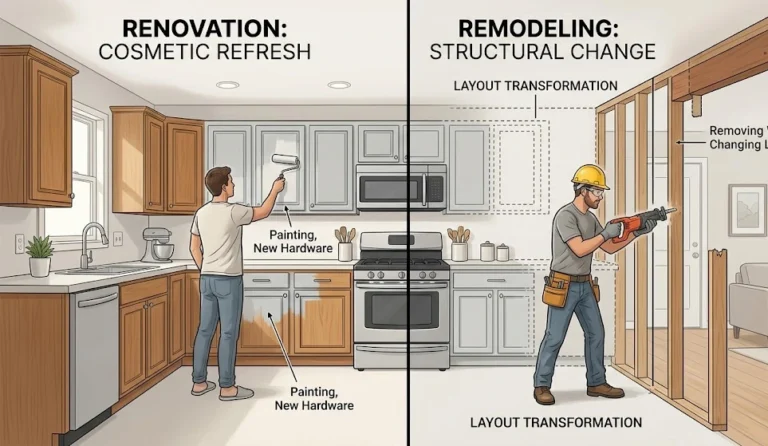
Renovation means updating, repairing, or restoring an existing space without changing its main layout or structure. Remodeling means changing how a space works, looks, or flows by altering the layout, structure, plumbing, electrical, HVAC, or room function. In simple terms, renovation refreshes what already exists. Remodeling reimagines the space.
A homeowner painting cabinets is renovating. A homeowner moving the sink, removing a wall, and changing the kitchen layout is remodeling. That difference affects cost, permits, timeline, resale value, and the type of contractor you need.
Here’s what nobody tells you at the start: the words matter less than the scope of work. Contractors, lenders, permit offices, and inspectors care about what you are changing, not what you call it.
A “quick bathroom renovation” can become a remodel the moment you move plumbing. A “kitchen refresh” can become a structural project if you remove a load-bearing wall. That is where budgets break.
In 2026, this matters even more. Material pricing is still uneven, borrowing costs are not cheap, energy incentives have changed, and many homeowners are improving homes instead of moving. NAHB says remodeling demand is supported by older homes, mortgage rate lock-in, and aging-in-place needs. (National Association of Home Builders)
Who is this Renovation vs Remodeling guide beneficial for?
This guide is useful if you are:
- A homeowner planning a kitchen, bathroom, basement, or whole-home project
- A seller deciding what to improve before listing
- A buyer comparing a fixer-upper with a move-in-ready home
- A landlord updating a rental property
- A homeowner searching “remodeling contractor near me” or “renovation contractor in my city”
- A family planning aging-in-place upgrades
- A local contractor writing better service pages
- A real estate investor trying to avoid over-improving a property
- A DIY homeowner unsure when permits are needed
What is the real difference between renovation and remodeling?
The real difference is scope. Renovation improves the existing condition. Remodeling changes the layout, structure, purpose, or systems of the space. A renovation makes a room feel newer. A remodel makes a room work differently.
Think of renovation as a better version of the same room.
Examples include:
- Painting walls
- Replacing flooring
- Refacing cabinets
- Installing new countertops
- Updating light fixtures
- Replacing a vanity
- Swapping old appliances
- Repairing damaged drywall
Now think of remodeling as a new version of the room.
Examples include:
- Removing a wall
- Moving a kitchen island
- Relocating plumbing
- Converting a garage into an office
- Turning a half bath into a full bath
- Finishing a basement
- Building an addition
- Reworking HVAC or electrical layouts
The simplest test is this:
Ask, “Will the room still work the same way after the project?”
If yes, you are probably renovating.
Ask, “Will the room work differently after the project?”
If yes, you are probably remodeling.
This is why Renovation vs Remodeling is not just a vocabulary debate. It affects the entire project plan.
Why do homeowners confuse renovation and remodeling?
Homeowners confuse renovation and remodeling because contractors, TV shows, real estate listings, and local markets use the words loosely. In everyday speech, both words often mean home improvement. In planning, permits, and budgeting, they are not the same.
Reddit discussions show the confusion clearly. Some users say Americans often use “remodel” and “renovation” almost interchangeably. Others define renovation as making a space new without changing layout, while remodeling changes the plan or structure. (Reddit)
That real language matters for SEO too.
A homeowner might search:
- “bathroom renovation near me”
- “bathroom remodel cost in Chicago”
- “kitchen renovation contractor in Atlanta”
- “home remodeling company near me”
- “do I need a permit to renovate my bathroom?”
The same person may use both words for the same project.
Here is my strong opinion: contractors should not fight the homeowner’s wording. They should clarify the scope.
Instead of saying, “That is not a renovation,” say:
“Are we keeping the same layout, or are we moving plumbing, electrical, walls, or fixtures?”
That one question saves money, time, and arguments.
Is renovation cheaper than remodeling in 2026?
Renovation is usually cheaper than remodeling because it keeps the layout, structure, and major systems in place. Remodeling often costs more because it can involve demolition, permits, licensed trades, engineering, inspections, and hidden conditions inside walls.
In 2026, cost planning needs more caution than it did a few years ago. The U.S. Bureau of Labor Statistics reported that final demand prices rose 4.0 percent over the 12 months ending March 2026, and goods prices were a major driver of the March increase. (Bureau of Labor Statistics)
NAHB also reported that inputs to new residential construction were up 4.2 percent year over year in late 2025, with metal products showing notable pressure. (National Association of Home Builders)
That affects renovation and remodeling differently.
A renovation is more exposed to finish pricing. Think cabinets, tile, flooring, doors, windows, paint, and hardware.
A remodel is exposed to finishes plus labor, framing, engineering, plumbing, HVAC, electrical, concrete, steel, lumber, and inspections.
Renovation cost behavior
Renovation costs are easier to control because fewer surprises hide behind the walls.
For example, replacing cabinet doors is predictable. Painting a room is predictable. Replacing a faucet is usually predictable.
The danger comes when “simple” work touches old systems.
A flooring change can expose subfloor damage. A tile upgrade can require structural reinforcement. A vanity replacement can reveal old shutoff valves that no longer work.
That is why even a renovation needs a contingency.
For cosmetic projects, plan a 10 percent buffer. For older homes, use 15 percent.
Remodeling cost behavior
Remodeling has more unknowns.
Open a wall and you may find bad wiring. Move a shower and you may need new drain slope. Remove a wall and you may need an engineer, beam, temporary supports, and inspections.
This is where homeowners get burned. They budget for the pretty part. Then the unpretty part eats the money.
A smart remodel budget includes:
- Design and planning
- Demolition
- Structural work
- Plumbing
- Electrical
- HVAC
- Insulation
- Drywall
- Finish materials
- Permit fees
- Inspections
- Waste removal
- Temporary living costs
- Contingency
Which adds more value: renovation or remodeling?
Renovation often delivers better short-term resale return because it costs less and improves visible appeal. Remodeling can add more lifestyle value and long-term function, but expensive remodels do not always return more money at resale.
This is the section many contractors avoid.
Not every remodel is a great investment.
A remodel may make your home much better for your family. That has real value. But resale ROI is not the same as personal usefulness.
Zonda’s 2025 Cost vs. Value Report shows smaller exterior-focused projects can recover very high resale value. Garage door replacement had a reported national average job cost of $4,672 and resale value of $12,507, while a minor kitchen remodel showed $28,458 in job cost and $32,141 in resale value. (Zonda)
That does not mean every garage door creates profit in every city. It means visible, buyer-friendly improvements can outperform expensive custom changes.
When renovation usually wins for resale
Renovation may be better if:
- You plan to sell within 12 months
- The layout already works
- Buyers in your area want move-in-ready condition
- You have a limited budget
- The home needs cosmetic freshness
- Your local market punishes outdated finishes
Good resale renovations include paint, cabinet refacing, flooring, lighting, entry door updates, exterior cleaning, and curb appeal work.
When remodeling wins for living
Remodeling may be better if:
- The layout frustrates you daily
- You need accessibility changes
- You need more storage
- Your kitchen workflow is broken
- You are adding a bathroom
- You are converting unused space
- You plan to stay for five years or longer
A remodel should solve a pain point. If it only follows a trend, slow down.
Do you need permits for renovation vs remodeling in your city?
Cosmetic renovation often does not require a permit, but remodeling often does when it changes structure, electrical, plumbing, mechanical systems, occupancy, or the home’s footprint. Permit rules vary by city, county, and state, so always check your local building department before work starts.
This is where local SEO and real life meet.
A San José city guide says cosmetic-only work like cabinets or countertops without utility changes typically does not require a permit, but remodels involving electrical, plumbing, mechanical, or structural changes do. (San José City)
Oregon’s building code division says permits are required for specific alterations to existing homes, including structural, plumbing, mechanical, and electrical changes. (Oregon)
So the permit test is not the word renovation. It is the work.
Permit red flags
You should check permits if the project includes:
- Removing or adding walls
- Moving plumbing fixtures
- Adding electrical circuits
- Upgrading an electrical panel
- Moving HVAC ducts
- Replacing or relocating a water heater
- Adding windows or doors
- Changing stairs
- Converting a garage
- Finishing a basement
- Building a deck
- Adding square footage
Here is the uncomfortable truth: skipping permits may feel cheaper until you sell, refinance, file an insurance claim, or deal with unsafe work.
A permit is not just paperwork. It is documentation that the work met minimum safety standards.
What about small bathroom renovations?
A bathroom paint and vanity update may not need a permit.
A bathroom gut with the same layout might need trade permits, depending on local rules.
A bathroom layout change almost always deserves a permit check.
The worst advice is “nobody will know.”
Someone may know later. It might be an inspector, buyer, appraiser, insurance adjuster, or your own contractor when the next project starts.
How do you decide between renovation and remodeling?
Choose renovation when the room already works but looks tired. Choose remodeling when the room fails your lifestyle, safety, storage, accessibility, or layout needs. The right choice depends on your goal, timeline, budget, and how long you plan to stay.
Use this decision framework.
Choose renovation if you say:
- “I like the layout, but it looks dated.”
- “I need this done quickly.”
- “I am preparing to sell.”
- “I want a cleaner, newer look.”
- “I have a limited budget.”
- “I do not want major disruption.”
Choose remodeling if you say:
- “This layout does not work.”
- “We need another bathroom.”
- “The kitchen flow is terrible.”
- “We need aging-in-place upgrades.”
- “We are staying long term.”
- “The home no longer fits our family.”
A remodel is not automatically better. It is just deeper.
The best home improvement decision is not the biggest one. It is the one that solves the real problem.
What are real examples of renovation vs remodeling?
A renovation keeps the same basic room and updates surfaces or fixtures. A remodel changes function, structure, layout, or systems. The same room can include both renovation and remodeling work.
Kitchen example
Renovation:
- Paint cabinets
- Replace cabinet hardware
- Install new backsplash
- Update countertops
- Replace lighting
- Keep the sink and appliances in place
Remodeling:
- Move the sink to an island
- Remove a wall
- Add a pantry
- Change appliance locations
- Expand into a dining room
- Rework plumbing and electrical
A kitchen renovation can take days or weeks.
A kitchen remodel can take months.
Bathroom example
Renovation:
- Replace vanity
- Install new mirror
- Paint walls
- Change light fixture
- Replace faucet
- Keep toilet, tub, and shower locations
Remodeling:
- Convert tub to walk-in shower
- Move toilet
- Add double vanity
- Change ventilation
- Expand into a closet
- Add heated floors with electrical work
Basement example
Renovation:
- Paint walls
- Replace flooring
- Add lighting fixtures
- Improve storage
Remodeling:
- Finish an unfinished basement
- Add bedroom and egress window
- Add bathroom
- Install new HVAC runs
- Create rental or in-law suite
This is why contractor estimates must define scope line by line.
What does Renovation vs Remodeling mean for local contractors near me?
For local contractors, the difference affects licensing, pricing, project management, and search visibility. Homeowners may search both words, but contractors should explain the scope clearly before quoting.
A contractor page that says “home renovation in Dallas” may attract someone who wants a full kitchen remodel.
A page that says “bathroom remodeling in New Jersey” may attract someone who only wants a cosmetic refresh.
The best local content should cover both terms, then guide the homeowner.
Example local heading:
“Kitchen Renovation vs Remodeling in Chicago: When Do You Need a Permit?”
That heading works because it answers a real local search question.
Another example:
“Bathroom Renovation vs Remodeling in Atlanta: Cost, Timeline, and Contractor Scope”
This format helps Google, AI Overviews, and voice search because it matches how people ask questions.
Local modifiers to use naturally
Use phrases like:
- in your city
- near me
- local building code
- city permit office
- county inspection
- licensed contractor
- local remodeling company
- home renovation contractor in [city]
- kitchen remodeler near [neighborhood]
Do not stuff city names. Use them where they help.
What should be in a renovation or remodeling contract?
A strong contract should define the exact scope, materials, allowances, payment schedule, permit responsibility, change-order process, warranty, timeline, and cleanup rules. The more detailed the contract, the fewer expensive arguments you will have.
This is one of the biggest competitor gaps.
Most articles explain the difference. Few explain how that difference enters the contract.
Your contract should answer:
- What is included?
- What is excluded?
- Who pulls permits?
- Who pays permit fees?
- What brands and models are included?
- What happens if hidden damage appears?
- How are change orders approved?
- Who handles inspections?
- What is the payment schedule?
- What warranty applies?
- Who removes debris?
- What are work hours?
- What happens if materials are delayed?
Watch allowance language
An allowance is a budget placeholder.
For example, your contract may include a $3,000 tile allowance. If you choose tile that costs $4,800, you pay the difference.
Allowances are not bad. Vague allowances are bad.
Ask for:
- Brand
- Model
- Quantity
- Finish
- Unit price
- Labor inclusion
- Delivery fees
That level of detail feels boring. It also protects your money.
Which tools help plan renovation vs remodeling?
The best tools help homeowners estimate cost, visualize scope, track decisions, and check code or incentive rules. No tool replaces a contractor, but the right tool can prevent vague conversations and weak estimates.
Here are useful tools and brands to consider.
| Tool or brand | Best use | Honest note |
| Zonda Cost vs. Value | Resale ROI research | Great for national and regional averages, not exact bids |
| ENERGY STAR Product Finder | Energy-efficient products | Useful for windows, HVAC, heat pumps, and appliances |
| IRS Form 5695 guidance | Tax credit filing history | Important for eligible 2025 projects and records |
| ICC Digital Codes | Code reference | Helpful, but local amendments still matter |
| Homewyse | Ballpark cost ranges | Good starting point, not a contractor quote |
| Houzz | Design inspiration and contractor discovery | Inspiration can inflate budgets fast |
| Buildertrend | Contractor project management | Best when contractor actually uses it well |
| CoConstruct | Selections and communication | Strong for design-build workflows |
| Bluebeam | Plan review and markup | More useful for pros than homeowners |
| Lowe’s and Home Depot calculators | Material planning | Convenient, but labor and code details are missing |
| XactRemodel | Professional estimating | Used in industry workflows, not casual DIY planning |
| Google Sheets | Budget tracking | Simple and surprisingly effective |
Zonda says its Cost vs. Value methodology uses real estate professional surveys and estimating data from Zonda’s collaboration with Verisk’s XactRemodel. (Zonda)
What 2026 energy and tax changes should homeowners know?
Homeowners should not assume 2026 projects qualify for the same federal energy credits as 2025 projects. The IRS states the Energy Efficient Home Improvement Credit applied for 2023 through 2025, with limits for heat pumps and other upgrades. ENERGY STAR also notes these credits were available through December 31, 2025.
This is a major update many older articles miss.
The IRS page last updated March 10, 2026 says the Energy Efficient Home Improvement Credit covered 2023 through 2025 at 30 percent, up to $1,200, with a separate $2,000 annual limit for heat pumps, biomass stoves, and boilers. (IRS)
ENERGY STAR states federal income tax credits for homeowners were available through December 31, 2025, allowing up to $3,200 for energy-efficient upgrades. (ENERGY STAR)
So what should a 2026 homeowner do?
Keep records if your project was placed in service in 2025.
For 2026 projects, check current federal, state, utility, and local rebate programs before assuming savings.
Energy upgrades still matter
Even without the same federal credit, energy upgrades may still be smart.
Consider:
- Heat pump integration
- Air sealing
- Insulation
- Efficient windows
- Electric panel capacity
- Smart thermostats
- Heat pump water heaters
- Better ventilation
Energy upgrades are not just green. They affect comfort, moisture, indoor air quality, and long-term operating cost.
What mistakes make renovation and remodeling projects fail?
Most projects fail because the homeowner starts with inspiration instead of scope. Beautiful photos do not define structural work, permits, utility changes, materials, labor, inspections, or hidden conditions.
Here are the mistakes I would warn any homeowner about.
Mistake 1: Asking for a quote too early
Do not ask, “How much to remodel my kitchen?”
Ask:
“Can you price two scopes, one keeping the layout and one moving the sink and range?”
That gives you a real comparison.
Mistake 2: Choosing the cheapest bid
The cheapest bid may exclude important items.
Look for missing details:
- Permits
- Demolition
- Disposal
- Subfloor repair
- Electrical upgrades
- Plumbing changes
- Drywall repair
- Painting
- Final cleaning
A low bid can become the most expensive bid after change orders.
Mistake 3: Not checking permit responsibility
Never assume the contractor is pulling permits.
Ask:
“Who pulls permits, whose name is on them, and who schedules inspections?”
Mistake 4: Ignoring how you live during the project
A bathroom renovation is annoying.
A kitchen remodel can disrupt meals for weeks.
A whole-home remodel can affect sleep, pets, work calls, school routines, and privacy.
Budget for life, not just labor.
How should you talk to a contractor about renovation vs remodeling?
Use clear scope language. Tell the contractor what you want to keep, what you want to change, what problems you need solved, and what budget range you want respected. Good contractors price scope, not vague dreams.
Use this script:
“I want to compare renovation vs remodeling options. Option one keeps the same layout and updates finishes. Option two changes the layout and may move plumbing or electrical. Can you help me understand the cost, permit, and timeline difference?”
That script makes you sound prepared.
It also tells the contractor you are not just collecting random numbers.
Ask these questions
- Is this project a renovation, remodel, or both?
- Do we need permits?
- Are any walls load-bearing?
- Will plumbing or electrical move?
- Do I need an architect or engineer?
- What hidden conditions are common in homes like mine?
- What is your change-order process?
- What brands are included?
- How long will the space be unusable?
- What can I do before work starts?
The best contractors welcome detailed questions. The wrong ones get defensive.
Is DIY renovation safer than DIY remodeling?
DIY renovation can be reasonable for painting, simple flooring, hardware, basic fixtures, and cosmetic updates. DIY remodeling is riskier because structural, electrical, plumbing, HVAC, and code work can affect safety, insurance, and resale.
DIY is not bad. Overconfidence is bad.
Good DIY renovation projects:
- Painting
- Installing shelves
- Replacing cabinet pulls
- Simple landscaping
- Peel-and-stick backsplash
- Basic trim repair
- Swapping door hardware
Risky DIY remodel work:
- Removing walls
- Electrical panel upgrades
- Moving gas lines
- Shower waterproofing
- Structural beams
- Stair changes
- Basement bedrooms
- Egress windows
The internet makes hard projects look easy because videos skip the panic.
They skip the part where the wall is open, the pipe is corroded, the store is closed, and your family wants the water back on.
If a mistake can cause fire, flood, structural failure, or failed inspection, hire a licensed pro.
What is the best planning checklist before you start?
Before starting, define your goal, classify the project, check permits, set a realistic budget, choose materials early, compare contractors, and create a contingency. Planning is cheaper than fixing mistakes during construction.
Use this checklist.
Step 1: Define the real goal
Write one sentence.
“I want this project because…”
Examples:
- We need better kitchen storage.
- We need a safer shower.
- We want to sell next spring.
- We need a bedroom for a parent.
- We want lower energy bills.
Step 2: Classify the work
Mark each item as renovation or remodeling.
Paint cabinets: renovation.
Move sink: remodeling.
Replace flooring: renovation.
Remove wall: remodeling.
Step 3: Check local permit rules
Use your city or county building department site.
Search:
“[your city] residential remodel permit”
“[your county] bathroom remodel permit”
Step 4: Build two budgets
Budget A: keep layout.
Budget B: change layout.
This is the smartest way to avoid regret.
Step 5: Add contingency
Use 10 percent for simple renovation.
Use 15 to 25 percent for remodeling, older homes, or hidden systems.
Step 6: Choose materials before demo
Late selections cause delays.
Pick tile, fixtures, cabinets, flooring, paint, hardware, and appliances early.
Step 7: Get detailed estimates
Compare scope, not just price.
A clear $42,000 estimate may be better than a vague $31,000 estimate.
FAQs about Renovation vs Remodeling
What is the difference between renovation and remodeling in simple words?
Renovation updates what is already there. Remodeling changes how the space works. Painting a bathroom is renovation. Moving the shower and toilet is remodeling.
Is a kitchen update a renovation or remodel?
It depends on the scope. New paint, counters, cabinet doors, and lighting are renovation. Moving appliances, plumbing, walls, or the island is remodeling.
Is bathroom remodeling worth it in 2026?
It can be worth it if it improves safety, function, storage, or resale appeal. If the layout already works, a bathroom renovation may offer better value than a full remodel.
Do I need a permit for a renovation?
Sometimes. Cosmetic work often does not need a permit, but structural, electrical, plumbing, and mechanical changes often do. Local rules decide.
Do I need a permit for remodeling?
Often, yes. Remodeling commonly changes layout, structure, plumbing, electrical, HVAC, or room use. Those changes usually require permit review.
Is renovation better before selling?
Often yes. Buyers usually respond well to fresh paint, clean flooring, updated lighting, curb appeal, and move-in-ready finishes. Major custom remodels may not return their full cost.
Is remodeling better if I plan to stay?
Usually, yes. If the home no longer fits your lifestyle, a remodel can improve daily life more than cosmetic updates.
Can a project be both renovation and remodeling?
Yes. A kitchen project may remodel the layout and renovate the finishes. Many real projects include both.
Why do contractors call everything remodeling?
Many do it because homeowners search that word. Others use it as a broad service category. Always ask what scope they mean.
What is the cheapest renovation with high impact?
Paint, lighting, cabinet hardware, entry door improvements, deep cleaning, and landscaping often create strong visual impact without major construction.
What is the biggest hidden cost in remodeling?
Hidden systems are the biggest risk. Old wiring, plumbing, water damage, framing problems, and code upgrades can raise costs after demolition.
Should I renovate or build new?
Renovate if the structure and layout mostly work. Remodel if the home needs functional change. Build new if the existing structure cannot support your goals.
Final takeaway: Should you renovate or remodel?
Renovation vs Remodeling comes down to one question: are you improving the current space, or changing how the space works?
If the layout is good, renovate.
If the layout is the problem, remodel.
If you are selling soon, be careful with expensive custom changes. If you are staying long term, focus on comfort, safety, energy performance, and daily function.
My strongest advice is simple: price the “keep the layout” option before you price the dream layout. Many homeowners discover they can get 80 percent of the benefit for far less money. Others discover the layout really is the problem.
Both answers are valid. Guessing is not.
2026 Material Watch
The next wave of Renovation vs Remodeling decisions will not be only about paint colors and open kitchens. Materials and systems are changing fast.
Watch these in 2026:
- Smart Glass: Dynamic glazing can control privacy, glare, and heat gain, but it still needs careful budget review.
- Heat Pump Integration: Heat pumps remain a major comfort and efficiency upgrade, especially when paired with insulation, air sealing, and panel planning.
- Recycled Steel Framing: Useful where strength, durability, and lower waste matter, but pricing can move with steel market volatility.
- Low-Carbon Concrete: More common in larger projects, but worth watching for additions and foundation work.
- Panelized and Modular Components: These can reduce site time when local code and design allow.
- Smart Ventilation: Better indoor air quality will matter more as homes become tighter and more energy efficient.