Matching Bathroom Fixture Finishes: A Homeowner’s Guide
Matching Bathroom Fixture Finishes When Your Shower, Faucet and Accessories Come From Different Brands
Most bathroom remodels do not use a single product line from one brand. The shower system comes from one place, the vanity faucet from another, and the towel bars, robe hooks and drain covers are picked up later. On the design board everything says “matte black” or “brushed gold.” Once it is installed, the shower column looks slightly warmer than the faucet, the black towel bar has a sheen the shower trim does not, and the drain cover is a different shade again.
Key Takeaways: Matching Bathroom Fixture Finishes
- Finish names are not standards. Two brands can both label a product “brushed nickel” or “matte black” and still produce visibly different colors because of the coating process, base material, texture, and gloss level.
- Polished chrome is the most forgiving finish when mixing brands. Gold, brass, rose gold, and gunmetal are the hardest to match because they vary the most between suppliers.
- Gloss level causes most black-finish mismatches. Two flat matte blacks usually pair well, while a satin black next to a flat black looks obviously different.
- Choose the shower system and vanity faucet first. Treat their finish as the reference and compare every other metal item (towel bars, hooks, drain covers, cabinet pulls) against them, not against catalog photos.
- Order physical samples and view them in your own lighting. Daylight and warm or cool bulbs change how brushed and gold finishes look.
- To mix finishes on purpose, use two finishes (three at most), assign one finish per function, and repeat each at least twice.
- Record the brand, model, and finish code of every fixture. This makes future replacement parts easier to match, though colored finishes can still vary between production batches.
This is one of the most common small disappointments in a remodel, and it is mostly avoidable. This guide explains why finishes vary, which combinations are forgiving, and the practical steps that keep a bathroom looking intentional rather than assembled from leftovers. If you are still planning your project, the Bathroom Budget Planner is a good place to set aside room in the budget for matching hardware before you start buying.
Why the “same” finish rarely matches
A finish name is a marketing label, not a standard. Two manufacturers can both call a product “brushed nickel” or “gunmetal” and still produce noticeably different colors. Several things drive the difference:
- The process. Chrome and many metallic colors are applied by electroplating or by PVD (physical vapor deposition). Black and white are often powder-coated or painted. A plated gold and a PVD gold can look alike in a photo and different side by side.
- The base material. A brass body, a zinc-alloy handle and an ABS plastic shower head can all be coated “chrome,” but light reflects off them differently because the surface underneath is different.
- The texture. Brushed finishes depend on the direction and depth of the brushing. A faucet brushed vertically and a shower arm brushed horizontally can read as two colors under the same light.
- Gloss level. “Matte black” covers everything from a flat, chalky look to a soft satin. The gloss level is usually what makes black pieces look mismatched, more than the color itself.
- Batch variation. Even within one brand, two production batches of a colored finish can drift slightly. That is why a replacement part ordered two years later sometimes stands out.
Which finishes are most forgiving
If you are mixing brands, some finishes are easier to keep consistent than others.
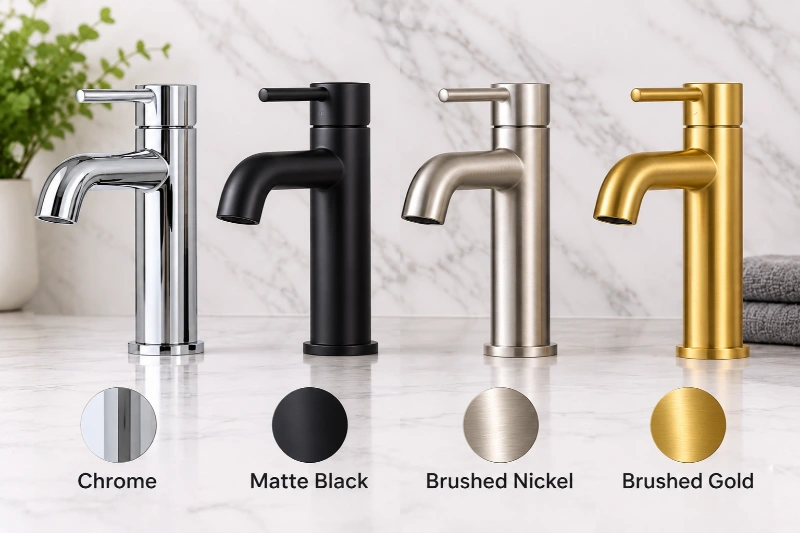
Polished chrome is the most forgiving. It is a mirror-like surface, so small differences in tone are hard to see, and almost every category of bathroom product is available in it.
Matte black is moderately forgiving if you match the gloss level. Put a satin black next to a flat black and the difference is obvious; two flat blacks from different makers usually sit together fine.
Brushed nickel and brushed stainless vary in warmth. Some lean gray, some lean slightly yellow. Keep them on separate walls if they do not match closely.
Gold, brass, rose gold and gunmetal are the hardest. These colored metallic finishes vary the most between suppliers, and the human eye is very sensitive to warm-tone differences. If your design depends on a gold or gunmetal look, plan to buy the main visible pieces from one source, or be ready to compare samples.
Practical steps before you buy
1. Decide which pieces are the “anchor”
The shower system and the vanity faucet are the largest, most visible metal items in most bathrooms. Choose these first and treat their finish as the reference. Everything else (towel bars, hooks, toilet paper holder, drain covers, cabinet pulls) should be compared against them, not against a catalog photo.
2. Get physical samples or swatches
Screens and product photography are not reliable for color. Many brands will send a finish chip or a small sample part. If they will not, order the cheapest item in the finish (a robe hook or a drain cover) and look at it next to your anchor piece in daylight and under your actual bathroom lighting. Warm white and cool white bulbs change how brushed and gold finishes look, and lighting choices such as those in our Best LED Bathroom Mirrors guide can shift how metal tones read in the room.
3. Match gloss as well as color
Hold the two items at an angle to the light. If one reflects a soft highlight and the other does not, they will look different on the wall even if the color is close. Ask the seller for the gloss description (matte, satin, semi-gloss) if it is not listed.
4. Separate close-but-not-identical pieces
If two items are almost the same, put physical distance between them. A towel bar on the opposite wall from the shower valve is far less noticeable than a hook directly beside the shower trim. Pieces that touch or sit on the same plane are where mismatches show.
5. Keep the documents
Write down the brand, model and finish code of each piece and keep the receipts. When a shower cartridge, hose or handle needs replacing later, you can order the same finish code instead of guessing. This matters more for colored finishes than for chrome.
Mixing finishes on purpose
Not every bathroom has to be one finish. Deliberate mixing can look good when it is clearly intentional:
- Use one finish per function. For example, all water-delivering fixtures (shower, faucet, tub spout) in brushed gold, and all accessories (bars, hooks, holders) in matte black.
- Repeat each finish at least twice. A single gold item in an otherwise black room looks like a mistake; two or three gold items look like a choice.
- Keep to two finishes, three at most. Beyond that, the room starts to look unplanned.
- Tie the finishes to something else in the room, such as a mirror frame, light fixtures or cabinet hardware, so the metal tones have a reason to be there.
The overall style of the room helps decide how much mixing works. Clean, restrained rooms usually look best with one or two finishes (see our Minimalist Bathroom Ideas ).
Cleaning and long-term appearance
Finishes wear differently, and care matters as much as the original color match:
- Use mild soap and a soft cloth. Abrasive pads and powder cleaners can scratch plated and brushed surfaces and dull matte coatings.
- Avoid strong acidic or chlorine-based cleaners on colored finishes unless the manufacturer says they are safe. Lime scale removers are a common cause of discolored gold and black fixtures.
- In hard-water areas, dry the shower head and handles after use or wipe them weekly. Mineral spots look worse on dark matte finishes than on chrome.
- Clean all the fixtures in the room the same way, so they age at a similar rate.
Towel bars and hooks take the most daily contact, so it also helps to choose towels and hardware together. Our Towel Buying Tips guide covers what holds up over years of use.
A note for contractors and remodelers
If you are fitting out several bathrooms, such as a rental property, a multi-unit build or a house with three or four bathrooms, finish consistency becomes a supply issue as well as a design issue. Order all the visible metal pieces for the project at the same time where possible, so they come from the same production run. If items must be ordered in stages, keep one approved sample of each finish on site and compare every delivery against it before installation. The approved physical sample, not the catalog photo or the finish name, is the reference that matters if a question comes up about color.
Quick checklist
- Pick the shower system and vanity faucet first and treat them as the reference finish.
- Compare every other metal item against those pieces, not against photos.
- Match gloss level as well as color, especially for black.
- Be most careful with gold, brass, rose gold and gunmetal.
- Put distance between items that are close but not identical.
- Record brand, model and finish code for future replacement parts.
- Clean all fixtures gently and in the same way.
A bathroom with fixtures from several brands can still look like one design. The difference is checking the finishes side by side before they go on the wall, rather than discovering the mismatch once the tiles are grouted.
Frequently asked questions
Do all bathroom fixtures have to be the same finish?
No. Fixtures that are seen together, such as the shower trim, tub spout and vanity faucet, look best in matching finishes. Accessories can differ if the mix is deliberate: one finish per function, each repeated at least twice, and no more than two or three finishes in the room.
Can you mix chrome and brushed nickel in the same bathroom?
Yes, but keep them apart. Chrome is mirror-bright and brushed nickel is soft and slightly warm, so they can look like a mistake when they sit side by side on the same wall. Placing them on separate walls or in separate zones, such as chrome at the shower and brushed nickel on cabinet hardware, makes the mix look intentional.
Why does matte black look different from one brand to another?
Usually because of gloss level. One maker’s matte black can be flat and chalky while another’s is a soft satin, and the coating type (powder coat or paint) and base material change how it reflects light. Compare the actual pieces at an angle in your own lighting before you buy.
Which bathroom fixture finishes are hardest to match?
Gold, brass, rose gold and gunmetal. These colored metallic finishes vary the most between suppliers, and the eye is very sensitive to warm-tone differences. Buy the main visible pieces from one source, or compare physical samples first.
Should the shower and the faucet match?
If they are visible in the same sightline, yes, they should match or be a clearly deliberate pairing. Treat the shower system and vanity faucet as the anchor pieces and match everything else to them.
How do I find a matching replacement part years later?
Record the brand, model and finish code of every fixture and keep the receipts. Finish codes let you reorder the same finish, though colored finishes can still vary slightly between production batches, so compare the new part to the installed one when it arrives.
About the contributor: This article was contributed by the Quality Sanitary Ware Team. Quality Sanitary Ware is a sourcing and trading company in Ningbo, China, founded in 2011, that supplies shower sets, shower heads and mixers to wholesale and OEM/ODM buyers. With 15 years of industry experience, the team handles sourcing, factory audits, quality control, sampling and consolidated shipping for its customers.