Minimalist Bathroom Ideas: Less Clutter, More Calm
What Is a Minimalist Bathroom?
A minimalist bathroom is a design approach that pares the space down to essential fixtures, a restrained color palette, and concealed storage, so the room reads as calm and spacious rather than busy. It favors clean lines and natural materials over decorative excess, though the strongest 2026 versions avoid feeling cold or sterile.
Minimalism is often confused with related styles. Scandinavian design shares the same restraint but leans on pale wood and soft textiles; Japandi blends Japanese wabi-sabi with Scandinavian simplicity, favoring imperfect, natural materials. True minimalism is style-agnostic — it’s a discipline of subtraction that can be applied to a spa-like primary bath or a 40-square-foot powder room alike.
Takeaway: Minimalist doesn’t mean bare — it means every material, fixture, and storage decision earns its place.
A cluttered vanity is one of the fastest ways to make an entire bathroom feel chaotic — and it’s exactly why minimalist bathroom ideas have become one of the most-searched renovation topics of 2026. Homeowners aren’t just chasing a trend; they’re responding to real fatigue with over-stuffed counters and bathrooms that function more like storage closets than places to reset. The good news is that a minimalist bathroom doesn’t require gutting your space or spending a fortune. It requires intentional choices: a restrained palette, smart storage, water-efficient fixtures, and a floor plan that breathes. This guide walks through the design principles, materials, layouts, and budget-by-budget strategies that define minimalist bathrooms in 2026, grounded in current data from the National Kitchen & Bath Association, the EPA, and leading remodeling cost reports.
Why Minimalist Bathroom Design Is Dominating 2026
Bathroom design is shifting toward calmer, less ornamented spaces, but the data shows this isn’t a stark, all-white revival. According to the NKBA | KBIS 2026 Bath Trends Report — based on a survey of nearly 700 designers, remodelers, and manufacturers — contemporary and modern minimalist styles were named a popular direction for the next three years by 57% of respondents, trailing only transitional/timeless design (70%) and organic/natural styles (65%). The same report found that 72% of respondents said bathrooms are growing in footprint to make room for wellness-centered layouts, universal design, and better storage — all core minimalist priorities.
From Stark White to Warm Minimalism
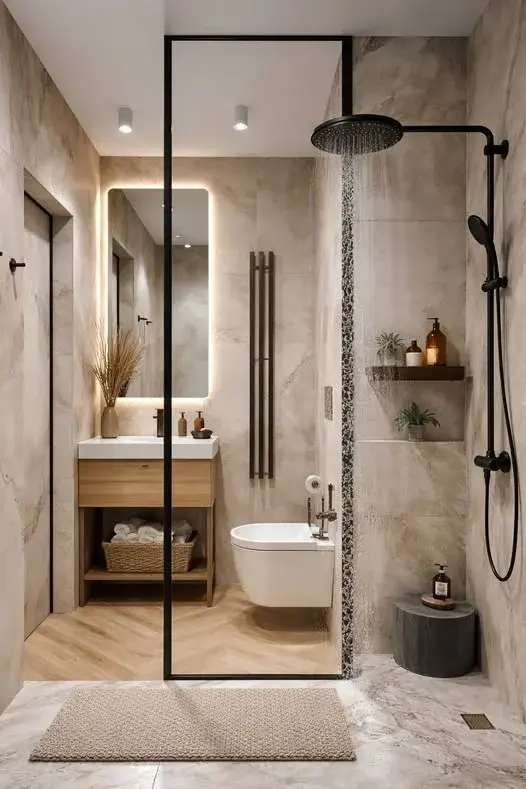
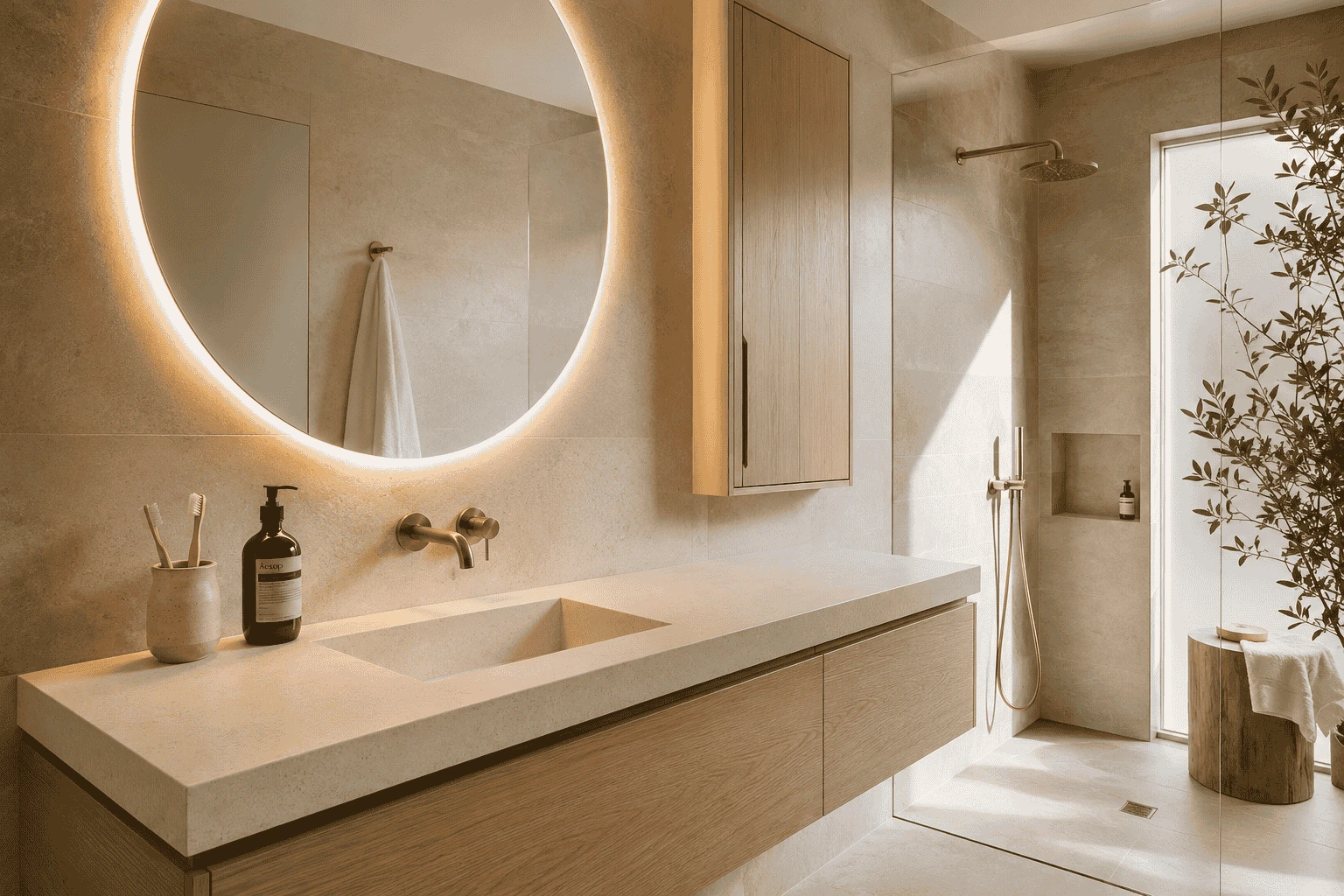
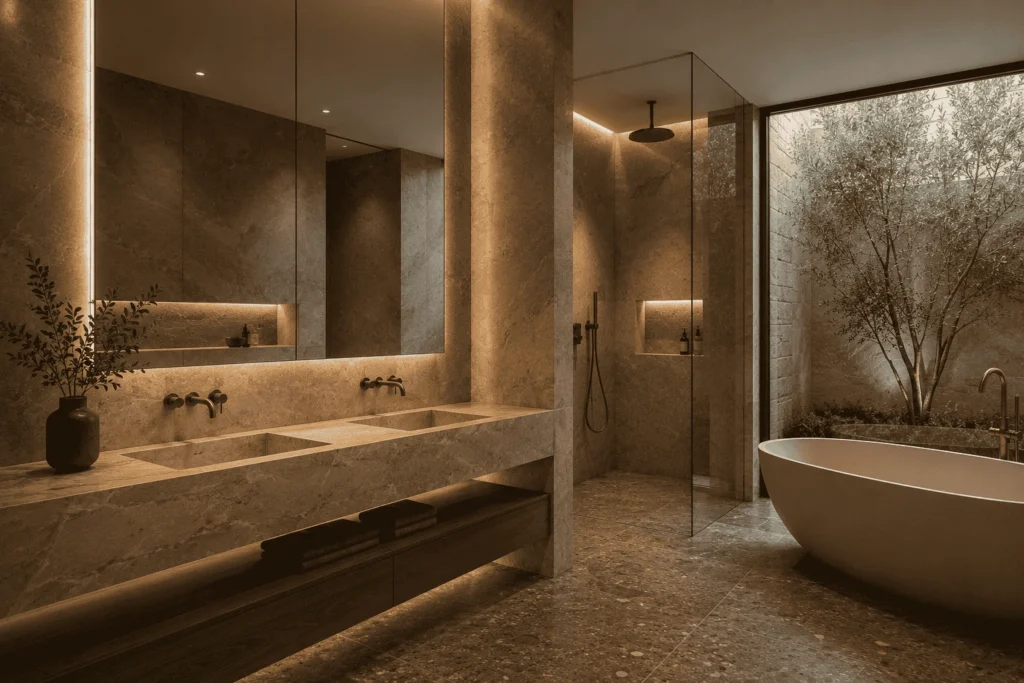
The defining shift in 2026 is warmth. Rather than the cold, glossy white minimalism of the last decade, designers are describing an ‘organic minimalist’ or ‘warm minimalist retreat’ aesthetic that swaps sharp contrast for soft taupe, brushed brass, and creamy natural stone. This lines up with NKBA’s material findings: wood-faced vanities have overtaken painted cabinetry in popularity (62% vs. 53%), reflecting a broader biophilic push toward natural, tactile finishes even within pared-down layouts.
Takeaway: 2026’s minimalist bathrooms are quieter, not colder — the goal is calm, not clinical.
Core Principles of a Minimalist Bathroom
A Restrained Color Palette
Neutrals remain the foundation of minimalist bathroom design. NKBA’s survey found 96% of respondents identify neutrals as the most popular bath color family, led by off-white (58%), light brown/tan (54%), and white (40%). Brown-based greens are the strongest accent color moving into the space, with sage favored by 64% of respondents and olive by 43%, well ahead of bolder hues like teal or emerald.
Concealed, Purposeful Storage
Every item that stays on a counter is a decision the room has to visually accommodate. Minimalist bathrooms rely on floating vanities, recessed medicine cabinets, and drawer organizers so surfaces stay clear without sacrificing storage capacity.
One Material, Used Confidently
Rather than mixing several accent materials, the strongest minimalist bathrooms pick one texture — a fluted tile, a slab of natural stone, a wood-grain vanity — and let it carry the room. Layering more than two contrasting textures tends to undercut the calm a minimalist space is built to create.
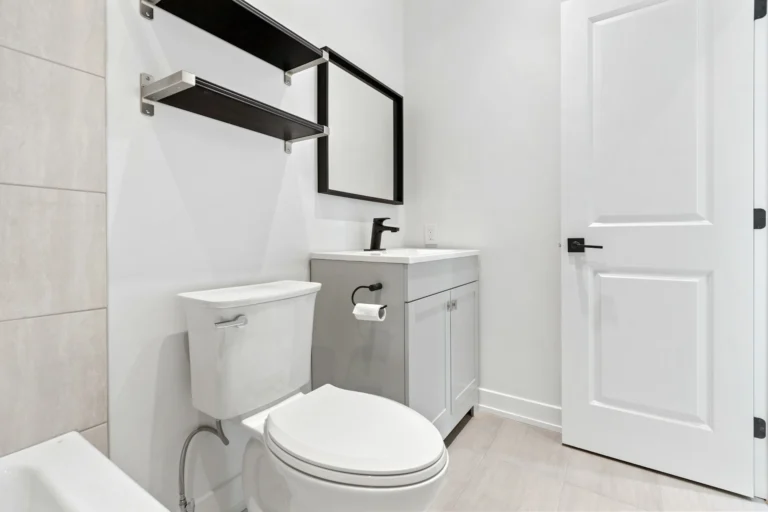
What fixtures does a minimalist bathroom need? At minimum: a wall-hung or floating vanity, a concealed or single-lever faucet, a frameless or minimal-frame shower enclosure, and a toilet with a clean silhouette (wall-hung or skirted). Anything beyond that should be storage-driven, not decorative.
Minimalist Bathroom Layout & Space Planning
Layout is where minimalism becomes functional rather than purely aesthetic. Aging-in-place and universal design elements — once viewed as purely clinical — are now considered mainstream in bathroom design: 32% of NKBA survey respondents say aging-in-place is already mainstream and another 48% say it’s approaching that status. Wide doorways, curbless showers, and barrier-free entries all support the open, uncluttered floor plan minimalism depends on, while also improving long-term usability.
| Feature | Small Bathroom (Powder/Guest) | Primary/Large Bathroom |
| Vanity | Small floating vanity or pedestal sink to keep sightlines open | Double floating vanity with concealed storage below |
| Shower/Tub | Prioritize a walk-in shower over a tub if space is tight | Curbless walk-in shower; freestanding tub only if space allows |
| Storage | Recessed niche, mirrored medicine cabinet | Built-in linen tower, drawer organizers, concealed hamper |
| Lighting | One well-placed vanity light plus a ceiling fixture | Layered lighting: ambient, task, and accent |
Takeaway: Minimalism scales — the principles of clear sightlines and concealed storage matter as much in a 35-square-foot powder room as a primary suite.
Best Materials & Finishes for a Minimalist Bathroom
Natural Stone and Large-Format Tile
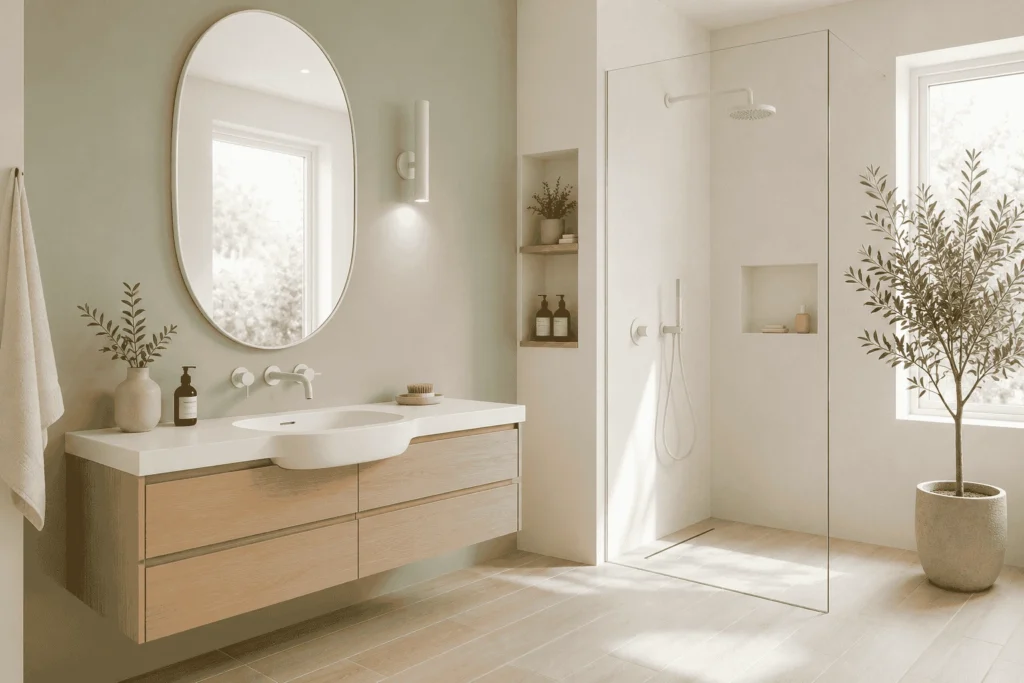
Large-format tile reduces grout lines, which keeps surfaces visually quiet and easier to clean — both minimalist priorities. Natural stone (or stone-look porcelain) surfaces continue to anchor the ‘warm minimalist’ look for 2026, often used on a single feature wall rather than throughout the room.
Wood-Faced Vanities
As noted above, wood-faced cabinetry has overtaken painted finishes in NKBA’s 2026 survey (62% vs. 53%), and it’s a natural fit for minimalist design because a single wood tone reads as calm and unified rather than busy.
Matte and Brushed Metal Finishes
Polished chrome no longer reads as the default minimalist finish. NKBA data shows matte (54%), brushed (51%), and satin (46%) faucet finishes all outperforming polished (39%) — flatter finishes photograph and read as quieter, with less glare and fewer visible water spots.
Water-Efficient Fixtures: The Sustainable Side of Minimalism
Minimalism and sustainability overlap more than most homeowners realize. A pared-down fixture package is also, in most cases, a more water-efficient one. The EPA’s WaterSense program certifies fixtures that use at least 20% less water while matching or beating standard performance.
| Fixture | Water Savings | Typical Cost Savings |
| WaterSense toilet | Up to ~13,000 gal/year vs. an old, inefficient toilet | ~$170/year; ~$3,400 over the toilet’s lifetime |
| WaterSense showerhead | About 2,700 gal/year (max 2.0 gpm vs. 2.5 gpm standard) | ~$70/year in water and energy costs |
| WaterSense faucet/aerator | 30%+ reduction in sink flow rate | Up to $250 over the fixture’s lifetime |
| Full WaterSense bathroom retrofit | Can pay for itself in as little as one year | Compounds across toilet, shower, and faucet savings |
For sourcing and specifics on certified fixtures, the EPA WaterSense program maintains a searchable directory of labeled toilets, showerheads, and faucets.
Takeaway: A minimalist fixture package that leans on WaterSense-labeled products can pay for itself within a year on water and energy savings alone.
Smart Storage Solutions That Keep a Bathroom Clutter-Free
- Floating vanities with soft-close drawers instead of open shelving
- Recessed (in-wall) medicine cabinets rather than surface-mounted ones
- Drawer organizers and dividers sized to actual toiletries, not generic bins
- A single, well-edited display shelf instead of scattered counter items
- Concealed laundry hampers built into cabinetry rather than freestanding baskets
Storage planning is also where a minimalist remodel is most likely to go wrong without professional input — cabinetry that looks sleek but doesn’t match how a household actually stores toiletries creates clutter within months. Working from a professional bathroom remodeling guide before finalizing cabinetry can help match the storage plan to daily habits rather than just the showroom look.
Minimalist Bathroom Color Palettes for 2026
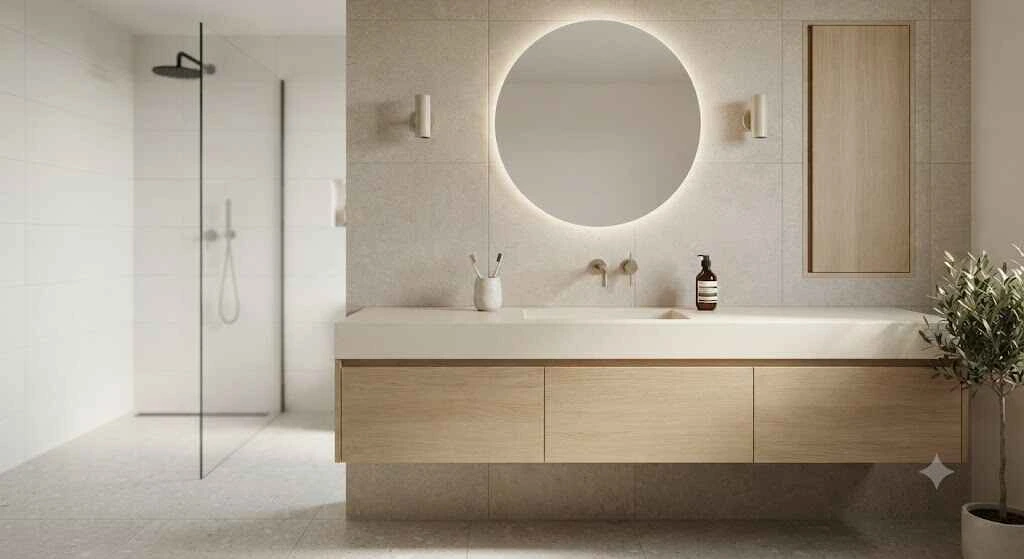
Stick to one dominant neutral (off-white, warm white, or light greige), one warm wood or stone tone, and — if desired — one muted accent such as sage or olive green. NKBA’s data shows this combination reflects where the industry consensus is heading: light neutrals for walls and surfaces, natural wood for cabinetry, and brown-based greens as the primary accent color for 2026, ahead of bolder blues or teals.
Common Minimalist Bathroom Mistakes to Avoid
- Over-styling with three or more competing textures (tile, stone, wood grain, patterned wallpaper)
- Choosing open shelving without a realistic plan for what stays visible day to day
- Prioritizing a trendy fixture finish over durability and easy maintenance
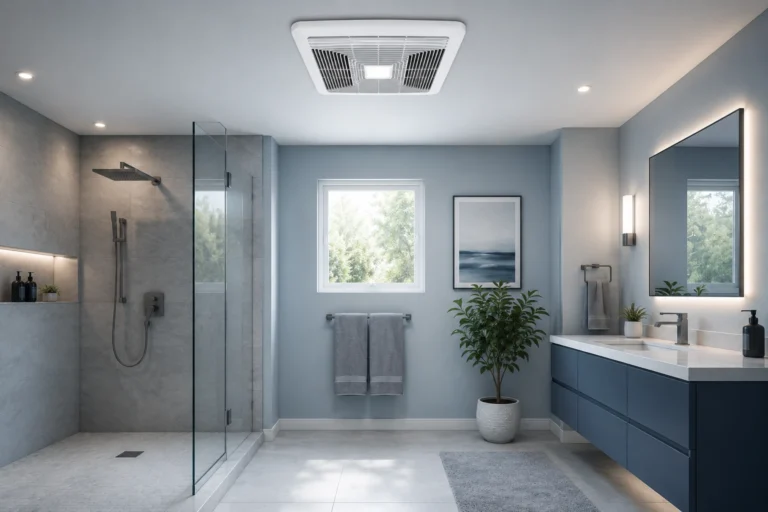
- Skipping ventilation upgrades — a minimalist bathroom still needs proper moisture control
- Going so stark and cold that the room feels clinical rather than calming
Minimalist Bathroom Ideas by Budget
Minimalist design is achievable at every price point — the difference is scope, not philosophy. National 2026 cost data puts a full bathroom remodel between roughly $6,456 and $24,715 for spaces of 40–150 square feet, according to a 2026 homeowner survey conducted by This Old House.
| Tier | Typical Cost (2026) | What’s Included | Typical ROI |
| Cosmetic refresh | $2,000–$6,500 | New vanity, fixtures, paint, hardware, re-caulking; same layout | 71–86% |
| Mid-range remodel | $15,000–$30,000 | New tile, glass shower enclosure, quality cabinetry, updated plumbing fixtures | ~74–80% |
| High-end remodel | $30,000–$75,000+ | Custom cabinetry, natural stone, heated floors, layout changes, smart fixtures | 36–55% |
Mid-range projects consistently deliver the strongest return: a midrange bathroom remodel returns roughly 80% of its cost at resale, the highest since 2007, according to industry Cost vs. Value Report data cited by This Old House, while high-end remodels typically return closer to 36–55%, since luxury finishes rarely command a dollar-for-dollar premium at resale.
Cost & ROI of a Minimalist Bathroom Remodel
ROI figures vary somewhat by source and market, but the pattern across 2026 reporting is consistent: modest, well-executed remodels outperform luxury ones on a percentage-return basis. Separate 2026 analysis from Opendoor, drawing on Cost vs. Value data, found a national midrange 5×7 bathroom remodel costs around $26,138 and adds about $20,910 in resale value — an 80% return — compared with roughly 42% for an upscale remodel with the same footprint.
Because scope has such a large effect on return, it’s worth getting a personalized remodeling estimate before deciding between a cosmetic refresh and a full mid-range remodel — the right tier depends on how long you plan to stay in the home and the comparable homes in your market.
Step-by-Step: Planning Your Minimalist Bathroom Remodel
- Audit current clutter and storage needs before choosing any fixtures — design storage around real habits, not aspirational ones.
- Set a budget with a 10–15% contingency for plumbing or structural surprises, which affected about 1 in 3 homeowners in 2026 surveys.
- Choose one dominant material or texture to anchor the room instead of layering several.
- Select WaterSense-labeled fixtures for the toilet, showerhead, and faucet to reduce both water use and long-term utility costs.
- Plan layered lighting — ambient, task, and accent — rather than a single overhead fixture.
Hire a licensed professional for plumbing and electrical work, and confirm permits are pulled where required. A bathroom remodeling specialist can flag layout or waterproofing issues before they become the hidden costs homeowners report most often.
Frequently Asked Questions
What is a minimalist bathroom?
A minimalist bathroom uses a restrained color palette, essential fixtures, and concealed storage to create a calm, clutter-free space. It emphasizes clean lines and natural materials over decorative extras.
Is minimalist bathroom design expensive?
No — minimalism is a design discipline, not a price point. A cosmetic refresh with a new vanity, fixtures, and paint can achieve a minimalist look for roughly $2,000–$6,500, while full remodels scale up from there.
What colors work best for a minimalist bathroom?
Light neutrals dominate: off-white, light tan/brown, and white are the three most popular bath colors in 2026 industry surveys, often paired with a muted accent like sage or olive green.
How do I make a small bathroom look minimalist?
Use a floating or pedestal vanity to keep sightlines open, choose large-format tile to minimize grout lines, and rely on a recessed medicine cabinet instead of surface-mounted storage.
What’s the difference between minimalist and Scandinavian bathroom design?
Minimalism is a broader discipline of subtraction and restraint. Scandinavian design shares that restraint but leans specifically on pale wood tones and soft textiles; Japandi blends it with Japanese wabi-sabi materials.
Do minimalist bathrooms need to be all white?
No. The 2026 trend is toward ‘warm minimalism’ — soft taupe, cream, and light wood tones rather than stark, cold white, which many designers now consider dated.
What storage works best in a minimalist bathroom?
Floating vanities with soft-close drawers, recessed medicine cabinets, and sized drawer organizers outperform open shelving, which requires constant curation to stay visually calm.
Are floating vanities practical?
Yes, when paired with adequate drawer storage. Floating vanities visually open up a room and make floor cleaning easier, but they should be sized to actual storage needs, not chosen for looks alone.
What fixtures save the most water in a bathroom remodel?
WaterSense-labeled toilets offer the largest single savings, up to about 13,000 gallons per year versus an old, inefficient model, followed by WaterSense showerheads and faucet aerators.
How much does a minimalist bathroom remodel cost in 2026?
National data puts most bathroom remodels between $6,456 and $24,715 for 40–150 square-foot spaces, with cosmetic refreshes starting around $2,000 and high-end remodels exceeding $30,000.
What is the ROI on a minimalist bathroom remodel?
Mid-range remodels — the scope most aligned with minimalist design — return roughly 74–80% of cost at resale in 2026 industry data, outperforming both bare cosmetic updates and high-end luxury remodels on a percentage basis.
How do I keep a minimalist bathroom clutter-free long term?
Build storage around your household’s actual daily items before finalizing cabinetry, and limit counter display to one or two objects. Concealed storage does more long-term work than willpower.
Conclusion
Minimalist bathroom design in 2026 isn’t about doing less for its own sake — it’s about making every material, fixture, and storage decision count, from a wood-faced vanity to a WaterSense-labeled showerhead. Whether you’re planning a weekend refresh or a full remodel, Home Renova Hub has more bathroom remodeling guides to help you plan the next step with confidence.