Best Bathroom Faucets for Every Sink, Style, and Budget
A bathroom faucet can look perfect online and still be wrong for your sink. The mounting holes may not match, the spout may barely reach the basin, or the water stream may hit at an angle that splashes your countertop every morning.
The best bathroom faucets solve those practical problems while also fitting your room’s style and budget. A good choice should be comfortable to operate, easy to clean, efficient with water and supported by readily available replacement parts.
This guide compares ten strong options for American homes. It also explains exactly what to measure before buying, which certifications matter and how to choose among single-hole, centerset, widespread and vessel-sink designs. Whether you are replacing one outdated fixture or following a complete bathroom remodeling guide, the goal is the same: choose a faucet you will not regret after installation.

What Are the Best Bathroom Faucets Right Now?
The best bathroom faucet depends on your sink configuration and daily needs. Delta Nicoli is a strong all-around widespread choice, Moen Rinza suits buyers concerned about visible fingerprints, Pfister Rancho offers approachable value, and Delta Trinsic works well in minimalist bathrooms. Vessel sinks require a properly sized tall faucet such as the Delta Trinsic Vessel model.
Quick comparison
| Faucet | Best for | Configuration | Listed flow rate | Important consideration |
| Delta Nicoli | Best overall widespread option | 3-hole widespread | 1.2 GPM | Confirm 6–16-inch hole spacing |
| Moen Rinza | Easier everyday cleaning | Single-hole or widespread versions | 1.2 GPM on selected versions | Spot resistance does not prevent mineral deposits |
| Kohler Desette | Modern value | Single-hole | 1.2 GPM | Verify whether a deck plate is included |
| Pfister Rancho | Budget-friendly widespread setup | 3-hole widespread | 1.2 GPM | Compare included installation components |
| Delta Trinsic | Premium minimalist design | Single-hole | 1.2 GPM | Slim styling may not suit every traditional room |
| American Standard Townsend | Traditional and transitional rooms | 3-hole widespread | 1.2 GPM | Requires more countertop space |
| Pfister Jaida | Waterfall-style appearance | Single-control | 1.2 GPM | Open-channel spouts need regular wiping |
| Delta Trinsic Vessel | Above-counter vessel sinks | Tall single-hole | 1.2 GPM | Measure vessel rim and spout position carefully |
| Delta Sparrow | Flexible replacement projects | 1- or 3-hole, 4-inch setup | 1.2 GPM | Deck plate affects the finished appearance |
| Kohler Simplice | Premium widespread installation | 3-hole widespread | 1.2 GPM | Higher-cost positioning than basic models |
Flow rates and installation details can vary by exact model number and regional version. Always verify the manufacturer’s specification sheet before ordering.
How We Selected These Bathroom Faucets
We evaluated faucet configuration, spout geometry, listed flow rate, water-efficiency information, handle usability, finish options, certification details, installation requirements, manufacturer support and evidence from reputable independent testing. Home Renova Hub did not conduct hands-on laboratory testing for this article, so no product is presented as personally tested.
This distinction matters. Many online “best” lists imply first-hand experience even when their recommendations are based only on retailer descriptions. Our shortlist combines:
- Current manufacturer specifications
- WaterSense and efficiency information
- Installation compatibility
- Independent editorial testing where available
- Drain, deck-plate and supply-line considerations
- Maintenance requirements
- Suitability for common bathroom layouts
Better Homes & Gardens reported evaluating ten faucets over six months and selected the Delta Nicoli as its leading overall model. The Spruce has also published in-home faucet testing that considers installation, operation, cleaning and design. Those findings are useful, but they should still be combined with measurements from your actual sink. (Better Homes & Gardens)
1. Delta Nicoli: Best Overall Widespread Bathroom Faucet
The Delta Nicoli is a well-rounded choice for homeowners who want a clean transitional design, separate hot and cold handles and flexible widespread installation. Selected widespread models support three-hole installations with adjustable spacing and a water-saving 1.2 GPM flow rate.
The Nicoli works particularly well on a primary-bath vanity where there is enough countertop space for three separate components. Its shape is modern without being so distinctive that it becomes difficult to coordinate with mirrors, lighting and cabinet hardware.
Delta lists selected Nicoli widespread models for three-hole installations with centers ranging from 6 to 16 inches. That flexibility makes the faucet useful for new countertops as well as many existing widespread sinks. (Delta Faucet)
Pros
- Flexible widespread hole spacing
- Balanced modern-transitional appearance
- Separate temperature controls
- Selected as a leading model in extended independent testing
- Water-efficient 1.2 GPM specification on current versions
Cons
- Requires three holes and more installation space
- Two handles take longer to clean than one
- Exact included parts differ by model and retailer
Best for: Primary bathrooms, double vanities and homeowners who prefer separate handles.
2. Moen Rinza: Best for an Easier-Care Finish
Moen Rinza is a practical choice for busy bathrooms because selected Spot Resist finishes are designed to reduce the appearance of fingerprints and water spots. Current widespread versions also list a 1.2 GPM flow rate, WaterSense compliance, ADA-related usability and adjustable 8–16-inch installation spacing.
Spot-resistant does not mean hard-water-proof. Dissolved calcium and magnesium can still leave mineral deposits when water dries on any faucet. However, a brushed, spot-resistant surface can make ordinary fingerprints and light spotting less noticeable than a mirror-like finish.
Selected Moen Rinza widespread listings include a drain assembly and carry the company’s limited lifetime warranty for residential use. Confirm those details for the exact model before purchase. (Lowe’s)
Pros
- Finish helps reduce the visibility of fingerprints and water spots
- Contemporary shape
- WaterSense-listed versions
- Adjustable widespread installation
- Single-handle and widespread choices are available
Cons
- Mineral buildup still requires cleaning
- Different Rinza versions have different installation requirements
- Spot Resist finish choices may cost more than basic chrome
Best for: Family bathrooms, high-touch vanities and homeowners who dislike constant polishing.
3. Kohler Desette: Best Modern Value
The Kohler Desette combines a streamlined single-handle layout with a current 1.2 GPM flow specification. It is a good option for smaller vanities or modern bathrooms where users want simple temperature control and less surface area to clean.
A single-handle faucet is often easier to operate with one hand than a two-handle widespread design. It also leaves more open counter space around the sink, which can make a compact bathroom feel less crowded.
Kohler offers Desette models in more than one configuration, so buyers should distinguish between the single-control and widespread products before ordering. The single-handle version is the more space-efficient choice. (kohler)
Pros
- Compact single-handle design
- Easy temperature adjustment
- Contemporary shape
- Water-efficient listed flow
- Less hardware to wipe around
Cons
- A single-handle design provides less independent hot-and-cold control
- A deck plate may be necessary for an existing three-hole sink
- Included accessories should be checked by model number
Best for: Guest bathrooms, apartments and modern compact vanities.
4. Pfister Rancho: Best Budget-Friendly Widespread Faucet
Pfister Rancho is a sensible value choice for shoppers who want the appearance and separate controls of a widespread faucet without immediately moving into a luxury price category. Current versions list a 1.2 GPM flow rate and WaterSense qualification.
The Rancho’s advantage is not an unusual technology. It is the combination of familiar styling, common widespread sizing and mainstream manufacturer support. That makes it easier to consider for a straightforward vanity update.
Pfister lists both widespread and single-control Rancho configurations. The widespread model suits a three-hole countertop, while the single-control version is better for a compact setup. (Pfister US)
Pros
- Accessible entry point for a widespread design
- WaterSense-listed versions
- Familiar styling
- Separate hot and cold controls
- Brand-backed replacement support
Cons
- Finish and component selection vary by version
- Not as visually distinctive as premium designer faucets
- Widespread installation takes longer than a single-hole setup
Best for: Budget-aware remodels, rental refreshes and traditional three-hole vanities.
5. Delta Trinsic: Best Premium Minimalist Faucet
Delta Trinsic is a strong premium option for bathrooms built around clean lines and minimal visual clutter. Its single-hole models offer a slim profile, single-handle control and a listed 1.2 GPM flow rate.
Trinsic works best when the rest of the room uses similarly restrained shapes. It can coordinate well with frameless mirrors, floating vanities, simple sconces and modern cabinet pulls.
The collection includes standard-height, widespread and vessel-sink versions. That range is useful for maintaining a consistent design across multiple bathrooms, but it also means buyers must verify the exact height and installation type. (Delta Faucet)
Pros
- Refined minimalist styling
- Compact single-hole installation
- Multiple configurations within the collection
- Ceramic-disc technology on selected models
- Water-efficient listed flow
Cons
- Premium positioning
- Slim contemporary styling may look out of place in ornate bathrooms
- Exact model selection is important because dimensions vary
Best for: Modern primary baths, floating vanities and coordinated whole-home renovations.
6. American Standard Townsend: Best Traditional Choice
The American Standard Townsend is a good fit for homeowners who prefer architectural details and a more traditional or transitional appearance. Current widespread models combine three-hole installation, a high-arc profile and a 1.2 GPM flow rate.
Townsend works especially well with Shaker-style cabinetry, framed mirrors and classic lighting. The design adds more visual weight than a thin modern faucet, making it suitable for larger vanities.
A high arc provides useful hand clearance, but faucet height should still be checked against medicine cabinets, shelves and shallow basins. (American Standard)
Pros
- Traditional architectural character
- Separate hot and cold controls
- Useful clearance under the spout
- Water-efficient listed flow
- Established manufacturer
Cons
- Requires more counter space
- More detailed surfaces can take longer to clean
- May overpower a very small vanity
Best for: Traditional homes, transitional bathrooms and furniture-style vanities.
7. Pfister Jaida: Best Waterfall-Style Faucet
Pfister Jaida is designed for shoppers who want a distinctive open-channel or trough-like water presentation. Selected single-control versions support one- or three-hole installation, include a deck plate and list a 1.2 GPM WaterSense flow rate.
The open spout can become a visual focal point in a powder room. However, it also exposes more of the water channel, so dried droplets and mineral residue may be more visible than on a closed spout.
Pfister lists ADA-related usability and NSF/ANSI/CAN 61 compliance on selected Jaida models. Match the exact model number to those specifications instead of assuming every finish or version is identical. (Pfister US)
Pros
- Distinctive waterfall-like appearance
- Selected models fit one- or three-hole sinks
- Deck plate included on certain versions
- WaterSense-listed flow
- Single-handle operation
Cons
- Open channel needs regular wiping
- Mineral deposits may be more visible
- Water stream must be carefully aligned with the basin
Best for: Powder rooms, decorative vanities and homeowners who want a statement faucet.
8. Delta Trinsic Vessel: Best Faucet for a Vessel Sink
The Delta Trinsic Vessel faucet is made for above-counter vessel basins that require additional spout height. It offers the collection’s minimalist appearance in a taller format and lists a 1.2 GPM flow rate.
A vessel faucet should not be selected by height alone. The spout must clear the vessel rim while placing the water stream near the basin’s drain area. A stream that lands too close to the side wall can create noise and splashing.
Measure from the countertop to the vessel rim, then compare that measurement with the faucet’s spout height and reach. Also leave enough room behind the handle for full movement. (Delta Faucet)
Pros
- Designed for above-counter basins
- Clean single-handle layout
- Coordinates with other Trinsic fixtures
- Water-efficient listed flow
- Tall profile provides vessel clearance
Cons
- Incorrect placement can cause splashing
- Not intended for a standard drop-in sink
- Taller fixtures become more visually prominent
Best for: Vessel basins and modern spa-style vanities.
9. Delta Sparrow: Best Flexible Replacement Faucet
The Delta Sparrow is a useful replacement option because selected single-handle models can fit a single-hole sink or a three-hole, 4-inch configuration when used with the appropriate deck plate. That flexibility can help cover unused holes without replacing the sink or countertop.
This is particularly valuable in an older bathroom where the owner wants a single-handle faucet but already has a compact three-hole sink. The deck plate creates a finished appearance over the unused openings.
The current model information lists a 1.2 GPM flow rate. Check the deck plate width against the existing sink surface, especially when the old faucet has left discoloration or marks. (Delta Faucet)
Pros
- Works with common replacement layouts
- Can cover compact unused holes
- Single-handle control
- Water-efficient listed flow
- Straightforward contemporary appearance
Cons
- A deck plate creates a different look from a true single-hole installation
- It may not cover widely spaced holes
- Existing surface marks may remain visible
Best for: Quick faucet replacements and four-inch three-hole sinks.
10. Kohler Simplice: Best Premium Widespread Installation
Kohler Simplice is a polished widespread option for buyers who value a well-documented installation system, established brand support and certification details. Current specifications list 8–16-inch centers, a 1.2 GPM flow rate, WaterSense compliance and selected NSF and ADA-related qualifications.
Its flexible widespread spacing suits many custom countertops. Kohler’s specification materials also identify quick-connect installation features on selected models, which may simplify part of the under-sink connection process.
No quick-connect system eliminates the need to check shutoff valves, supply compatibility, drain alignment and access beneath the vanity. (kohler)
Pros
- Flexible widespread spacing
- WaterSense-listed
- Documented certification information
- Quick-connect features on selected models
- Established replacement-parts network
Cons
- Premium price positioning
- Three-piece installation still requires careful alignment
- More countertop area is needed than for a single-hole faucet
Best for: Premium primary bathrooms and homeowners prioritizing documented specifications.
How Do You Choose the Right Bathroom Faucet?
Choose a bathroom faucet by checking the existing mounting holes first, then measuring spout reach, spout height and basin depth. After confirming physical fit, compare handle accessibility, flow rate, finish maintenance, drain compatibility, included parts, warranty coverage and the availability of replacement cartridges.
1. Count and measure the mounting holes
Do not purchase a faucet based only on a product photograph.
Common configurations include:
- Single-hole: One opening for the faucet body and handle.
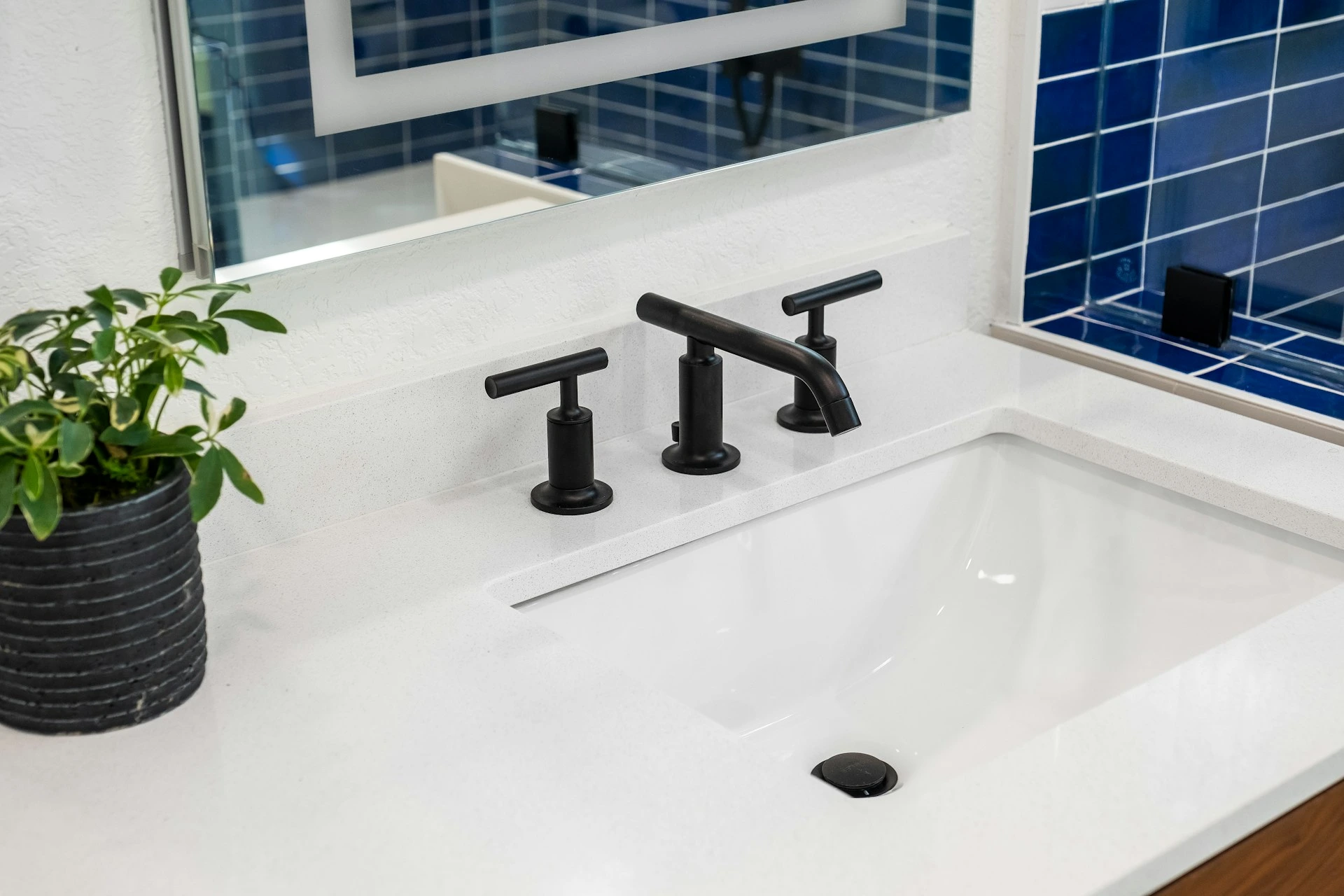
- Centerset: Usually three holes grouped within a four-inch span.
- Mini-widespread: Three separate pieces with relatively close spacing.
- Widespread: Separate spout and handles, often adjustable from 8 to 16 inches.
- Wall-mounted: Plumbing exits from the wall rather than the countertop.
- Vessel faucet: A taller deck-mounted faucet for an above-counter basin.
A single-hole faucet can sometimes cover an existing compact three-hole setup with a deck plate. It cannot automatically fit every widespread layout. Home Depot and Lowe’s both advise matching the faucet configuration to the sink or countertop openings before installation. (The Home Depot)
2. Measure spout reach
Spout reach is the horizontal distance from the faucet body or installation centerline to the water outlet.
The stream should land comfortably inside the basin, ideally near the drain area rather than on the back wall or front slope. A short spout can force users to press their hands against the basin. An excessively long spout may direct water too close to the front edge.
3. Compare spout height with basin depth
A tall faucet is not automatically more convenient. A high outlet above a shallow basin can increase splashing, particularly when the stream hits a curved or angled surface.
For a vessel sink, measure:
- Countertop to vessel rim
- Vessel rim thickness
- Horizontal distance to the drain
- Available space behind the faucet
- Clearance below mirrors, shelves and cabinets
4. Choose an accessible handle style
Lever handles are generally easier to operate than small round knobs. For an accessible bathroom, controls should be usable with one hand without tight grasping, pinching or twisting, and the required operating force should remain within applicable accessibility guidelines. The U.S. Access Board identifies a maximum operating force of five pounds for covered operable parts. (Access Board)
A product advertised as “ADA compliant” still needs to be installed within an accessible overall layout. Faucet selection alone does not make the entire bathroom compliant.
5. Check flow rate and WaterSense labeling
Current federal standards generally limit private lavatory faucets to 2.2 GPM. EPA’s current public WaterSense guidance states that labeled bathroom sink faucets use no more than 1.5 GPM, at least 30% below that federal baseline, while meeting performance criteria. Many current residential models are listed at 1.2 GPM. (The Department of Energy’s Energy.gov)
EPA has also published a draft WaterSense specification revision proposing a 1.2 GPM maximum. As of July 2026, that document remains a draft in the available official material, so shoppers should rely on the current label and exact product specification rather than assuming the proposal is final. (US EPA)
Use the official EPA WaterSense bathroom-faucet guidance and WaterSense product search to verify labeled products.
6. Look beyond the exterior finish
The valve controls the faucet’s operation. Ceramic-disc cartridges are common in quality modern faucets because the hard ceramic surfaces provide smooth control and resist ordinary wear.
Still, no cartridge should be described as permanent or leak-proof. The long-term ownership experience also depends on water quality, installation, supply pressure and whether replacement cartridges are available.
7. Verify drinking-water contact certifications
Faucets and components that contact drinking water may be certified to standards such as NSF/ANSI/CAN 61 for health-effects requirements. NSF/ANSI 372 addresses lead-content verification against the 0.25% weighted-average threshold for wetted surfaces. (NSF)
EPA’s Lead Free Rule requires covered manufacturers and importers introducing regulated plumbing products into commerce to obtain third-party certification. The rule’s certification requirement took effect September 1, 2023. (US EPA)
Look for certification marks on the product, packaging or specification sheet. EPA provides a useful guide to identifying lead-free certified drinking-water products.
8. Check every included component
Before ordering, confirm whether the box includes:
- Drain assembly
- Deck plate
- Flexible supply lines
- Mounting hardware
- Quick-connect hose
- Installation tool
- Valve cartridge
- Optional flow restrictor
- Instructions and warranty documentation
A faucet may appear inexpensive until missing components are added.
Which Bathroom Faucet Type Is Best?
A single-hole faucet is best for compact counters and easy cleaning. A centerset model is practical for common four-inch three-hole sinks. A widespread faucet gives a more upscale appearance and flexible spacing. Vessel faucets suit raised basins, while wall-mounted faucets free counter space but require precise rough plumbing.
| Type | Main advantage | Main limitation | Best location |
| Single-hole | Compact and easy to clean | May need a deck plate on an older sink | Small or modern vanity |
| Centerset | Fits many standard three-hole sinks | Less visual separation between parts | Guest or family bathroom |
| Widespread | Flexible spacing and upscale appearance | More pieces to install and clean | Primary bathroom |
| Vessel faucet | Clears an above-counter basin | Incorrect placement may splash | Vessel-sink vanity |
| Wall-mounted | Frees countertop space | Requires precise in-wall plumbing | Custom remodel |
| Touchless | Reduces handle contact | Requires power and sensor maintenance | Shared or accessibility-focused bath |
Wall-mounted faucets receive significant attention on visual platforms because they create an uncluttered, spa-like counter. However, moving the plumbing into a wall is usually most practical during a larger renovation rather than a simple faucet replacement. (LinkedIn)
What Faucet Finish Is Best for Hard Water?
Brushed nickel and other softly textured finishes usually hide dried droplets and fingerprints better than polished chrome or glossy black. However, no finish prevents hard-water minerals from forming. Regular drying and gentle cleaning matter more than the finish name alone.
Finish comparison
| Finish | Hides spots | Cleaning considerations | Style |
| Chrome | Low | Shows droplets but is usually easy to wipe | Bright and versatile |
| Brushed nickel | High | Grain can disguise light spotting | Warm and adaptable |
| Stainless appearance | High | Usually practical for busy rooms | Modern and neutral |
| Matte black | Medium | Pale mineral residue may be visible | Bold and contemporary |
| Polished nickel | Low | Needs frequent polishing | Warm, reflective and upscale |
| Brass or gold tone | Varies | Coating type affects care | Decorative and warm |
Never use an abrasive pad, aggressive acid or unapproved chemical cleaner unless the faucet manufacturer specifically permits it. Start with a soft cloth, mild soap and water. If flow decreases, inspect and clean the aerator according to the manufacturer’s instructions. Pfister notes that hard-water conditions may require periodic cleaning of aerators or supply screens. (Pfister US)
Is a 1.2 GPM Bathroom Faucet Enough?
For routine handwashing, toothbrushing and face washing, a well-designed 1.2 GPM bathroom faucet is generally adequate. Perceived performance depends on the aerator, water pressure and stream shape—not flow rate alone. A partially clogged aerator can make even a compliant faucet feel weak.
EPA’s WaterSense criteria include performance requirements in addition to maximum flow. Current technical material states that labeled faucets must maintain at least 0.8 GPM at 20 psi, helping prevent an unacceptably weak stream under lower-pressure conditions. (US EPA)
Before replacing a faucet because of weak flow:
- Check whether both shutoff valves are fully open.
- Unscrew and inspect the aerator.
- Remove mineral particles from the aerator screen.
- Check flexible supply lines for kinks.
- Compare hot-only and cold-only flow.
- Ask a plumber to investigate persistent pressure problems.
What Is the Best Bathroom Faucet for Each Room?
Use a compact single-handle faucet in a small guest bath, a durable easy-care model in a family bathroom, a flexible widespread faucet in a primary bath and a properly measured tall faucet for a vessel sink. Accessibility-focused bathrooms benefit from lever controls and generous approach space.
Powder room
Prioritize visual impact and compact proportions. A waterfall or sculptural faucet can work because use is typically lighter, but it should still be easy to wipe.
Family bathroom
Choose an uncomplicated lever handle, an easy-care finish and a manufacturer with accessible replacement parts. Avoid delicate surfaces that require special cleaning.
Primary bathroom
A widespread faucet often suits a larger vanity and gives each user more control. Match the faucet scale to the sink and countertop rather than automatically buying the tallest model.
Aging-in-place bathroom
Look for lever or sensor operation, clear hot-and-cold indicators and comfortable reach. Review the complete vanity layout against current accessibility guidance instead of relying only on an ADA-related product label.
Vessel-sink bathroom
Use a vessel-height model and calculate where the stream will land. Faucet and sink should be selected as a pair whenever possible.
How Much Should You Spend on a Bathroom Faucet?
Spend enough to obtain the correct fit, documented specifications, reliable valve technology and accessible replacement parts. A modest faucet from an established manufacturer can be a better long-term purchase than a decorative model with unclear certification, limited instructions or no replacement-cartridge support.
Prices change frequently by finish, retailer and promotion, so fixed price bands can become inaccurate quickly. Evaluate total project cost instead:
- Faucet
- Drain assembly
- Supply lines
- Shutoff valves
- Deck plate
- Countertop or sink modification
- Plumber labor
- Wall repair for wall-mounted models
- Future replacement cartridges
Chrome is often among the more affordable finish choices. Specialty metallic finishes and unusual faucet heights generally cost more.
Can You Install a Bathroom Faucet Yourself?
A capable homeowner can often replace a straightforward deck-mounted faucet when the shutoff valves work, the sink holes match and the plumbing is accessible. Hire a licensed plumber when valves are corroded, connections leak, holes need modification, plumbing must move inside a wall or local requirements call for professional work.
Basic replacement process
- Turn off the hot and cold shutoff valves.
- Open the faucet to release pressure.
- Place a towel and container under the connections.
- Disconnect the supply lines.
- Remove the drain linkage if necessary.
- Loosen the mounting hardware.
- Clean the sink or countertop surface.
- Install the new faucet according to its instructions.
- Connect the drain and supply lines.
- Turn water on slowly and inspect every joint.
- Remove the aerator and flush the lines if instructed.
- Reinstall the aerator and check operation.
Never force a corroded shutoff valve. A failed valve can turn a small fixture replacement into a water-damage emergency.
Common Bathroom Faucet Buying Mistakes
The most expensive faucet mistake is purchasing by appearance before confirming fit. Other frequent errors include ignoring spout reach, assuming every box contains a drain, mixing incompatible finishes, choosing a vessel faucet by height alone and treating spot-resistant finishes as protection against hard-water minerals.
Avoid these mistakes:
- Ordering before measuring hole spacing
- Confusing centerset and widespread configurations
- Forgetting countertop thickness
- Ignoring clearance behind the handle
- Placing the stream against the basin wall
- Assuming the drain finish will match
- Using a tall faucet with a shallow sink
- Buying an unverified product with no service parts
- Cleaning the finish with an abrasive product
- Choosing a wall-mounted faucet after the wall is already finished
- Relying on one retailer’s shortened specification list
- Assuming all models in a collection have identical certifications
Seven-Step Bathroom Faucet Buying Checklist
A successful faucet purchase follows a simple sequence: identify the mounting layout, measure the basin, select the correct faucet height, confirm flow and certification, choose a maintainable finish, check included parts and verify service support. Complete these steps before comparing decorative details.
- Photograph the existing sink and plumbing.
- Count the holes and measure from center to center.
- Measure basin depth, faucet reach and available height.
- Check the exact model’s GPM and WaterSense status.
- Review certification and accessibility information.
- List every included and separately required component.
- Confirm warranty terms and replacement-part availability.
Save the specification sheet and receipt after installation. Record the model number inside the vanity cabinet so future cartridge or aerator replacement is easier.
Final Verdict
The best bathroom faucet is not simply the model with the most fashionable finish or the highest price. It is the faucet that fits your sink, places water comfortably inside the basin, remains easy to operate and gives you confidence that parts will be available later.
For an adaptable widespread installation, start with the Delta Nicoli. Consider Moen Rinza when visible fingerprints and water spots are a major concern. Pfister Rancho offers practical value, while Delta Trinsic suits a more refined minimalist renovation. Choose the tall Trinsic Vessel version only after measuring an above-counter sink carefully.
For more planning help, explore the home renovation resources from Home Renova Hub before purchasing fixtures, finishes or installation materials.