Quartz Countertops | Quartz vs Granite Countertops: Complete Guide 2026
Key Takeaway
Quartz countertops are engineered from crushed quartz and resin, giving a non-porous, low-maintenance surface that never needs sealing, typically costing $50–$200 per square foot installed. Granite is 100% natural stone, more heat-resistant, and each slab is one of a kind, typically costing $40–$200 per square foot installed but usually needing periodic sealing. Neither material is objectively “better” — the right choice depends on how you cook, how much upkeep you want, and the look you’re after. This guide breaks down cost, durability, maintenance, safety and design trends for 2026 so you can decide with confidence.
What Are Quartz Countertops?
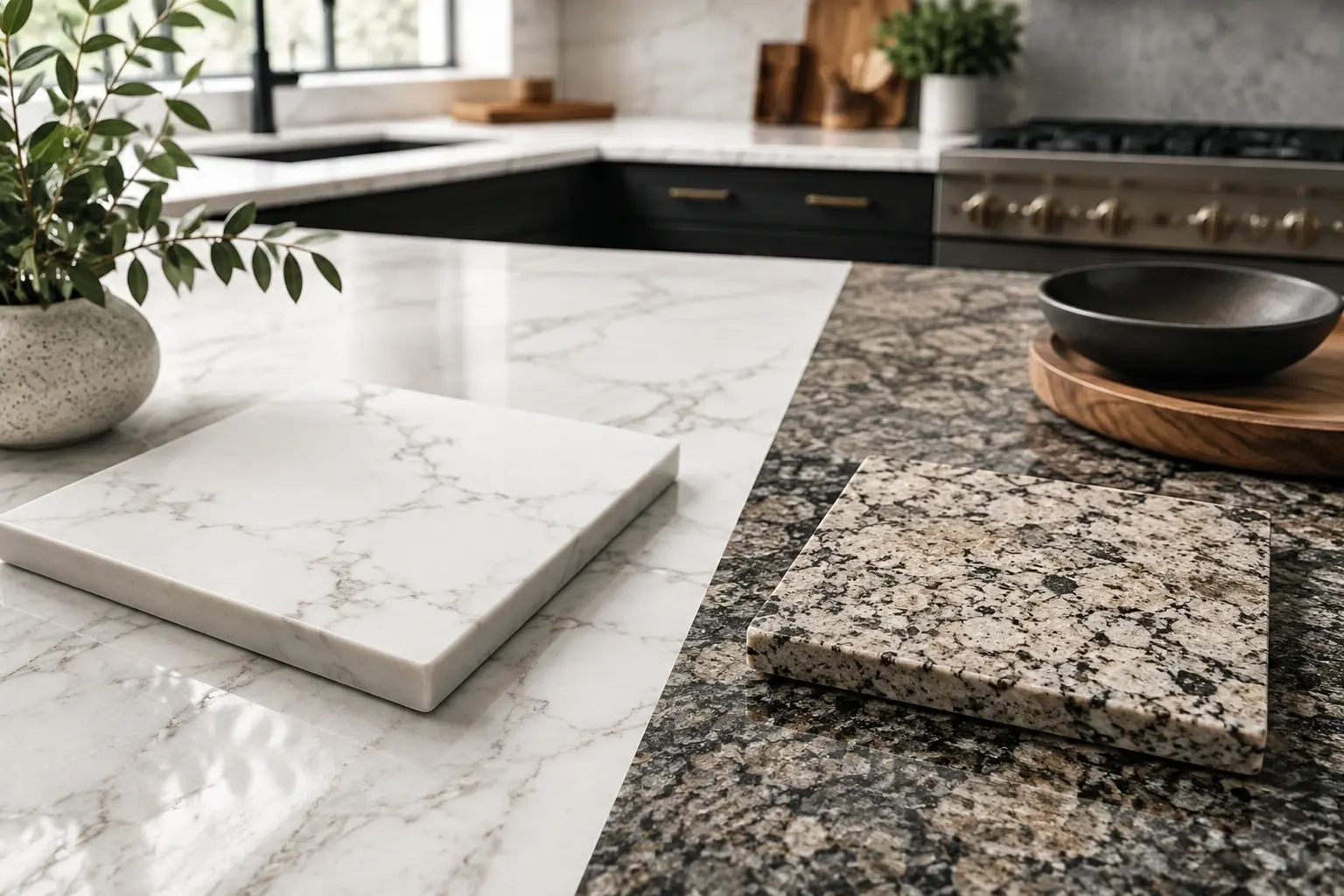
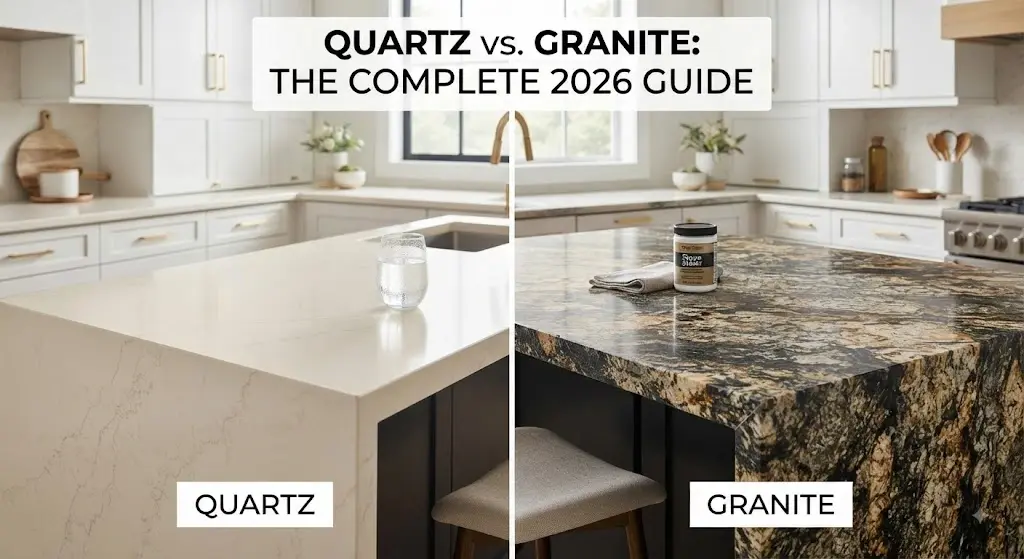
Quartz countertops are an engineered surface made from roughly 90–95% crushed natural quartz bound together with polymer resins and pigments. Because the material is manufactured rather than cut whole from a quarry, quartz countertops offer highly consistent color, pattern and thickness from slab to slab.
The engineering process is also what makes quartz non-porous. Unlike a stone that formed naturally over millions of years, engineered quartz has no open pores for liquid to seep into, which is why manufacturers can back it with a surface that resists staining without ever being sealed. Popular quartz brands include Cambria, Silestone, Caesarstone and MSI Q Quartz, each offering dozens of color and pattern lines, from solid neutrals to dramatic marble-look veining.
What Are Granite Countertops?
Granite countertops are cut from solid slabs of natural igneous rock, quarried and polished rather than manufactured. Every slab is unique, with mineral-driven color variation, veining and flecking that no two kitchens will ever match exactly.
Granite forms from cooled magma and is composed mainly of quartz, feldspar and mica, which is what gives it its natural sparkle and hardness. Because it’s a porous natural stone, most granite benefits from a penetrating sealer to resist staining, though how often resealing is needed depends on the specific stone, its finish, and how the kitchen is used, according to the Natural Stone Institute’s consumer guidance.
Quartz vs Granite Countertops: Quick Comparison
Here is a side-by-side snapshot before we go deeper into each factor.
| Factor | Quartz | Granite |
| Material | Engineered (90–95% crushed quartz + resin) | 100% natural stone |
| Installed cost (2026) | $50–$200+/sq ft (Mid-grade: $85–$120) | $40–$200+/sq ft (Mid-grade: $80–$150) |
| Sealing required | Never | Usually, periodically |
| Porosity | Non-porous | Porous (varies by stone) |
| Heat resistance | Good, but trivets recommended | Excellent |
| Pattern consistency | Very consistent, brand to brand | Unique per slab |
| Best for | Low-maintenance, consistent look | Natural character, heavy cooking |
Quartz vs Granite Cost in 2026: How Much Do They Cost?
While entry-level slabs of quartz and granite can cost nearly the same (starting around $40–$50 per square foot installed), their pricing diverges as you move up in quality.
- Entry-Level (Budget-Friendly): Basic builder-grade granite can occasionally undercut entry-level quartz, starting around $40/sq ft. However, standard entry-level options for both materials generally sit comfortably in a similar price tier.
- Mid-Grade Average: Across 2026 pricing guides, mid-grade quartz commonly averages $85–$120 per square foot installed, while mid-grade granite averages roughly $80–$150 per square foot.
- Total Project Cost: A 30–35-square-foot countertop can commonly run from roughly $2,000 to $6,000 or more installed, depending on material grade, fabrication, cutouts, edge profiles and local labor.
What shifts the total isn’t just the base material — it’s brand (name-brand quartz lines like Cambria carry a premium), slab thickness, edge profile, sink cutouts, and regional labor rates. Furthermore, because granite requires periodic sealing over its lifetime, its long-term cost of ownership can edge slightly higher than quartz even when the upfront sticker prices match.
Durability: Which Countertop Lasts Longer?
Both quartz and granite are extremely durable and can last for decades, often outliving the kitchen they were installed in. Granite is naturally harder and more heat-tolerant; Both materials are highly durable, but either can chip around exposed edges or cutouts if subjected to a hard impact.
Granite ranks high on the Mohs hardness scale, generally in the 6–7 range, which is why it shrugs off scratches from knives and cookware. Quartz, because it’s bound with resin, is slightly more prone to visible seams and, in rare cases, resin discoloration from prolonged direct sunlight — which is why quartz isn’t typically recommended for outdoor kitchens. For an indoor kitchen used normally, either material will realistically outlast most other elements of the room.
Maintenance: Sealing, Cleaning and Everyday Care
Quartz needs no sealing, ever — just a mild soap and water or a pH-neutral cleaner. Granite is porous enough that most fabricators recommend periodic sealing, with guidance from the Natural Stone Institute noting that some granites need it and others rarely do, depending on the specific stone and finish.
This is the single biggest lifestyle difference between the two materials. With quartz, there’s no test to run and no calendar reminder to set. With granite, homeowners are advised to check performance periodically (a simple water-drop test is commonly recommended by fabricators) and reseal with a penetrating sealer when water no longer beads on the surface. Day-to-day, both materials should be cleaned with non-abrasive, pH-neutral products — harsh acidic cleaners like straight vinegar or bleach are discouraged on both surfaces, per Natural Stone Institute care guidance.
Heat Resistance: Can You Put a Hot Pan on Quartz or Granite?
Granite handles direct heat better than quartz. Because quartz contains resin, manufacturers and fabricators consistently recommend using trivets or hot pads rather than setting pans straight from the stove or oven onto the surface, since sudden thermal shock can discolor or crack the resin binder over time.
Granite is essentially cooled volcanic rock, so it tolerates direct heat far better, though even granite fabricators still recommend trivets for extended contact or extremely high heat. If you cook frequently and tend to set hot cookware straight down without thinking about it, this is one of the more practical differentiators between the two materials.
Appearance and Design Trends for 2026
2026 design trends favor texture over pure gloss on both materials. Honed and leather-finish granite are gaining ground over high-polish looks, while quartz trends are shifting toward warm beiges and soft creams with subtle veining, moving away from stark pure-white slabs. Waterfall edges remain a strong choice for kitchen islands on either material.
If you want a completely one-of-a-kind slab with natural veining and mineral flecking, granite is unmatched — no two installations will ever look identical. If you want a specific, repeatable look (useful if you’re matching an island to perimeter counters, or simply want total predictability before the slab arrives), quartz’s manufactured consistency is the safer bet.
Stain and Scratch Resistance
Quartz resists staining better because it’s non-porous; granite resists scratching better because it’s naturally harder. Spilled wine, oil or coffee left on quartz is far less likely to leave a permanent mark than the same spill on unsealed granite.
That said, well-sealed granite performs very well against staining too — the difference mainly shows up when a granite countertop is overdue for resealing, or when a highly porous granite variety wasn’t sealed properly during installation. Neither material is scratch-proof: cutting directly on either surface with a knife will dull your knife blade and can leave fine marks over time, so a cutting board is recommended regardless of which material you choose.
Health and Safety: What Homeowners Should Know About Silica
The health risk connected to “quartz” is a fabrication-industry issue, not something a homeowner is exposed to from a finished, installed countertop. It’s worth understanding, though, because it explains why choosing a reputable fabricator matters.
Engineered quartz contains a very high percentage of crystalline silica, at or above roughly 90% by some estimates, compared to natural granite, which typically contains closer to 45–50% silica. When slabs are cut, ground or polished during fabrication, that process releases fine respirable silica dust, which has been linked to a serious and irreversible lung disease called silicosis among fabrication workers, according to occupational health data published by OSHA and the CDC’s National Institute for Occupational Safety and Health (NIOSH).
OSHA has run a focused compliance and inspection initiative specifically covering engineered stone fabrication shops, and NIOSH has published health advisories on the issue. A 2023 JAMA Internal Medicine study of California fabrication workers documented dozens of confirmed silicosis cases tied to engineered stone dust exposure. This risk is tied to the cutting and polishing process at the fabrication shop, not to a sealed, finished countertop sitting in your kitchen. The practical takeaway for homeowners: choose a fabricator that follows OSHA’s dust-control requirements (wet cutting, ventilation, respiratory protection), which is also a reasonable proxy for a shop that takes quality and safety seriously overall.
Resale Value and ROI
Both quartz and granite are considered premium countertop upgrades that appraisers and buyers recognize, and neither has a consistent resale edge over the other nationally — local buyer preference and kitchen condition matter more than the specific stone choice.
What tends to matter more for resale is condition and cohesion: a well-maintained countertop that fits the overall kitchen style typically supports value better than a higher-cost material that’s chipped, stained, or clashes with dated cabinetry. If you’re remodeling with resale in mind within the next few years, a light, neutral quartz in a widely appealing tone is a safe, low-risk choice; if you’re staying long-term and love the one-of-a-kind look, granite is just as sound an investment.
Which Is Better for Your Kitchen? A Decision Framework
Rather than a single winner, match the material to how you actually live in your kitchen:
- Choose quartz if: you want zero sealing maintenance, a highly consistent color match, and strong stain resistance for a busy family kitchen.
- Choose granite if: you cook often and set pans down directly on the counter, want a completely unique natural slab, or prefer a fully natural material over an engineered one.
- Choose quartz if: you’re matching a large island to perimeter counters and need the pattern to repeat exactly.
- Choose granite if: you’re budget-conscious at the entry level, since low-grade granite can undercut low-grade quartz in some markets.
- Choose either if: your priority is long-term durability — both materials, properly cared for, can outlast a 15–20 year kitchen renovation cycle.
Common Mistakes to Avoid When Choosing a Countertop
- Comparing only the per-square-foot sticker price without factoring in edge profile, cutouts, and — for granite — long-term sealing cost.
- Skipping an in-person slab viewing; photos and small samples rarely capture true veining and color variation.
- Assuming all quartz brands perform identically — resin quality and UV stability vary by manufacturer.
- Choosing a fabricator based on price alone without confirming dust-control practices, licensing and warranty terms.
- Forgetting to ask how the specific granite slab has been treated (resin-filled vs. unresined), since that affects sealing needs.
Step-by-Step: How to Choose Between Quartz and Granite
- Define your priority: near-zero maintenance (quartz) vs. natural, one-of-a-kind character (granite).
- Set a realistic budget range, including fabrication, edge profile, and cutouts — not just the per-square-foot slab price.
- Visit a slab yard in person to view full slabs, not just small samples, under your kitchen’s lighting if possible.
- Ask any fabricator you’re considering about their dust-control and safety practices, plus warranty coverage.
- Order a physical sample of your top 2–3 choices and live with them in your kitchen for a few days before committing.
- Confirm sealing requirements (if granite) and get the maintenance schedule in writing from your installer.
Frequently Asked Questions
Is quartz cheaper than granite?
Not consistently. Entry-level slabs of both materials start in a very similar range ($40–$50 per square foot installed), meaning basic granite can sometimes be found slightly cheaper than quartz. However, mid-grade quartz typically averages $85–$120/sq ft, while mid-grade granite ranges from $80–$150/sq ft. Premium brands and long-term sealing maintenance can also tip the lifetime cost scales for either material.
Which is more durable, quartz or granite?
Both are highly durable for decades of daily use. Granite is naturally harder and more heat-resistant; quartz resists chipping and staining slightly better because it’s non-porous and manufactured for consistency.
Do quartz countertops need to be sealed?
No. Quartz is non-porous by design and never needs sealing, which is one of its main advantages over natural stone.
How often should granite countertops be sealed?
It varies by stone type, finish, and use — some granites rarely need resealing, while others benefit from it periodically. The Natural Stone Institute recommends consulting your fabricator and following the specific sealer manufacturer’s instructions rather than a fixed schedule.
Can you put a hot pan directly on quartz?
It’s not recommended. Because quartz contains resin, sudden direct heat can cause discoloration or cracking over time, so trivets or hot pads are advised even though quartz can tolerate brief, moderate heat.
Is granite better than quartz for resale value?
Neither has a consistent nationwide edge. Both are considered premium upgrades; condition, cohesion with the rest of the kitchen, and local buyer taste tend to matter more than which of the two materials you choose.
Is quartz or granite safer for a kitchen?
Once installed and sealed at the edges, both are safe, food-contact-appropriate surfaces. The silica health risk discussed in the news relates to the fabrication process — cutting and polishing slabs — not to a finished countertop in your home.
What is the difference between quartz and quartzite?
Quartz is an engineered material made from crushed quartz and resin. Quartzite is a completely different, naturally occurring metamorphic rock — despite the similar name, it behaves more like granite and requires sealing.
Does quartz scratch or chip more easily than granite?
Granite generally resists scratching better due to its natural hardness, but quartz resists chipping at edges and corners reasonably well too. Neither should be used as a cutting surface directly.
What is the average cost of a granite kitchen countertop in 2026?
Most 2026 pricing guides put granite between $40 and $200 per square foot installed, with a typical 30–35 square foot kitchen totaling roughly $2,400–$6,000 depending on grade, edge profile and cutouts.
Which countertop material is easier to clean day to day?
Quartz is generally easier because it’s non-porous — mild soap and water or a pH-neutral cleaner is usually enough. Granite requires the same gentle approach but is more sensitive to whether it’s currently well-sealed.
Can quartz be used outdoors?
It’s generally not recommended. UV exposure can affect the resin in quartz over time, so granite or quartzite are typically better suited to outdoor kitchens and patios.
Final Thoughts
Quartz and granite are both excellent, long-lasting choices, and 2026 pricing has made them close enough that cost alone rarely settles the decision. If you want a consistent, sealing-free surface, quartz is the lower-maintenance path. If you want a completely natural material with unmatched heat resistance and one-of-a-kind veining, granite remains hard to beat. The right call comes down to your cooking habits, your maintenance tolerance, and the look you want your kitchen to have for the next 15–20 years.
If you’re weighing countertop options as part of a larger kitchen or bathroom remodel, Home Renova Hub’s remodeling resources can help you plan the full project and budget before you commit to a material.