Best LED Bathroom Mirrors: 2026 Buying Guide
Finding the best LED bathroom mirrors comes down to solving one specific problem: bad bathroom light. If you’ve ever tried to shave, apply makeup, or trim a beard under a single overhead fixture, you already know the issue — shadows fall in the wrong places and colors look off. An LED bathroom mirror fixes this by putting light where your face actually is, not the ceiling.
This guide skips the affiliate-style top-10 lists and instead breaks down what actually separates a good LED mirror from a disappointing one: the real difference between frontlit, backlit, and dual-lit designs; the electrical code rules a licensed contractor has to follow; how to size a mirror to your vanity; and what you should expect to pay at each quality tier. Whether you’re planning a full bathroom remodel or a weekend upgrade, you’ll leave with a framework for choosing — not just a list of products.
What Is an LED Bathroom Mirror?
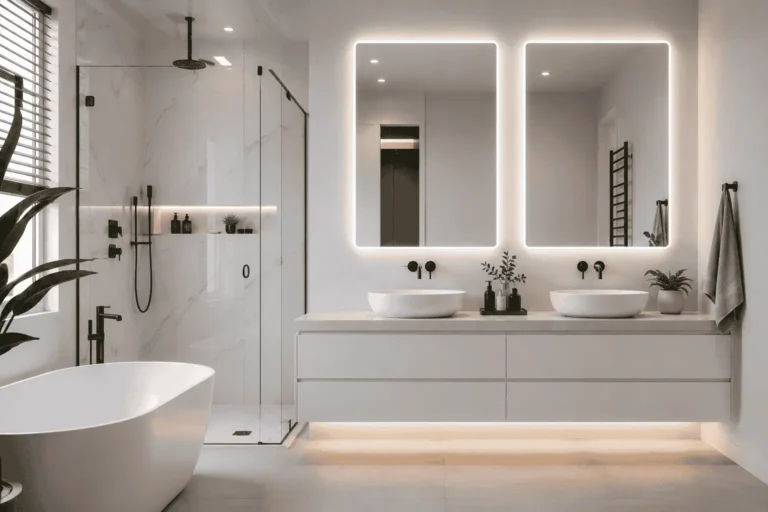
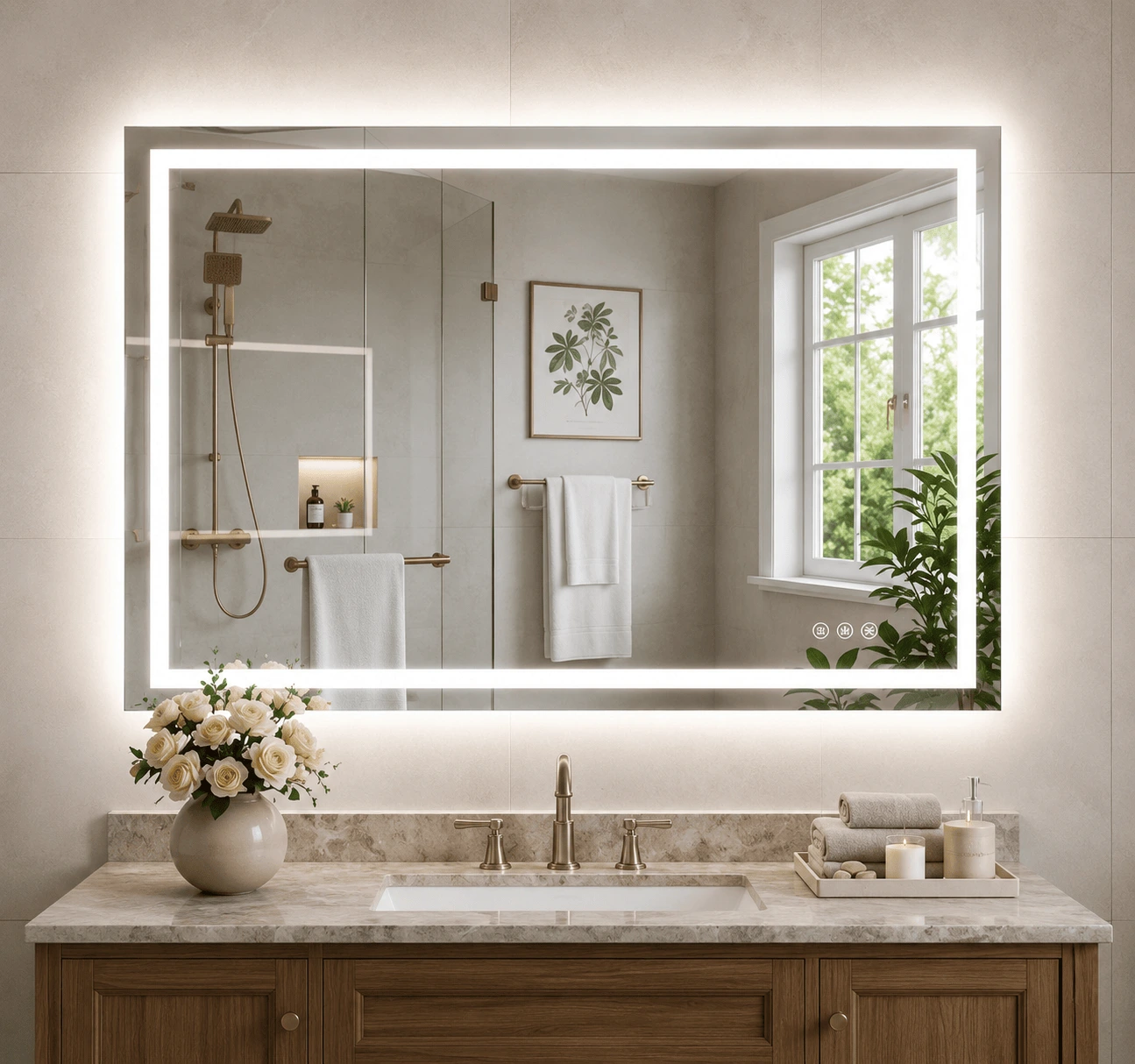
An LED bathroom mirror is a mirror with LED lighting built into or behind the glass, so light comes from around or behind your reflection instead of from a single ceiling fixture. This produces even, shadow-free illumination for grooming tasks — shaving, applying makeup, skincare routines — and most current models add dimming, adjustable color temperature, and heated anti-fog glass as standard features.
LED bathroom mirrors generally fall into three categories, based on where the light sits relative to the glass:
- Frontlit — an LED panel or strip mounted on the mirror’s face or top edge, shining forward onto the user
- Backlit — LEDs mounted behind the mirror, creating a halo or ambient glow around the frame
- Dual-lit — both frontlit and backlit elements, independently controlled, combining task lighting with ambient light
Takeaway: An LED bathroom mirror isn’t a single product category — it’s a lighting method. The right type depends on whether you need task lighting for grooming, ambient light for the room, or both.
| Product Model / Brand | Best For | Key Highlight | Action |
|---|---|---|---|
| Keonjinn LED Mirror | Best Popular Value | Sleek modern profiles, high customer satisfaction, anti-fog | Check Price on Amazon |
| LOAAO LED Mirror | Best Functional Styling | Versatile mounting, smart touch controls, crisp reflections | Check Price on Amazon |
| Krugg LED Mirror | Best Design Innovation | Advanced lighting tech, premium build quality, modern aesthetics | Check Price on Amazon |
| Various Styles & Brands | Best Variety & Selection | Browse alternative sizes, shapes, and custom configurations | Explore Styles on Amazon |
Top Mistakes to Avoid When Buying an LED Bathroom Mirror
Avoid these common mistakes to ensure your new LED bathroom mirror delivers excellent lighting, lasts for years, and complies with electrical safety standards.
❌ Choosing Style Over Function
A backlit mirror creates beautiful ambient lighting, but it usually isn’t bright enough for shaving, makeup, or skincare. For daily grooming, choose a frontlit or dual-lit mirror.
🎨 Ignoring CRI Ratings
Brightness alone doesn’t guarantee accurate colors. Choose a mirror with a CRI of 90+ if you regularly shave, apply makeup, or want natural-looking skin tones.
📏 Buying the Wrong Size
An oversized mirror can overwhelm a vanity, while one that’s too small looks awkward. A good rule is to select a mirror that’s 2–4 inches narrower than the vanity.
💡 Choosing Fixed Color Temperature
Mirrors with only one color temperature limit flexibility. A model offering 2,700K–6,500K lets you switch between relaxing warm light and bright daylight for grooming.
🚿 Forgetting Damp/Wet Ratings
Mirrors installed near tubs or showers should carry the correct damp-location or wet-location safety rating to comply with electrical codes.
⚡ Skipping GFCI Protection
Plug-in LED mirrors should always be connected to a GFCI-protected outlet. This safety feature helps reduce the risk of electrical shock in wet environments.
🛠 Ignoring Installation Requirements
Hardwired mirrors often require new wiring or a junction box. If you’re not experienced with electrical work, hiring a licensed electrician is usually the safest option.
📋 Not Checking the Warranty
The LED driver typically fails before the LEDs themselves. Look for manufacturers offering at least a 3–5 year warranty for added peace of mind.
💡 Expert Tip
The best LED bathroom mirror isn’t necessarily the most expensive one. Focus on high CRI (90+), adjustable color temperature, anti-fog functionality, the correct safety rating, and a size that complements your vanity. These features will have a much bigger impact on everyday use than smart controls alone.
Frontlit vs. Backlit vs. Dual-Lit: Which Should You Choose?
Each lighting style trades off task-lighting performance against ambiance and price. The comparison below reflects how each type typically performs, based on published manufacturer specifications and buying-guide testing from home-improvement outlets.
| Type | How It Works | Grooming Light Quality | Best For | Typical Price Range |
|---|---|---|---|---|
| Frontlit | LED strip faces outward, illuminating the user directly | Best — even, shadow-free light on the face | Shaving, makeup, skincare, task-focused vanities | $100–$300 |
| Backlit | LEDs face the wall, creating a glow around the mirror edge | Fair — ambient only, not direct task light | Powder rooms, ambiance, statement pieces | $90–$250 |
| Dual-lit | Independent front and back LED circuits | Best — switchable between task and ambient modes | Primary/master bathrooms, double vanities | $150–$450 |
| Lighted medicine cabinet | LED light guides built into a mirrored cabinet door | Very good, plus adds storage | Small bathrooms short on counter and cabinet space | $200–$600+ |
Takeaway: If you only get direct light from one style, choose frontlit or dual-lit — backlit-only mirrors look striking but don’t replace task lighting at the vanity.
What Specs Actually Matter When Buying an LED Mirror?
Short answer: color temperature (CCT), color rendering index (CRI), dimming range, and a damp- or wet-location safety rating are the four specs that separate a good LED mirror from a disappointing one. Marketing terms like “smart” or “premium” don’t tell you anything on their own — these four do.
| Spec | What It Means | What to Look For |
|---|---|---|
| Color temperature (CCT) | Measured in Kelvin (K); describes whether light looks warm/yellow or cool/blue | A tunable range roughly 2,700K (warm) to 6,500K, which matches ENERGY STAR’s qualifying range for LED lamps |
| Color rendering index (CRI) | How accurately a light source renders true colors on a 0–100 scale | 80+ to meet ENERGY STAR’s minimum for LED lighting; 90+ for more accurate skin-tone and makeup rendering |
| Dimming | Ability to lower brightness without flicker | Stepless or multi-stage dimming; confirm the driver is flicker-free at low output |
| Damp/wet rating & listing | Certification for safe use in a bathroom’s humidity | UL or ETL listing plus a damp-location (or wet-location, if near a tub/shower spray zone) rating |
The U.S. Department of Energy and the EPA’s ENERGY STAR program define both CCT and CRI thresholds for qualifying LED products, which is a useful independent benchmark when a listing doesn’t specify a number.
Learn more from the U.S. Department of Energy’s guidance on choosing energy-efficient light bulbs.
Takeaway: A mirror advertised as “3 color modes” is only useful if it also states the actual Kelvin values and a CRI of 80 or above — ask for the spec sheet, not just the marketing copy.
How to Size an LED Mirror for Your Vanity
Sizing an LED mirror is mostly about proportion and coverage, not just fitting the wall space:
- Width: many bath designers suggest choosing a mirror roughly 2–4 inches narrower than the vanity or sink cabinet on each side, so the reflection feels centered rather than cramped
- Height: mount so the light band sits close to eye level for the primary users of the bathroom — this is what makes “face-level” LED lighting actually functional, not just decorative
- Double vanities: either one continuous mirror spanning both sinks, or two matching mirrors centered over each basin
- Small bathrooms: a single frontlit mirror sized to the sink, or a lighted medicine cabinet, recovers storage space you’d otherwise lose to a stand-alone light fixture
Takeaway: Oversized mirrors look impressive in photos but can wash out a small bathroom with reflected glare — match the mirror’s light output to the room’s actual size, not just the wall it fills.
Electrical Code and Installation Requirements
Short answer: LED bathroom mirrors are typically wired on a dedicated, GFCI-protected circuit if plug-in, or hardwired to a lighting circuit if permanently installed, and any fixture within the tub or shower’s damp/wet zone must carry the matching safety listing. This is the step most product roundups skip — and the one that determines whether your installation passes inspection.
Under the National Electrical Code (NEC), enforced locally through NFPA 70:
- All 125-volt bathroom receptacles require GFCI protection, whether from a GFCI receptacle or a GFCI breaker at the panel
- Fixtures located within roughly 3 feet horizontally and 8 feet vertically of a tub or shower’s edge must be rated for damp locations; fixtures subject to direct spray must carry a wet-location rating
- A hardwired mirror light is typically supplied from the general bathroom lighting circuit rather than a GFCI receptacle circuit — check with a licensed electrician, since some local jurisdictions add stricter amendments
- Plug-in mirrors with a cord and plug still need their outlet GFCI-protected like any other bathroom receptacle
| Zone | Fixture Rating Needed | Why |
|---|---|---|
| Inside tub/shower spray zone | Wet-location listed | Direct water contact requires the highest sealing rating |
| Within ~3 ft / 8 ft of tub or shower edge | Damp-location listed | Humidity and occasional splash, without direct spray |
| General vanity wall, away from wet zones | UL/ETL listed indoor fixture | Standard bathroom humidity; still requires safety listing |
For the authoritative code language, see the National Fire Protection Association’s NFPA 70, National Electrical Code, and confirm any project-specific requirement with your local building department or a licensed electrician before installation.
Takeaway: Code compliance isn’t optional trivia — a mirror light installed without the right damp/wet rating, or on the wrong circuit, can fail inspection and needs to be redone at extra cost.
Cost Guide: What Should You Budget?
LED bathroom mirror prices scale with size, features, and build quality. The tiers below reflect the price bands commonly seen across current home-improvement retailers and manufacturer listings.
| Tier | Typical Price Range | What You Get | Best For |
|---|---|---|---|
| Entry | $80–$150 | Single-mode or basic 3-CCT frontlit or backlit LED, touch on/off, small-to-mid sizes | Budget updates, rentals, powder rooms |
| Mid-range | $150–$300 | Dimming, wider CCT range, anti-fog defogger, larger sizes, better CRI | Most primary bathroom remodels |
| Premium | $300–$600+ | Dual-lit independent circuits, memory settings, smart/touch controls, large-format or double-vanity sizing, extended warranty | Master baths, double vanities, design-forward remodels |
Installation labor (if hardwiring or relocating an electrical box) typically adds to the mirror’s purchase price and depends on your local electrician’s rates and whether new wiring is required.
Takeaway: Mid-range LED mirrors deliver the best value for most remodels — the jump from entry to mid-range buys real functional upgrades (dimming, anti-fog, better CRI), while premium pricing mostly buys size and smart-control extras.
DIY Installation vs. Professional Installation
Should you install an LED bathroom mirror yourself? It depends on whether the mirror is plug-in or hardwired.
Plug-in / cord-and-switch mirrors
- Mount the mirror using the included wall bracket or hooks — comparable to hanging a standard mirror
- Plug into an existing GFCI-protected outlet; no new wiring required in most cases
- Reasonable for an experienced DIYer comfortable with basic wall anchors
Hardwired mirrors
- Requires running or extending circuit wiring to a junction box behind the mirror
- Should be installed or at minimum inspected by a licensed electrician to meet local code and pass inspection
- Often bundled into a bathroom remodel’s broader electrical scope rather than done as a stand-alone swap
Takeaway: If your project already involves opening the wall for a remodel, hardwiring is usually worth the extra step — it hides cords and gives a cleaner finished look.
7 Common Mistakes to Avoid
- Choosing backlit-only for task lighting — it looks great but doesn’t replace direct light for shaving or makeup
- Ignoring CRI — a mirror with a low CRI can make skin tones and makeup colors look inaccurate, even at high brightness
- Skipping the damp/wet rating check for mirrors near a tub or shower
- Undersizing the mirror relative to a wide double vanity, leaving the reflection feeling cramped
- Choosing a fixed color temperature when a tunable 2,700K–6,500K range costs little more and works for both grooming and relaxing use
- Forgetting to confirm GFCI protection on the receptacle for plug-in mirrors
- Not checking warranty length — LED drivers, not the glass, are the most common failure point over time
Care & Maintenance Checklist
| Task | Frequency | Why It Matters |
|---|---|---|
| Wipe glass with a non-ammonia cleaner and microfiber cloth | Weekly | Ammonia-based cleaners can degrade anti-fog coatings and edge seals over time |
| Check anti-fog/defogger function | Monthly | Confirms the heating element and its circuit are still working |
| Inspect edges and seals for moisture intrusion | Every 6 months | Catches early seal failure before it reaches the LED driver |
| Test dimmer and mode-switching functions | Every 6 months | Flicker or lag can signal an aging driver |
| Confirm GFCI (plug-in models) still trips correctly | Annually | GFCI devices can wear out; testing keeps the safety protection active |
Takeaway: Most LED mirror “failures” are driver or seal issues, not the LEDs themselves — a simple maintenance routine adds years to the fixture’s usable life.
8. FAQs
What is the best type of LED bathroom mirror for grooming?
A frontlit or dual-lit mirror is best for grooming tasks because the light faces directly outward onto the user, providing even, shadow-free illumination for shaving, makeup, and skincare.
How much do LED bathroom mirrors cost?
LED bathroom mirrors typically range from about $80 for basic entry-level models to $600 or more for large, premium dual-lit mirrors with smart controls, based on current home-improvement retailer pricing.
What color temperature is best for a bathroom mirror?
There’s no single best color temperature — a tunable mirror covering roughly 2,700K (warm) to 6,500K (daylight) lets you switch between a relaxing tone and a brighter, more accurate tone for makeup or shaving.
Do LED bathroom mirrors need to be on a GFCI circuit?
Plug-in mirrors need to draw power from a GFCI-protected receptacle, since the NEC requires GFCI protection for bathroom receptacles. Hardwired mirror lighting is typically supplied from the general lighting circuit rather than a receptacle circuit — confirm the specifics with a licensed electrician.
Can I install an LED mirror near my shower or tub?
Only if it carries the correct safety listing for that zone. Fixtures within about 3 feet horizontally and 8 feet vertically of a tub or shower edge generally need a damp-location rating, and fixtures exposed to direct spray need a wet-location rating.
What is CRI and why does it matter for a bathroom mirror?
CRI (color rendering index) measures how accurately a light source renders true colors on a 0–100 scale. ENERGY STAR requires a CRI of at least 80 for qualifying LED products; 90+ is preferable for accurate skin tone and makeup application.
Should I choose a frontlit or backlit mirror?
Choose frontlit if grooming and task lighting is the priority. Choose backlit mainly for ambiance and visual style. Many buyers choose dual-lit mirrors to get both, switchable from a single control.
How do I size an LED mirror for my vanity?
A common design guideline is to choose a mirror about 2–4 inches narrower than the vanity or sink cabinet on each side, centered over the sink, with the light band positioned near eye level.
Is a hardwired or plug-in LED mirror better?
Plug-in mirrors are easier to install and relocate. Hardwired mirrors give a cleaner, cord-free look and are often the better choice when a bathroom is already being remodeled and the wall is open.
What does anti-fog or defogger mean on an LED mirror?
It’s a heating element embedded behind the glass that keeps the mirror surface a few degrees above the surrounding humidity, preventing condensation from forming during and after a shower.
How long do LED bathroom mirrors last?
The LEDs themselves are typically rated for tens of thousands of hours of use. In practice, the LED driver and edge seals are the more common points of failure, which is why warranty length and build quality matter as much as the advertised LED lifespan.
Do LED mirrors use a lot of electricity?
No — LED lighting uses substantially less energy than incandescent or halogen bulbs for a comparable amount of light, which is part of why ENERGY STAR and the U.S. Department of Energy promote LED adoption broadly.