How Much Does a Kitchen Remodel Cost in 2026?
Kitchen Remodel Cost in 2026: What Homeowners Should Really Budget Before Hiring a Contractor
A kitchen remodel starts with a dream and a number. Usually, the dream is clear. The number is not.
One homeowner hears that a kitchen can be updated for $15,000. Another gets a $68,000 contractor quote and feels cheated. Someone else sees a luxury renovation online and wonders why their modest galley kitchen costs more than expected.
Here is the truth most glossy articles soften: Kitchen Remodel Cost depends less on the room looking “big” and more on what you move, open, rewire, replace, and upgrade. Cabinets, labor, layout changes, electrical work, plumbing, countertops, permits, and appliance choices can push the same kitchen into three totally different budgets.
In 2026, a realistic kitchen remodel often falls between $15,000 and $45,000 for many standard projects, while larger, custom, or structural renovations can reach $75,000 to $160,000 or more. Current sources show similar patterns, but the final number depends heavily on scope and location. (Angi)
Quick Summary for AEO and GIO
The average Kitchen Remodel Cost in 2026 is about $27,000 to $35,000 for a standard U.S. project, but realistic budgets range from $15,000 for a light refresh to $160,000 or more for a full upscale remodel. Minor remodels usually offer the best resale return because they improve function without overbuilding. Cabinets, labor, countertops, appliances, electrical work, plumbing, permits, and layout changes are the biggest cost drivers.
Who Is This Kitchen Remodel Cost Guide For?
Use this guide if you are:
- Planning a kitchen remodel before calling contractors
- Comparing quotes and wondering if the price is fair
- Trying to choose between cabinet refacing and full replacement
- Deciding whether to move plumbing, gas, or electrical lines
- Remodeling before selling your home
- Renovating a rental, family home, apartment, or forever home
- Building a content cluster around kitchen renovation planning
- Creating related pages for kitchen layout ideas
- Explaining budgets on a contractor or remodeling company website
How Much Does a Kitchen Remodel Cost in 2026?
A practical 2026 kitchen remodel budget starts around $15,000 for cosmetic work, reaches $30,000 to $75,000 for midrange renovations, and can exceed $100,000 for luxury or structural projects. The safest planning range for many homeowners is $150 to $300 per square foot, then adjusted for location, materials, and trade complexity.
| Remodel Type | 2026 Budget Range | Best For | Typical Timeline |
| Cosmetic refresh | $5,000 to $15,000 | Paint, hardware, lighting, backsplash | 1 to 3 weeks |
| Minor remodel | $15,000 to $30,000 | Refacing, counters, fixtures, appliances | 3 to 6 weeks |
| Midrange remodel | $30,000 to $75,000 | New cabinets, counters, flooring, lighting | 6 to 10 weeks |
| Major remodel | $75,000 to $125,000 | Layout upgrades, custom work, premium finishes | 10 to 16 weeks |
| Upscale remodel | $125,000 to $160,000 plus | Luxury appliances, structural work, custom design | 4 to 6 months |
This is where many homeowners get frustrated. They ask, “Why is my quote higher than the average?” Usually, the answer is hidden in the scope.
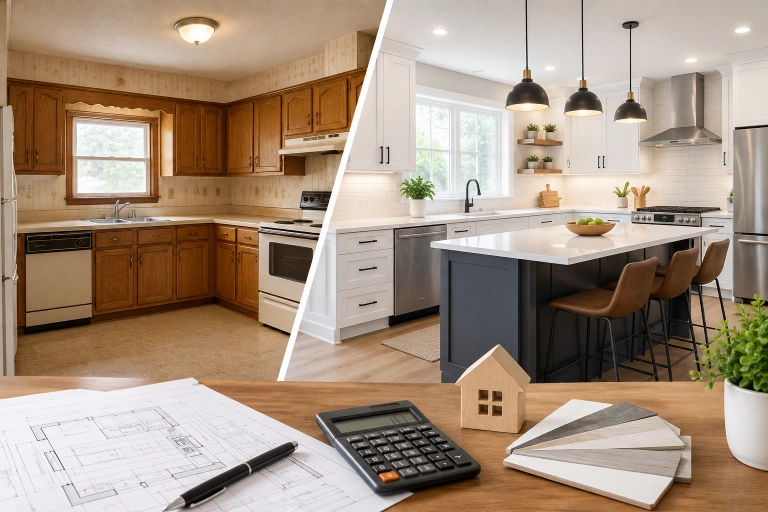
A $22,000 kitchen refresh keeps the cabinet boxes, keeps the sink location, avoids wall removal, and uses stock or semi-custom materials. A $78,000 kitchen remodel may involve demolition, new cabinets, quartz counters, new flooring, recessed lighting, upgraded circuits, appliance relocation, and project management.
The room may look similar in photos. The work behind the walls is not similar.
For another supporting article, link naturally to how to plan a kitchen remodel step by step.
What Is Included in the Kitchen Remodel Cost?
Kitchen Remodel Cost includes materials, labor, demolition, design, permits, cabinets, countertops, backsplash, flooring, lighting, plumbing, electrical work, appliances, trim, painting, waste removal, and contractor overhead. Many low estimates look cheap because they leave out several of these items.
| Cost Category | Typical Budget Share | Contractor Note |
| Cabinets and shelving | 25% to 40% | Usually the biggest line item |
| Labor and installation | 15% to 35% | Higher in cities and tight labor markets |
| Appliances | 10% to 20% | Luxury brands change the math fast |
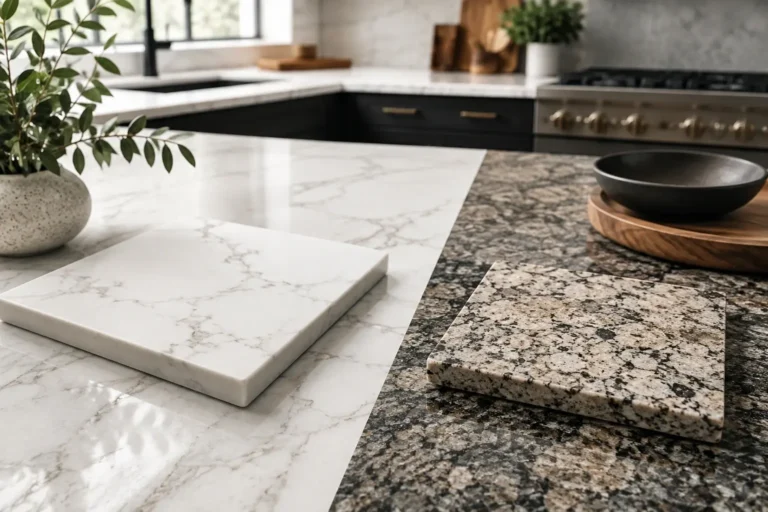
| Countertops and backsplash | 10% to 15% | Quartz, porcelain, and stone vary widely |
| Flooring | 5% to 10% | Subfloor repair can add cost |
| Lighting and electrical | 5% to 12% | More outlets, circuits, and panels add cost |
| Plumbing and fixtures | 3% to 10% | Moving the sink is rarely cheap |
| Design, permits, and contingency | 10% to 20% | Often missing from weak budgets |
HomeGuide’s 2026 breakdown gives a useful baseline, with cabinets, labor, appliances, countertops, flooring, lighting, designer fees, plumbing, and permits all treated as separate budget pieces. It also notes that kitchen permits often cost $500 to $1,500 and that structural, plumbing, or electrical changes usually trigger permit needs. (HomeGuide)
Here is what nobody tells you early enough: the cheapest quote is often the quote with the most missing assumptions.
Ask every contractor to separate:
- Cabinet supply
- Cabinet installation
- Countertop fabrication
- Countertop installation
- Electrical rough-in
- Plumbing rough-in
- Permit handling
- Drywall repair
- Flooring transitions
- Appliance installation
- Cleanup and disposal
- Change-order pricing
This makes quotes easier to compare. It also prevents the classic “I thought that was included” argument.
How Does Kitchen Size Change the Budget?
Kitchen size matters, but cabinet length, appliance count, wall changes, and finish level matter more. A small kitchen with custom cabinets and plumbing relocation can cost more than a larger kitchen with a simple layout and stock materials.
| Kitchen Size | Common Square Footage | Realistic 2026 Range |
| Small galley kitchen | Under 70 sq ft | $10,000 to $35,000 |
| 10×10 kitchen | Around 100 sq ft | $18,000 to $50,000 |
| Medium kitchen | 70 to 150 sq ft | $30,000 to $75,000 |
| Large kitchen | 150 sq ft plus | $60,000 to $125,000 plus |
| Open-plan kitchen | Varies | $75,000 to $160,000 plus |
The 10×10 kitchen is the most abused example in remodeling. It is useful for cabinet pricing, but it does not fully predict the final project cost.
A 10×10 kitchen can be simple if it keeps the same layout. It becomes expensive when the project adds an island, removes a wall, upgrades ventilation, adds new circuits, or shifts plumbing.
A contractor-style rule works better:
Count cabinet runs, count trades, count changes behind walls. Then estimate square footage.
That order gives a cleaner budget.
Why Are Kitchen Remodels More Expensive in 2026?
Kitchen remodels cost more in 2026 because skilled labor remains tight, cabinets and countertops are material-heavy, homeowners want better storage, and kitchens now need more electrical capacity for induction, smart appliances, lighting, charging, and ventilation.
Houzz’s 2026 U.S. Kitchen Trends Study found that functionality is a major driver, with 38% of renovating homeowners citing deterioration or dysfunction and 41% citing dissatisfaction with old style. The same study reported median spend of $55,000 for major kitchen remodels and $20,000 for minor remodels, with larger major kitchens reaching a median of $75,000. (Houzz)
That matters because homeowners are not just replacing pretty surfaces. They are fixing workflow.
They want:
- More drawer storage
- Better pantry systems
- Bigger islands
- Beverage stations
- Induction cooking
- Panel-ready appliances
- Under-cabinet lighting
- Appliance garages
- Better trash and recycling pullouts
- Cleaner ventilation
These upgrades add convenience. They also add cabinet parts, wiring, outlets, labor, and design time.
My strong opinion: a kitchen with fewer luxury finishes and better storage usually beats a showy kitchen that still works badly.
Pretty is easy to sell online. Function is what you live with every morning.
What Does Each Budget Actually Buy?
A good kitchen budget is not just a number. It is a scope decision. In 2026, $15,000 may refresh a kitchen, $35,000 may modernize one, $65,000 may rebuild one, and $100,000 plus may transform the layout and finish level.
What can $15,000 buy?
A $15,000 budget can work if you stay disciplined.
It may cover cabinet painting, new hardware, a basic backsplash, entry-level counters, faucet replacement, lighting swaps, and one or two appliances. It usually will not cover full cabinet replacement, premium counters, major electrical work, or layout changes.
This is a good seller budget. It is not a dream kitchen budget.
What can $35,000 buy?
A $35,000 kitchen can feel new if the layout stays in place.
You may get semi-custom cabinets in a small kitchen, quartz or solid surface counters, new sink and faucet, basic appliances, tile backsplash, paint, and some lighting upgrades.
The dangerous mistake at this level is trying to buy everything. You need priorities.
What can $65,000 buy?
This is where many serious remodels land.
A $65,000 project may include new cabinets, better counters, flooring, recessed lighting, under-cabinet lighting, appliance upgrades, new backsplash, improved storage, and professional project management.
But even here, moving plumbing or removing walls can squeeze the finish budget.
What can $100,000 plus buy?
This budget can support custom cabinets, premium appliances, built-in refrigeration, wall ovens, large islands, porcelain slab backsplash, new windows, structural changes, and luxury fixtures.
It can also disappear quickly.
A Wolf range, Sub-Zero refrigerator, panel-ready dishwasher, custom hood, and integrated coffee station can consume a major share before cabinets are finished.
For a supporting guide, add luxury kitchen remodel ideas.
What Is the Most Expensive Part of a Kitchen Remodel?
Cabinets are usually the most expensive part of a kitchen remodel because they combine material, hardware, finish quality, layout planning, delivery, installation, and trim work. Cabinet choices can decide whether a remodel feels controlled or financially chaotic.
HomeGuide places cabinets and shelving at 25% of a remodel budget, while many contractor estimates place cabinetry closer to 30% to 40% depending on quality and kitchen size. HomeGuide also reports cabinet replacement can range from $4,500 to $15,000 on average, with high-end custom cabinets going much higher in large kitchens. (HomeGuide)
Cabinet options usually fall into four groups:
| Cabinet Option | Best For | Cost Behavior |
| Paint existing cabinets | Tight budgets | Lowest cost, prep-sensitive |
| Reface cabinets | Good boxes, dated doors | Moderate cost |
| Stock cabinets | Rental or budget remodels | Predictable, limited sizing |
| Semi-custom cabinets | Most homeowners | Best balance |
| Custom cabinets | Luxury or unusual layouts | Highest cost |
The cabinet decision also affects counters. A bad cabinet install makes countertop templating harder. A delayed cabinet delivery can delay the whole job.
That is why contractors obsess over cabinet lead time. It is not drama. It is scheduling survival.
What Hidden Costs Catch Homeowners Off Guard?
The most common hidden kitchen remodel costs are permit fees, electrical upgrades, plumbing changes, subfloor repairs, drywall repair, hazardous material testing, temporary kitchen setup, appliance storage, delivery fees, and change orders after demolition.
Homewyse warns that basic estimates often exclude costs such as code compliance work, hazardous material testing, general contractor markup, sales tax, and permit or inspection fees. It also states that difficult site conditions, local labor shortages, premium craftsmanship, and work outside the listed scope can raise costs. (Homewyse)
Watch these items closely:
- Old wiring that cannot support new appliance loads
- Uneven floors under existing cabinets
- Water damage near sinks or dishwashers
- Mold behind base cabinets
- Lead paint in older homes
- Asbestos flooring or adhesive
- Non-compliant venting
- Undersized electrical panels
- Missing GFCI protection
- Surprise framing issues after wall removal
A fair contingency in 2026 is usually 10% to 20%. Use 10% for a simple cosmetic refresh. Use 20% for older homes, layout changes, or structural work.
Here is the uncomfortable truth: a contingency is not “extra money.” It is part of the real budget.
How Does Kitchen Remodel Cost Change by Country and Region?
Global Kitchen Remodel Cost varies by labor rates, currency, tax, trade licensing, material imports, cabinet standards, and permitting rules. U.S. costs are often quoted in dollars, UK costs in pounds, Australia in Australian dollars, and Canada in Canadian dollars, so compare scope before comparing numbers.
| Region | 2026 Cost Pattern | Notes |
| United States | $15,000 to $160,000 plus | Wide spread by scope and metro area |
| United Kingdom | £6,200 to £50,000 plus | Checkatrade shows budget to bespoke ranges |
| Australia | A$15,000 to A$60,000 plus | Midrange work often includes engineered stone, appliances, splashback |
| Canada | C$10,000 to C$30,000 for cosmetic Ontario refreshes | Full projects rise with scope and trades |
| High-cost cities | Often 25% to 60% above average | Labor, permits, access, and demand drive premiums |
Checkatrade’s UK kitchen renovation guide lists full budget renovations at roughly £6,200 to £16,800 and bespoke renovations around £15,000 to £50,000, with fitting, units, and fitter day rates separated. Australian sources show budget kitchen renovations around A$15,000 to A$30,000 and midrange work around A$30,000 to A$60,000. (Checkatrade)
Regional rules matter too. GOV.UK says homeowners must check whether building regulations approval is needed before changing buildings in certain ways, and approval can differ from planning permission. It also warns that missing approval can cause compliance problems when selling a home. (GOV.UK)
In New York City, most kitchen and bathroom renovations require an ALT2 permit application when multiple work types are involved and the work does not change use, egress, or occupancy. That is a good example of why “simple remodel” means different things in different places. (New York City Government)
What Measurements Protect Your Budget?
Good kitchen design measurements prevent expensive mistakes. The right landing zones, aisle widths, countertop space, and appliance clearances reduce rework, improve safety, and help your kitchen feel expensive even when the budget is controlled.
NKBA planning guidance recommends at least 24 inches of landing area on one side of the cleanup or prep sink and 18 inches on the other. It also recommends a 36-inch wide by 24-inch deep continuous preparation area next to a sink. For refrigeration, it recommends at least 15 inches of landing area on the handle side or nearby. For cooking surfaces, it recommends 12 inches of landing space on one side and 15 inches on the other.
A few practical numbers to remember:
| Design Item | Useful Standard |
| Prep area near sink | 36 in wide by 24 in deep |
| Sink landing area | 24 in one side, 18 in other |
| Refrigerator landing area | 15 in nearby |
| Cooktop landing area | 12 in one side, 15 in other |
| Total countertop frontage | 158 in recommended |
| Oven landing area | 15 in next to or above oven |
NKBA also recommends 158 inches of total countertop frontage, 24 inches deep, with at least 15 inches of clearance above to support landing, prep, work, and storage needs.
This matters for cost because bad measurements create expensive fixes.
A too-tight island may force cabinet changes. A poor sink location may require extra plumbing. A wrong appliance opening can delay installation. A missing landing zone can make a kitchen feel awkward after thousands are spent.
Good planning is cheaper than rework.
Is Kitchen Remodel ROI Still Worth It in 2026?
Kitchen remodel ROI is strongest when the project improves broad buyer appeal without over-personalizing the space. Minor remodels often recover a higher percentage than luxury remodels because buyers value freshness, function, and move-in readiness more than someone else’s dream finishes.
The 2025 Cost vs. Value report lists a minor midrange kitchen remodel at $28,458 with $32,141 in resale value, which equals 113% cost recouped. Major midrange kitchen remodels show $82,793 in job cost and $42,130 in resale value, while major upscale projects show $164,104 in job cost and $58,561 in resale value. (Journal of Light Construction)
That data supports a blunt point: the best resale kitchen is often not the most expensive kitchen.
If you plan to sell soon, focus on:
- Cabinet fronts
- Countertops
- Neutral backsplash
- Clean lighting
- Modern faucet
- Functional appliances
- Fresh paint
- Simple flooring
- Repairing visible damage
If you plan to stay 10 years, lifestyle value matters more. Add the storage, seating, lighting, and cooking features your family will use daily.
ROI is not always financial. Sometimes ROI is breakfast without clutter.
Which 2026 Appliances and Energy Upgrades Should You Budget For?
In 2026, homeowners should budget for induction readiness, better ventilation, efficient dishwashers, heat pump water heater coordination, electrical wiring upgrades, and smart controls when these upgrades fit the home. Energy features can add upfront cost but reduce long-term utility waste.
The U.S. Department of Energy says ENERGY STAR-certified electric stoves, cooktops, ranges, and ovens may qualify for rebates up to $840 in eligible local programs. It also states that induction appliances are up to three times more efficient than gas stoves and up to 10% more efficient than conventional smooth-top electric ranges. (The Department of Energy’s Energy.gov)
DOE also lists heat pump water heaters as eligible for a tax credit up to 30% of cost paid, up to $2,000 per year, and possibly local rebates up to $1,750 where available. (The Department of Energy’s Energy.gov)
Brands and tools worth comparing in 2026:
| Brand or Tool | Best Use | Honest Note |
| Bosch | Dishwashers and compact layouts | Strong reputation, premium price |
| KitchenAid | Midrange appliance packages | Good balance for many homes |
| GE Profile | Smart appliance packages | Useful if you want connected features |
| Wolf | High-end ranges | Expensive and often overkill for resale |
| Sub-Zero | Luxury refrigeration | Excellent but budget-heavy |
| IKEA SEKTION | Budget to midrange cabinets | Great value, needs careful installation |
| Fabuwood | Semi-custom cabinets | Common contractor-friendly option |
| KraftMaid | Semi-custom cabinets | More flexible, higher cost |
| Cambria | Quartz surfaces | Premium look, premium pricing |
| Caesarstone | Quartz surfaces | Durable, style-driven |
| Homewyse | Estimating baseline | Good starting point, not a quote |
| Cedreo | 2D and 3D planning | Helpful for contractors and design previews |
Use these tools to compare options, not to chase trends.
For more content depth, link to induction cooktop pros and cons and best kitchen appliance brands.
How Can You Lower Kitchen Remodel Cost Without Making It Look Cheap?
The best way to lower Kitchen Remodel Cost is to keep the layout, reuse strong cabinet boxes, choose midrange durable materials, avoid moving plumbing, simplify tile patterns, buy appliances as a package, and make decisions before demolition starts.
Smart savings:
- Keep the sink where it is
- Keep the range location if ventilation works
- Reface cabinets instead of replacing solid boxes
- Use quartz remnants for small kitchens
- Choose simple backsplash tile
- Avoid waterfall island edges
- Use stock sizes where possible
- Select midrange hardware
- Limit recessed lighting changes
- Buy appliance packages during seasonal sales
- Decide finishes before demo
- Use open shelves only where they make sense
Bad savings:
- Hiring unlicensed electrical work
- Skipping permits where required
- Buying poor-quality cabinets
- Choosing fragile counters for heavy-use kitchens
- Ignoring ventilation
- Removing walls without proper evaluation
- Starting without a written scope
A cheap kitchen looks cheap when corners are cut in alignment, lighting, trim, and installation. A modest kitchen looks expensive when measurements, workmanship, and proportions are right.
Contractor-Style Kitchen Remodel Budget Checklist
Before you hire a contractor, define your scope, set your maximum budget, add contingency, choose must-haves, collect three itemized quotes, verify licenses, ask about permits, and confirm who manages delays, inspections, and change orders.
Use this checklist:
- Decide whether the remodel is cosmetic, midrange, major, or luxury.
- Measure the kitchen and count cabinet linear feet.
- List appliances you will keep and replace.
- Decide if plumbing moves.
- Decide if electrical circuits need upgrades.
- Choose cabinet level before quote collection.
- Choose countertop material early.
- Add 10% to 20% contingency.
- Ask who handles permits.
- Ask how change orders are priced.
- Confirm project timeline.
- Ask where appliances and materials will be stored.
- Confirm cleanup and disposal.
- Request proof of license and insurance.
- Keep every selection in writing.
A good quote should not feel mysterious. It should feel boring, detailed, and slightly uncomfortable because it forces decisions early.
That boring quote often saves the project.
🚩 2026 Kitchen Remodel: Contractor “Red Flag” Checklist
A higher price isn’t always a red flag, but vague logic is. Use this checklist to spot a bad fit before you sign a contract.
1. The “Electrical Blind Spot” (Most Critical for 2026)
In 2026, kitchen electrical needs have peaked due to induction cooking and smart appliances.
- The Red Flag: The contractor quotes a full kitchen remodel with an induction cooktop but never asks to see your electrical panel.
- The Reality: Induction ranges often require a dedicated 40-50 amp circuit. If your panel is at capacity or still uses a fuse box, you could face an unplanned $3,000–$5,000 upgrade mid-project. A pro identifies this before quoting.
2. The “Allowance” Trap
- The Red Flag: The quote uses generic “allowances” for everything (e.g., “$2,000 for all tile”).
- The Reality: In 2026, material volatility is real. If the allowance is set too low (e.g., $5/sq ft when the “Trending 2026” stone you want is $25/sq ft), the contractor will hit you with Change Orders that can bloat your budget by 30% after the demo is already done.
3. Skipping the Permit Talk
- The Red Flag: The contractor says, “We don’t need a permit if we’re just keeping things in the same spot,” even though you’re adding new outlets or moving a gas line.
- The Reality: 2026 building codes (like the updated NEC and IRC) are stricter on island power and ventilation. Working without a permit can lead to fines, “stop-work” orders, and major headaches when you try to sell the home later.
4. The “No-Dust” Guarantee is Vague
- The Red Flag: They don’t have a specific plan for HEPA filtration or zip-wall containment.
- The Reality: Modern remodeling is about “Clean Construction.” If they don’t mention dust management, expect fine silica and drywall dust to settle into your HVAC system and every closet in your house.
5. “Too-Good-To-Be-True” Timelines
- The Red Flag: They promise a full custom kitchen in under 4 weeks.
- The Reality: Between 2026 lead times for custom cabinetry (often 8-12 weeks) and the required “curing” time for floor leveling or slab templating, a 4-week full remodel is usually a sign of corner-cutting or a desperate bid.
6. Lack of “Smart-Home” Infrastructure Knowledge
- The Red Flag: They seem confused by under-cabinet LED drivers, smart leak sensors, or hidden charging stations.
- The Reality: If your contractor isn’t thinking about where the “brains” of your 2026 kitchen will live, you’ll end up with a beautiful room that has tangled cords and poorly placed routers.
💡 The Golden Rule of 2026 Quotes:“If it isn’t in writing, it doesn’t exist.” > A professional 2026 quote should include a Payment Schedule tied to milestones (e.g., 10% deposit, 30% after demo, 30% after cabinet install) rather than dates. Never pay the final 10% until the “Punch List” is 100% complete.
FAQs About Kitchen Remodel Cost in 2026
What is a realistic Kitchen Remodel Cost in 2026?
A realistic Kitchen Remodel Cost in 2026 is $15,000 to $45,000 for many standard projects and $75,000 plus for larger remodels with new cabinets, appliances, flooring, lighting, and layout changes.
Can I remodel a kitchen for $10,000?
Yes, but it will likely be a cosmetic refresh. Think paint, hardware, lighting, faucet, basic backsplash, and small repairs. Full cabinet replacement is unlikely.
Is $30,000 enough for a kitchen remodel?
Yes, if the kitchen is small or medium and the layout stays the same. You may need stock or semi-custom cabinets and controlled material choices.
Why is my kitchen remodel quote so high?
The quote may include labor, demolition, electrical work, plumbing, permits, cabinet installation, countertops, waste removal, and contractor overhead. Ask for an itemized scope.
What adds the most cost to a kitchen remodel?
Cabinets, labor, custom countertops, appliance upgrades, plumbing relocation, electrical upgrades, structural changes, and permit-related work add the most cost.
Should I replace or reface cabinets?
Reface cabinets if the boxes are solid and the layout works. Replace them if the boxes are damaged, poorly arranged, or too limited for your storage needs.
How long does a kitchen remodel take?
A light refresh may take 1 to 3 weeks. A midrange remodel often takes 6 to 10 weeks. Structural or luxury projects can take several months.
Do I need a permit for a kitchen remodel?
Often yes, if the project changes electrical, plumbing, gas, ventilation, structure, or layout. Cosmetic work may not need one, but local rules control this.
What is the best kitchen remodel for resale?
A minor to midrange remodel usually works best. Focus on clean cabinets, counters, lighting, appliances, flooring, and neutral finishes.
Are luxury kitchens worth it?
Luxury kitchens are worth it if you will use and enjoy them for years. They are usually weaker if your only goal is resale percentage.
What should I avoid in a 2026 kitchen remodel?
Avoid over-customizing, skipping ventilation, underestimating electrical needs, choosing fragile materials, starting without selections, and hiring only by lowest price.
How much contingency should I keep?
Keep 10% for simple projects and 15% to 20% for older homes, layout changes, or full gut remodels.
Final Words
Kitchen remodeling gets expensive because the kitchen is not one trade. It is a stack of trades inside one room.
Cabinetmakers, electricians, plumbers, countertop fabricators, flooring installers, painters, designers, inspectors, and appliance installers all touch the same space. That is why the cheapest number rarely tells the full story.
For 2026, the smart move is simple: define the scope before falling in love with finishes. Keep the layout if the layout works. Spend on storage, lighting, durable counters, safe electrical work, and better workflow. Cut back on trend-driven upgrades that will feel tired before the loan is paid off.
A beautiful kitchen is nice. A kitchen that works every day is better.
2026 Material Watch
Watch these kitchen remodel materials and systems in 2026:
- Sintered stone slabs for countertops and backsplash walls because they handle heat, stains, and large-format designs well.
- Ultra-compact porcelain surfaces for homeowners who want a stone look with lower maintenance.
- Low-VOC cabinet finishes for better indoor air quality during and after remodeling.
- Induction-ready electrical planning because more homeowners are moving from gas to efficient electric cooking.
- Modular pantry wall systems because storage is now a major kitchen value driver.
- Recycled aluminum cabinet components for lighter, moisture-resistant, sustainability-focused builds.
- High-efficiency ventilation inserts because open kitchens need quieter and stronger odor control.
- Bio-based composite panels for homeowners who want lower-impact cabinet and surface materials.