Renovation vs Remodeling: What’s the Difference? Complete 2026 Guide
Quick Key Takeaways
Which costs more — renovation or remodeling?
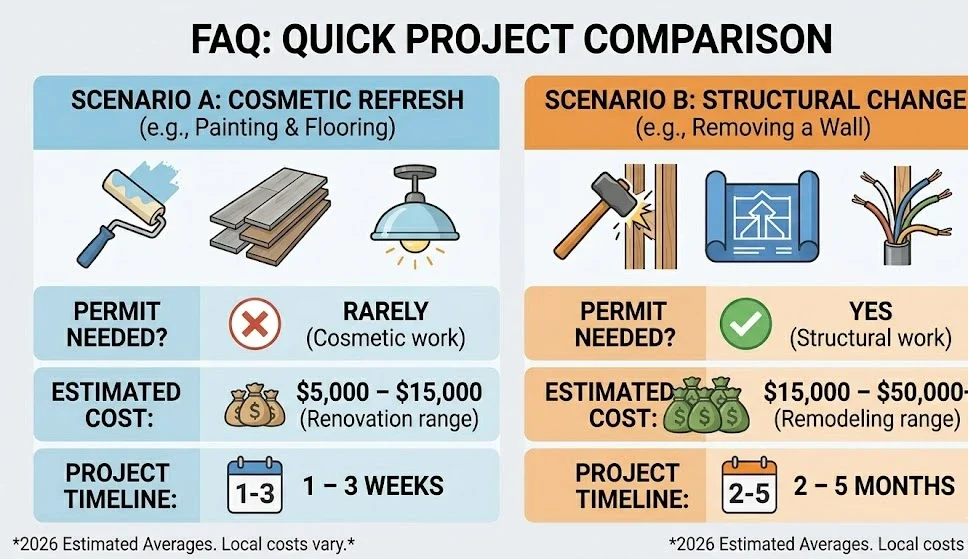
Remodeling costs more. A mid-range kitchen remodel averaged $26,790 in 2025 per the National Association of Realtors. A cosmetic kitchen renovation typically runs $5,000–$15,000. Structural changes, permits, and contractor labor all add to remodeling costs.
Does remodeling require a building permit?
Almost always, yes. Structural changes, electrical upgrades, plumbing moves, and additions require permits in most U.S. municipalities. Renovation work — painting, flooring, cabinet hardware — usually does not. Always check with your local building authority before starting.
Who Should Read This Guide?
This post is written for:
- Homeowners planning a kitchen, bathroom, or whole-home project
- First-time buyers weighing which updates to make before moving in
- Real estate investors calculating renovation ROI before a flip
- Anyone who has argued with a contractor about what “remodeling” actually means (it happens more than you think)
- Homeowners in cities like Boca Raton, Florida, where permit requirements can surprise out-of-state buyers
Why Does This Confusion Cost Homeowners Real Money?
Here is the honest truth: mixing up renovation and remodeling is not just a vocabulary mistake. It leads to blown budgets, permit violations, and contractor disputes.
A homeowner in Scottsdale, Arizona told me she hired a contractor for a “bathroom renovation” expecting cosmetic updates. He rerouted plumbing, moved a wall, and billed her for a full remodel — $38,000 instead of the $9,000 she budgeted. The contract said “renovation.” The work was clearly remodeling. She had no legal ground to stand on.
Knowing the difference protects you before you sign anything.

What Does Renovation Actually Mean in Construction?
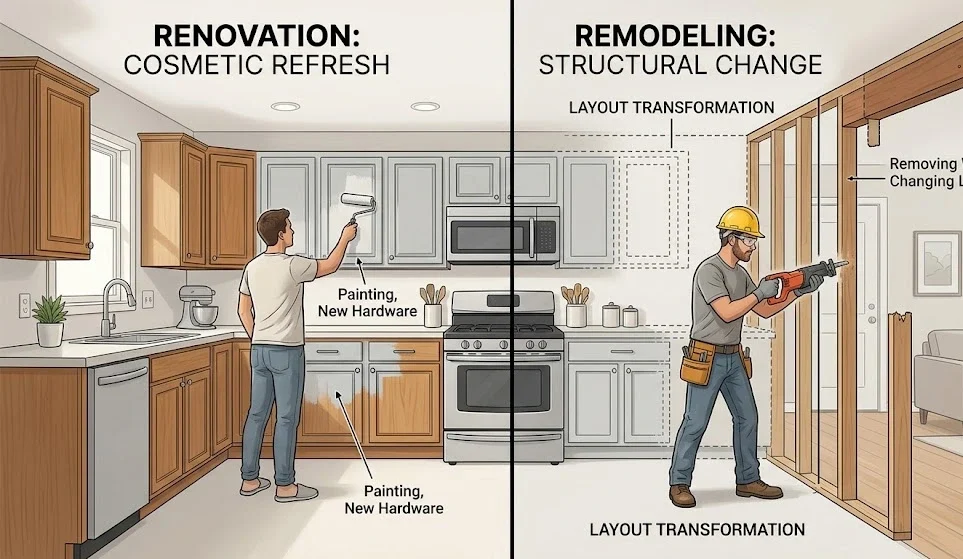
Renovation means to “make new again.” The word comes from the Latin renovare — to restore. In construction, renovation refers to work that refreshes or upgrades a space while keeping its existing structure and function intact.
Common renovation projects include:
- Repainting walls, ceilings, or exterior surfaces
- Replacing flooring (hardwood, tile, vinyl plank)
- Installing new fixtures — faucets, light switches, door handles
- Updating kitchen cabinet doors and hardware without moving cabinets
- Refinishing a bathtub instead of replacing it
- Adding insulation without structural changes
Renovation is mostly cosmetic. It does not change where walls stand, how rooms connect, or what a space is used for. It is what most people mean when they say “fix it up.”
What Does Remodeling Mean for Homes?
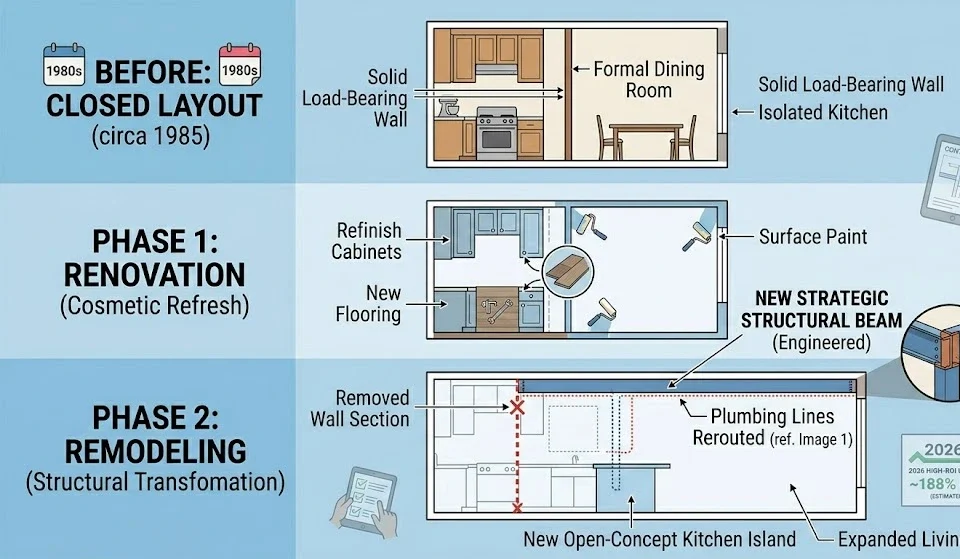
Remodeling changes the form, layout, or function of a space. It involves structural work that goes beyond the surface. A remodel can turn a cramped galley kitchen into an open-concept living area. It can convert a basement into a legal apartment.
Remodeling projects typically include:
- Removing or adding walls to change room layouts
- Converting a garage into a bedroom or home office
- Moving plumbing or electrical systems to new locations
- Building an addition onto the home
- Opening a closed kitchen into a dining or living space (open floor plan)
- Adding a second bathroom where none existed
Remodeling usually requires building permits because it affects the structural integrity of the home. Local codes in places like Boca Raton, Florida, and throughout California are particularly strict about this.
Renovation vs Remodeling: Side-by-Side Comparison Table
| Factor | Renovation | Remodeling |
| Definition | Restores or updates existing space | Changes structure, layout, or function |
| Structural changes | No | Yes |
| Permit required | Rarely | Usually yes |
| Average cost | $5,000–$20,000 | $20,000–$100,000+ |
| Project timeline | 1–4 weeks | 4–16 weeks |
| ROI potential | Moderate (60–80%) | High (70–90%) on key rooms |
| Disruption level | Low | High |
| Contractor type | Handyman or general contractor | Licensed remodeling contractor |
| Examples | Paint, flooring, fixtures | New layout, addition, conversion |
| Best for | Cosmetic refresh, resale prep | Long-term lifestyle improvement |
Data informed by Remodeling Magazine’s 2025 Cost vs. Value Report and NAR 2025 Remodeling Impact Report.
Is “Home Improvement” the Same as Renovation or Remodeling?
Home improvement is the umbrella term. Both renovation and remodeling fall under it. Maintenance — fixing a leaky pipe, replacing a broken shingle — is also home improvement but is neither renovation nor remodeling.
Think of it as a pyramid:
- Home Improvement (everything)
- Maintenance (repair what is broken)
- Renovation (restore and refresh)
- Remodeling (change and restructure)
Many platforms, including Houzz, Angi, and HomeAdvisor, use these terms interchangeably in their listings. That adds to the confusion. When you post a project on those platforms, be specific about whether you need structural work.
How Does Renovation vs Remodeling Affect Your Budget?
Budget planning is where most homeowners make their biggest mistake. They plan for a renovation and end up funding a remodel.
Here is what the 2026 market looks like for both:
Renovation Cost Ranges (2026 estimates):
- Full bathroom repaint, new fixtures, vanity update: $3,500–$8,000
- Kitchen cabinet refinishing + new countertops: $6,000–$14,000
- Whole-home flooring (hardwood or LVP, 1,500 sq ft): $8,000–$18,000
- Exterior paint + trim work: $4,000–$12,000
Remodeling Cost Ranges (2026 estimates):
- Kitchen remodel (mid-range): $25,000–$45,000
- Bathroom remodel (mid-range): $15,000–$35,000
- Basement conversion to living space: $30,000–$75,000
- Home addition (per square foot): $150–$400
According to the U.S. Census Bureau’s 2024 American Housing Survey, American homeowners spent an average of $13,667 on home improvements in 2023. The higher end of that spend was almost always remodeling projects.
Always build a 15–20% contingency fund on top of your estimate. Behind walls, in 2026, contractors regularly find outdated wiring, lead pipes, or mold — especially in homes built before 1990.
What Is the Return on Investment (ROI) for Each?
ROI depends on the project, not just whether it is renovation or remodeling. But there is a clear pattern here.
Top renovation projects by ROI (2025–2026 data):
- Garage door replacement: 194% ROI (top performer for years running)
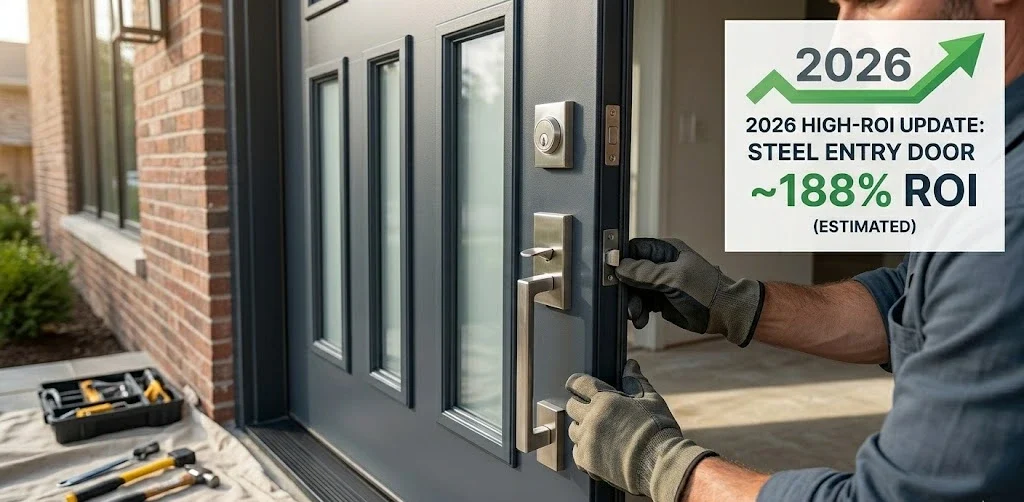
- Entry door replacement (steel): 188% ROI
- Exterior painting: 152% ROI
- Minor kitchen update (new cabinet fronts, hardware, appliances): 96% ROI
Top remodeling projects by ROI (2025–2026 data):
- Midrange bathroom remodel: 71% ROI
- Midrange kitchen remodel: 68% ROI
- Deck addition (wood): 83% ROI
- Master suite addition: 54% ROI
Source: Remodeling Magazine Cost vs. Value Report 2025
Here is the part that surprises most people: renovation often delivers a better ROI than remodeling. A $4,000 front door replacement returning $7,500 in added home value beats a $60,000 kitchen remodel returning $41,000. ROI does not always scale with spending.
The exception is when a home is functionally obsolete. A three-bedroom house with one bathroom in a competitive market will always benefit from a remodel that adds a second bath — the ROI there is real and measurable.
Do You Need a Permit for Renovation or Remodeling Work?
Permits protect you — not the contractor. This is a point most contractors do not lead with.
In general, renovation work does not require permits. Painting, flooring, replacing fixtures, and refinishing surfaces are cosmetic and do not affect structural integrity or safety systems.
Remodeling almost always requires permits when it involves:
- Removing or adding walls (especially load-bearing walls)
- Moving plumbing or adding new plumbing lines
- Adding or relocating electrical circuits and panels
- Building additions or converting spaces (garage to bedroom, for example)
- Installing HVAC systems or making significant modifications
The U.S. Department of Housing and Urban Development notes that unpermitted work can void your homeowner’s insurance, complicate a home sale, and create legal liability. In Boca Raton, Florida, for example, unpermitted additions have forced sellers to tear down structures before closing.
Always ask your remodeling contractor to pull permits. If they resist or say “we do not need one,” that is a red flag.
How Do You Choose Between Renovation and Remodeling?
This comes down to three questions:
1. What is actually wrong with the space? If the layout works but everything looks tired and dated, renovation is your answer. If the layout itself is the problem — the kitchen is too small, the bathroom is in the wrong place — remodeling is the only real fix.
2. What is your timeline? Renovations take weeks. Remodels take months. If you are planning to list your home in 90 days, a full kitchen remodel is almost certainly off the table. A renovation that tightens up the visual appeal is more realistic.
3. What does your market reward? Buyers in different markets expect different things. In high-end urban markets, buyers often prefer a blank slate and will remodel to their own taste. In suburban family markets, a finished, functional kitchen remodel often commands a real premium. Research your specific zip code before deciding.
Use platforms like Houzz and Angi to benchmark what renovations and remodels look like in your area and what they cost locally.
What Are the Biggest Mistakes Homeowners Make With Renovation and Remodeling Projects?
I have seen the same mistakes repeated across hundreds of projects. Here are the top ones:
Mistake 1: Calling it a renovation, budgeting for it, then discovering it needs a remodel
The single most common budget killer. Get a contractor on site before you set a budget — not after.
Mistake 2: Skipping permits to save time
You might save two weeks. You might lose $20,000 in resale value or face a stop-work order that extends your project by months.
Mistake 3: Optimizing for resale on a home they plan to keep for 20 years
ROI is relevant if you are selling. If you are staying, personal function and quality of life matter more than resale percentages.
Mistake 4: Choosing materials based on appearance alone
A beautiful tile floor in a high-traffic kitchen that chips within a year is a renovation failure. Work with your contractor on material durability ratings, not just looks.
Mistake 5: Ignoring the “while we’re at it” problem
Every remodel has this moment. While walls are open, it is tempting to update plumbing, electrical, and insulation. Sometimes that is smart. Often it turns a $30,000 kitchen remodel into a $55,000 project. Set a hard line and stick to it unless there is a safety issue.
What Is the Difference Between Home Restoration and Renovation?
Restoration returns a home to its original condition. Renovation updates it. This distinction matters most with historic properties.
If you own a 1920s craftsman bungalow and replace original wood windows with modern energy-efficient windows, that is renovation. If you restore the original windows using period-appropriate glass and joinery techniques, that is restoration.
Historic renovation programs through the National Park Service offer tax credits for certified restoration work on historic properties. As of 2026, the Federal Historic Tax Credit provides a 20% credit on qualified rehabilitation expenditures.
Restoration costs more per square foot than renovation in almost every case. But for the right property in the right market, it adds irreplaceable character that a standard renovation cannot replicate.
Kitchen Remodeling vs Kitchen Renovation: A Real-World Comparison
The kitchen is where this debate gets real. It is the highest-traffic room in most homes and the one most likely to influence a buyer.
Kitchen Renovation (what it includes):
- New cabinet door fronts and hardware (keeping existing cabinet boxes)
- Quartz or granite countertop replacement
- New backsplash tile
- Updated faucet and sink
- New lighting fixtures
- Paint
Estimated 2026 cost: $8,000–$20,000 Timeline: 2–4 weeks
Kitchen Remodeling (what it includes):
- Full cabinet replacement (custom cabinetry or semi-custom)
- Layout change — moving the island, removing a wall for open concept
- New plumbing runs if the sink or dishwasher moves
- New electrical circuits for modern appliances
- New flooring throughout
- High-end countertops (quartz, quartzite, or butcher block)
Estimated 2026 cost: $25,000–$70,000+ Timeline: 6–14 weeks
The Home Depot’s 2025 kitchen project data shows the average in-store kitchen design sale comes in around $18,000 — which is often misquoted as a “remodel” but is frequently a renovation-level refresh using RTA (ready-to-assemble) cabinetry.
Bathroom Renovation Costs vs Bathroom Remodeling Costs in 2026
Bathrooms are the second most common project homeowners tackle. Here is how renovation and remodeling split out:
Bathroom Renovation:
- Reglazing a tub instead of replacing it: $300–$650
- New vanity, mirror, and light fixture: $800–$2,500
- New tile floor (no subflooring): $1,200–$3,500
- Full cosmetic refresh (paint, fixtures, accessories): $3,500–$8,000
Bathroom Remodeling:
- Moving plumbing to change shower location: $2,000–$7,000 in plumbing alone
- Converting tub to walk-in shower: $5,500–$15,000
- Full gut and remodel (mid-range materials): $15,000–$25,000
- Luxury master bath remodel: $40,000–$80,000+
According to the National Kitchen and Bath Association (NKBA), bathroom remodel spending reached an all-time high in 2024, driven by aging-in-place modifications (walk-in showers, comfort-height toilets, grab bars) as the baby boomer generation continues updating homes for accessibility.
Open-Concept Remodeling: Is It Still Worth It in 2026?
The open floor plan dominated American home design for two decades. Post-pandemic preferences shifted. The 2025 Houzz Kitchen Trends Report noted a 22% increase in demand for “zones” — defined spaces within open plans that use islands, half-walls, and lighting to create some separation.
Open-concept remodeling — removing walls between kitchen, dining, and living areas — remains popular, but the full “one giant space” approach has peaked.
What replaces it: the “connected but defined” remodel. Partial wall removal, archways, and pocket doors give you sight lines and social connection without eliminating acoustic privacy. This remodel typically costs $8,000–$25,000 depending on whether the wall is load-bearing and how much finishing work is required.
If you are considering open-concept remodeling, consult a structural engineer before any contractor begins work. A load-bearing wall removal without proper beam installation is one of the most dangerous mistakes in residential remodeling.
How to Find a Reliable Renovation or Remodeling Contractor
The contractor you hire matters as much as the project plan. Here is what to look for:
For Renovation:
- Licensed general contractor or handyman (depending on your state’s licensing requirements)
- Strong portfolio of cosmetic work in homes similar to yours
- References from recent projects (not just Google reviews — call them)
- Clear, itemized written estimate
For Remodeling:
- Licensed remodeling contractor with structural work experience
- Proof of general liability insurance and workers’ compensation
- Experience pulling permits in your specific municipality
- Willingness to provide architect or engineer sign-off on structural changes
Platforms like Angi and HomeAdvisor have pre-screen processes for licensing and insurance. Houzz features vetted “Pro” listings with verified reviews. None of these platforms guarantee quality — they reduce some of the screening work, but you still need to interview contractors directly.
The best contractor source in 2026 is still a referral from a neighbor who recently completed a similar project.
What Does “Remodeling ROI” Really Mean for Homeowners?
ROI in remodeling is more complex than the percentage figures suggest.
Three types of ROI to consider:
- Financial ROI — The resale value your project adds vs. what you spent. This is what Remodeling Magazine tracks annually.
- Functional ROI — How much the project improves daily life. A master bath remodel that adds a double vanity has enormous functional ROI for a two-income couple with different schedules, even if the financial return is modest.
- Maintenance ROI — Replacing aging systems (roof, HVAC, plumbing, electrical) before they fail avoids emergency repair costs. A $15,000 plumbing replacement that prevents $40,000 in water damage is an ROI story that the cost-vs-value report never captures.
The framing I find most useful: renovation serves your buyer. Remodeling serves your life. If you are selling within three years, weight financial ROI heavily. If you are staying, weight functional ROI instead.
Residential Remodeling Trends Shaping 2026
The residential remodeling market is evolving quickly. Several trends are shaping what homeowners ask for and what contractors are building:
1. Multigenerational housing remodels The U.S. Census Bureau reports that 20% of Americans now live in multigenerational households. Remodels adding separate entrances, kitchenettes, and accessible bathrooms are among the fastest-growing project types.
2. Energy-efficient window replacements Beyond aesthetics, energy-efficient windows with low-E coatings and double-pane glass are standard in 2026 remodels. Many states offer rebates through utility programs and the federal Inflation Reduction Act efficiency credit.
3. Home office remodeling The permanent hybrid workforce has made the dedicated home office a remodeling priority. Contractors report that soundproofing, separate HVAC zones, and wired ethernet have become standard requests.
4. Accessible design Zero-entry showers, wider doorways (36 inches minimum), and lever-style door handles have moved from aging-in-place niche to mainstream remodeling spec.
5. Smart home integration Remodels increasingly include pre-wired infrastructure for smart lighting, security, and HVAC — even when clients do not install the systems immediately.
Renovation vs Remodeling: FAQs From Real Homeowners
1. Can I renovate my home without a contractor?
Yes, for most cosmetic renovation work. Painting, installing new fixtures, replacing flooring, and updating hardware are legal DIY projects in almost every U.S. state. Electrical and plumbing work — even renovation-level updates — often require a licensed professional or permit depending on your municipality.
2. Does renovation or remodeling add more value to a home?
Both add value, but the type of value differs. Renovation improves perceived condition and visual appeal — which strongly influences buyer first impressions. Remodeling can add functional value (extra bathroom, larger kitchen) that changes the home’s market tier. For pure ROI, exterior renovations and minor kitchen updates often outperform expensive remodels.
3. How long does a kitchen renovation take vs a full remodel?
A kitchen renovation typically takes 2–4 weeks. A full kitchen remodel — with layout changes, new cabinetry, and plumbing work — takes 6–14 weeks. Supply chain issues in 2026 mean custom cabinetry can add 8–16 weeks of lead time before the project even starts.
4. What is the difference between renovation and restoration?
Renovation updates a space to modern standards. Restoration returns it to its original historical condition. Restoration is more expensive and more precise. It is most relevant for historic homes and may qualify for federal or state tax credits.
5. Is open-concept remodeling still a good investment in 2026?
Open-concept remodeling still adds value, but the fully undivided great-room approach is less dominant than five years ago. The current trend favors connected-but-defined spaces with visual openness and some acoustic separation. A partial wall removal or archway can deliver much of the benefit at a fraction of the cost.
6. How do I know if my renovation project needs a permit?
Any work that affects structural elements, electrical systems, plumbing, or HVAC almost always requires a permit. Cosmetic work — painting, flooring, fixture replacement — usually does not. When in doubt, call your local building department. Most municipalities have online permit portals where you can check requirements by project type.
7. What is a remodeling contractor vs a general contractor?
A general contractor manages overall construction projects and typically subcontracts specialty work. A remodeling contractor specializes in residential renovation and remodeling projects. Some remodeling contractors hold their own licenses for carpentry, tile, and light electrical work. For a whole-home remodel, a general contractor with remodeling experience is often the better choice.
8. How much does a bathroom renovation cost in 2026?
A cosmetic bathroom renovation — new fixtures, vanity, tile, and paint — runs $4,000–$10,000 in most U.S. markets. A full bathroom remodel with layout changes and high-end materials ranges from $18,000 to $35,000+. Labor costs vary significantly by region; coastal cities run 20–40% higher than national averages.
9. What renovation projects have the best ROI for resale?
For 2025–2026, the top ROI renovation projects are garage door replacement (approximately 194%), steel entry door replacement (approximately 188%), and minor kitchen updates including hardware, paint, and appliances (approximately 96%). These figures come from Remodeling Magazine’s annual Cost vs. Value Report.
10. Can I remodel part of my house while living in it?
Yes, but it requires careful planning. Whole-house remodels that take the kitchen offline for 8–12 weeks are the most disruptive. Many homeowners set up temporary kitchens (a microwave, mini fridge, and coffee maker in the living room) and plan project phases to maintain a livable home. Bathroom remodels should always preserve at least one functional bathroom during the project.
11. How do remodeling costs differ between states?
Labor costs vary considerably. California, New York, and Massachusetts consistently run 25–40% above national averages. Southeastern states, including much of Florida outside major metro areas, tend to run closer to the national average. Material costs have largely normalized since the 2021–2022 supply chain crisis, though premium materials (custom cabinetry, natural stone) remain elevated in 2026.
12. What questions should I ask a remodeling contractor before hiring them?
Ask: Are you licensed and insured in this state? Will you pull all required permits? Can I see a portfolio of similar projects? Do you use subcontractors, and are they vetted? What does your payment schedule look like? Do you offer a written warranty on workmanship? How do you handle unexpected discoveries (mold, outdated wiring, structural issues)?
Wrapping Up: The Renovation vs Remodeling Decision Made Simple
The core rule is this: renovation refreshes, remodeling transforms.
If your home’s bones are good — good layout, functional rooms, reasonable flow — renovation is almost always the smarter financial move for most homeowners. A well-executed renovation can dramatically improve how a home looks and feels for a fraction of remodeling costs.
If the layout itself is the problem, renovation is a band-aid on a structural issue. In that case, a remodel is not an indulgence. It is the only real fix.
Before you call a contractor, write down in one sentence what is actually wrong with your space. If the answer is “it looks dated,” start with renovation. If the answer is “it does not work for how we live,” it is time to talk about remodeling.
Either way — get the scope in writing, pull the permits, and build in a contingency fund. The homeowners who avoid surprises are almost always the ones who did their homework before breaking ground.
Have a specific room or project you are wrestling with? The questions above are a great starting framework — and if you want to dig into contractor selection or specific room budgeting, explore more on our home improvement resources.
2026 Material Watch
The renovation and remodeling industry is moving fast in 2026. Here are several materials and systems worth following as they shift from niche to mainstream:
Vacuum Insulated Panels (VIPs) Thin, high-performance insulation panels that outperform traditional fiberglass batt at a fraction of the thickness. Increasingly used in wall assemblies where space is tight — particularly relevant for bathroom and kitchen remodeling.
Low-Carbon Concrete Alternatives Hempcrete and geopolymer concrete are entering residential remodeling applications — primarily in foundation repairs and basement projects. Both have significantly lower embodied carbon than standard concrete mixes.
Mass Timber Framing Cross-laminated timber (CLT) and glued-laminated beams are beginning to appear in residential additions and garage conversions, especially in markets with progressive building codes. Expect permit frameworks to catch up with material availability by 2027.
Whole-Home Heat Pump Integration As natural gas appliance bans expand across U.S. municipalities, heat pump HVAC systems — and heat pump water heaters — are becoming standard remodeling inclusions. The 2026 IRS energy efficiency credit covers up to 30% of heat pump installation costs.
Reclaimed Wood Surfaces Salvaged barn wood, old-growth reclaimed flooring, and upcycled timber accents have moved from boutique design choice to broadly requested renovation feature. Lead times are longer than virgin wood products but the aesthetic and sustainability story resonates strongly with 2026 buyers.
Electrochromic Smart Glass Still premium-priced, but electrochromic glass — which transitions from clear to tinted electronically — is entering high-end bathroom and home office remodeling specs. Watch for cost reductions as production scales over the next 24 months.
Last updated: June 2026. Data sources: Remodeling Magazine Cost vs. Value Report 2025, NAR 2025 Remodeling Impact Report, U.S. Census Bureau American Housing Survey 2024, National Kitchen and Bath Association 2025 Design Report, U.S. Department of Energy Home Energy Rebates Program.
Author’s note: Cost figures represent national averages and should be verified with local contractors. Regional labor and material costs vary significantly. Always consult a licensed professional before beginning any structural work.